-01%201.svg)
Key takeaways
- Automating GSTR 2B reconciliation delivers faster closes, higher ITC accuracy, and fewer vendor chases, with finance teams reporting 60-70% time savings.
- A strong tool can match purchase register data using multi-parameter, fuzzy, and tolerance-based logic, while learning from manual corrections.
- Systematic exception queues help identify missing invoices quickly, with root-cause insights and cross-period tracking to prevent duplicate or delayed claims.
- Built-in ITC claim optimisation maximises eligible credits, manages reversals, and balances cash flow with compliance through claim-versus-defer recommendations.
- Vendor follow up automation, via email and WhatsApp, raises supplier accountability using discrepancy packs, SLAs, and escalation rules.
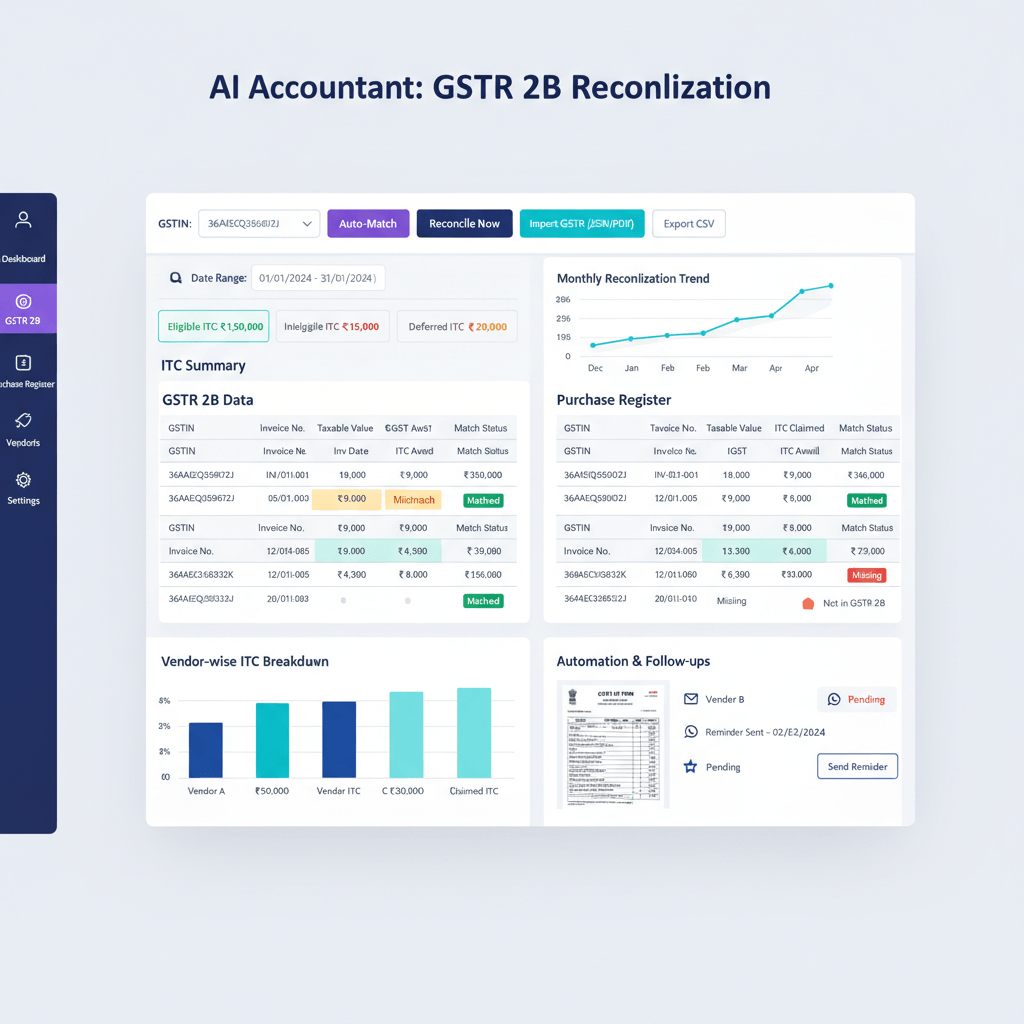
- A monthly dashboard converts reconciliation into executive visibility, showing ITC trends, match percentages, recovery potential, and vendor scorecards.
- For CA firms and SMEs, role-based access, maker-checker controls, and audit logs ensure secure, compliant, and scalable operations.
Primer: What You're Reconciling and Why It Matters
Understanding the difference between GSTR-2A and GSTR-2B is crucial for effective reconciliation. GSTR-2A shows dynamic supplier uploads that change in real time, GSTR-2B is your static monthly snapshot that forms the basis for ITC claims under GST rules. For a deeper comparison, see this GSTR-2A vs GSTR-2B finance guide and this note on distinguishing GSTR-2A and GSTR-2B.
Your typical reconciliation inputs include the Purchase Register for all purchase transactions, Credit Notes and Debit Notes for adjustments, and Journal Vouchers for special entries. GSTR-2B arrives in JSON or Excel from the portal. Practical guidance is available via the ICAI AI use case and GSTR-2A/2B reconciliation in TallyPrime.
A good reconciliation outcome offers clear match status categories, fast exception handling, and a complete audit trail. The process impacts cash flow directly, every unmatched invoice or delayed claim affects working capital. Getting this right matters.
Outcomes from Modern GSTR 2B Reconciliation Tools
The right reconciliation tool delivers tangible outcomes beyond matching numbers. Higher ITC accuracy yields earlier cash benefits through ITC claim optimisation. Exception queues reduce month-end chaos by prioritising mismatches with root causes. Vendor follow up automation improves supplier accountability through targeted reminders and escalations. A monthly dashboard highlights vendor behaviour, ITC recovery, and compliance gaps so you can act early.
For implementation specifics, refer to the GSTR-2B vs PR reconciliation guide, the GSTR-2B reconciliation guide, the ICAI AI use case, and TallyPrime reconciliation guidance.
“The cumulative effect is powerful, CA firms expand client capacity without extra headcount, SMEs close faster with confidence, and CFOs gain predictable ITC cash flows.”
Must-Have Feature Checklist
Match Purchase Register
Accurate, multi-parameter matching is the foundation, aligning GSTIN, invoice number, date, taxable value, and tax breakup together. Fuzzy logic reconciles INV/001 with INV-1, varying date formats, and truncated numbers, while amount tolerances ignore immaterial differences. The engine should learn from your manual links, so match rates improve over time. ICAI AI use case, GSTR-2B vs PR reconciliation, and TallyPrime reconciliation offer practical references. RCM transactions need special handling with reversed tax logic.
Identify Missing Invoices
Auto-bucketing highlights invoices present in GSTR-2B but absent in your Purchase Register, and vice versa. Root-cause hints point to GSTIN errors, number format differences, or unfiled returns. Cross-period tracking catches invoices filed in the wrong month, preventing both missed claims and duplicates. See the ICAI AI use case, this overview of GST reconciliation software, and Clear’s recon guide.
ITC Claim Optimisation
Automated eligibility checks flag Section 17(5) blocks, treat reverse charge correctly, and identify time-barred credits. Reason-coded recommendations balance claim-now versus defer, managing risk while improving cash flow. Provisional credits stay tracked until vendor filing, and ITC reversal scenarios get calculated when credit notes or amendments arrive. More depth is available in the GSTHero GSTR-2B guide, TaxGuru on AI in GSTR-2A/2B reconciliation, and Clear’s recon documentation.
Vendor Follow Up Automation
Discrepancy packs summarise issues for each vendor, with email and WhatsApp channels for quick action. Escalations route unresolved items to senior contacts on defined timelines, while delivery, open, and resolution tracking builds an audit trail. Learn more from this GSTR-2B vs PR recon guide.
Monthly Dashboard
An executive dashboard shows ITC eligibility, match rates, recovery potential, and aging analysis. Drill down from trend to transaction, export MIS and vendor scorecards, and forecast next month’s ITC based on patterns. For concepts and examples, see GST compliance health and the overview of GST reconciliation software.
Integrations and Data Handling
Direct ingestion from the GST portal avoids manual downloads. Excel or CSV uploads support your Purchase Register, Credit Notes, and Journal Vouchers. Bi-directional ERP sync, especially to TallyPrime reconciliation, eliminates double entry, and APIs enable custom workflows. When needed, OCR extracts fields from scanned invoices. See CashFlo’s software overview and the ICAI AI use case.
Collaboration and Controls
Multi-organisation workspaces suit CA firms and groups, with role-based permissions for juniors, reviewers, and admins. Maker-checker approvals, complete audit logs, and contextual comments ensure governance and speed. Explore the ICAI AI use case and TallyPrime guidance.
Scale, Reliability, Security
Expect stable performance even with thousands of invoices, automated backups, high availability, and robust error handling. Look for ISO 27001 and SOC-2 Type II certifications to assure data protection at scale, as emphasised in the ICAI AI use case.
Step-by-Step Workflow
Step 1: Ingest Your Data
Pull GSTR-2B for the period, upload the Purchase Register, add Credit and Debit Notes, and include Journal Vouchers. Validate formats and resolve upload issues immediately.
Step 2: Run Auto-Matching
Execute the engine to match purchase register entries using your rules and tolerances. Auto-bucketing creates matched, mismatched, and missing lists in minutes.
Step 3: Handle Exceptions
Resolve exceptions to identify missing invoices, fix date or number formats in bulk, and manually link obvious pairs, training the system as you go.
Step 4: Chase Vendors
Trigger vendor follow up automation with vendor-wise discrepancy packs, set SLAs, track acknowledgments, and escalate as per rules.
Step 5: Optimise ITC Claims
Apply ITC claim optimisation to maximise cash benefits, review reason-coded recommendations, defer selectively, and track provisional credits.
Step 6: Close and Sync
Lock the period, export for GSTR-3B, push reconciled entries to ERP, and archive reconciliation evidence for audit.
Step 7: Review Performance
Use the monthly dashboard for KPIs, vendor metrics, and improvement plans. For detailed references, see ICAI AI use case, TallyPrime reconciliation, Clear’s recon guide, and GSTHero’s GSTR-2B guide.
ROI and Business Case
Automation reduces reconciliation time by about 3x for typical volumes, improves working capital through faster ITC recovery, and lowers audit risk with complete trails. Staff focus shifts from mechanical matching to analysis and vendor management, improving morale and quality.
For deeper analysis, consult Clear’s recon documentation, GSTHero’s GSTR-2B guide, the ICAI AI use case, and TallyPrime reconciliation article.
Tool Landscape and Comparison Framework
Excel-based DIY suits small volumes but struggles with accuracy and scale. ERP add-ons integrate well yet often lack sophisticated fuzzy logic and automated vendor follow-ups. Specialised SaaS platforms provide end-to-end automation, strong algorithms, and communications.
- AI Accountant — configurable fuzzy rules, reason-coded exceptions, templated follow-ups, 300M+ transactions processed, ISO 27001 and SOC-2 Type II, Tally and Zoho Books integrations.
- ClearTax — strong reconciliation with vendor communication features, see GSTR-2B vs PR recon.
- CashFlo — reconciliation with working capital features, see GST reconciliation software.
- GSTHero — full GST automation including reconciliation, see GSTR-2B guide.
- Zoho GST — best for Zoho ecosystem users.
Compare solutions on ingestion flexibility, matching strength, ITC claim optimisation, vendor follow up automation, monthly dashboard, integrations, security, and pricing transparency. For pricing discussions, see this pricing and value overview.
Common Pitfalls to Avoid
- Over-relying on exact matches misses legitimate invoices due to prefixes, separators, or truncation, configure fuzzy rules and tolerances.
- Missing credit and debit note linkages skews net ITC, always pair adjustments to originals.
- Ignoring cross-period amendments breaks compliance, track original and amended positions clearly.
- No claim-defer rules leads to inconsistent ITC choices, define reason-coded decision criteria.
- Vague vendor follow-ups waste time, send actionable discrepancy packs with invoice-level details.
India-specific context and remedies appear in the ICAI AI use case, Clear’s recon guide, TallyPrime guidance, TaxGuru’s perspective, and this GSTR-2A vs GSTR-2B finance guide.
How AI Accountant Fits
AI Accountant processes high volumes securely with ISO 27001 and SOC-2 Type II. For match purchase register, it applies configurable fuzzy rules, tolerances, and learning from corrections. To identify missing invoices, it generates reason-coded exception lists with cross-period visibility. Its ITC claim optimisation engine provides claim-versus-defer recommendations with rationale, handles blocked credits and reversals, and tracks provisional exposure. Vendor follow up automation sends templated discrepancy packs over email or WhatsApp with SLAs, escalations, and full telemetry. The monthly dashboard offers ITC trends, aging, and vendor performance with drill downs and MIS exports, while Tally and Zoho Books integrations keep records in sync.
Example: Reconciling 1,000 March invoices, you ingest data, auto-match to reach 850 matches, 100 exceptions, and 50 vendor-missing items. You dispatch follow-ups in a click, bulk-fix common errors, finalise claims, and push entries to ERP. What once took days, now takes hours.
Implementation Playbook and POC Checklist
Preparation: Gather two months of GSTR-2B, Purchase Register, and adjustment documents, record current time taken and error rates for baseline.
Success metrics: 95%+ auto-match on steady-state, under one hour per 100 exceptions, at least 5% uplift in eligible ITC, vendor TAT improved by 50%.
Go-live: Assign roles, define maker-checker flow, lock dates, and ERP sync schedules.
Pilot: Test with one month, validate match accuracy, confirm templates and ERP integration, capture user feedback, refine rules.
Rollout: Start with current month, backfill gradually, document SOPs, train in phases.
Continuous improvement: Review match rates, vendor responsiveness, and new exception types, refine rules and share best practices.
Buyer Questions to Ask Any Vendor
- How do you handle amended invoices and credit notes across periods, and can you link all adjustments to originals with full traceability?
- What tolerances and fuzzy rules are configurable for amounts, dates, and invoice number patterns, at global or vendor level?
- Can I trace ITC decisions to specific rules and audit logs, and generate rationale reports on demand?
- What is your vendor follow up automation capability, templates, channels, delivery and open tracking, and evidence for audits?
- How detailed is the monthly dashboard, can I drill from organisation to vendor to document, and export MIS and scorecards?
- What security certifications do you hold, how do you encrypt data, and what are pricing tiers, limits, and overage policies?
- How do you handle RCM transactions, what is the uptime SLA, implementation timeline, training, and support model?
- Can we run a POC with our data, and how quickly can we migrate configurations to production?
- Do you provide APIs and webhooks for custom integrations, and how is versioning or deprecation communicated?
- What is your roadmap for AI-assisted exception resolution, predictive ITC, and vendor risk scoring?
Taking Action on Your Reconciliation
Start by quantifying your current pain, hours spent, error rates, and lost or deferred ITC. Build a feature checklist, run a proof-of-concept with real data, and evaluate actual match rates, exception throughput, and user adoption. The goal is not just compliance, it is maximising every rupee of eligible ITC while freeing your team for strategic work. Modern GSTR 2B reconciliation tools can match purchase register accurately, identify missing invoices at scale, optimise ITC, automate vendor follow-ups, and surface insights through dashboards. The sooner you automate, the sooner month-end becomes predictable.
FAQ
How should a CA structure the GSTR-2B vs Purchase Register reconciliation to minimise manual effort?
Follow a standard cycle, ingest GSTR-2B and the Purchase Register, auto-match with multi-parameter and fuzzy rules, bucket exceptions, push vendor follow-ups, and then run ITC optimisation. Tools like AI Accountant automate each step, including cross-period checks and reason-coded exceptions.
What tolerance settings are practical for amount and date mismatches in high-volume reconciliations?
Most firms use a small absolute tolerance for tax values, for example Re 1 or Rs 5, plus a date variance that accounts for entry delays, for example up to seven days. Configure vendor-specific overrides where chronic format issues exist, AI Accountant supports per-rule tolerances and vendor profiles.
How do I handle invoices filed by vendors in the wrong period without losing ITC eligibility?
Use cross-period tracking that links invoices to their economic month while recognising the filing month in GSTR-2B. Defer the ITC claim when conditions are not met, then auto-claim once the vendor files correctly. AI Accountant tags and rolls forward such items automatically.
What is the recommended approach to RCM entries during reconciliation and ITC planning?
Segregate reverse charge entries, validate tax computation, and ensure self-invoicing entries exist. Claim ITC only when payment and other conditions are met. Refer to this primer on reverse charge mechanism accounting in India for process nuances.
How do I ensure credit notes and debit notes are always linked to the correct base invoices?
Use document linking by GSTIN, invoice number variants, and period. A tool should auto-suggest linkages and prevent double reversals. AI Accountant maintains a chain of originals, amendments, and notes for accurate net ITC.
We are a CA firm, how do we implement maker-checker without slowing down the month-end?
Define clear roles, preparer reconciles and proposes ITC, checker approves or returns exceptions with comments. Batch approvals and focused queues keep speed high. AI Accountant’s role-based access and audit logs support this without extra overhead.
How can we prove vendor communication during audits for disputed ITC?
Maintain timestamped logs of sent messages, opens, and acknowledgments, with the exact discrepancy pack attached. AI Accountant records email and WhatsApp telemetry, enabling you to present a complete audit trail.
What KPIs should a CFO monitor on the monthly GST dashboard?
Track eligible versus claimed ITC, auto-match percentage, exception aging, vendor-wise risk, and recovery potential. Forecast next month’s ITC based on current trends. AI Accountant’s dashboard supports drill downs and MIS exports.
How do we balance early cash flow with compliance when vendor filings are delayed?
Adopt a claim-versus-defer policy with reason codes, for example vendor not filed, GSTIN mismatch, period shift. Use provisional claims only under defined thresholds and track exposure. AI Accountant automates recommendations and monitoring.
What volume and performance benchmarks should we demand from a tool during POC?
Target 95%+ auto-match on clean vendors, under one hour to resolve 100 exceptions, and full reconciliation for 5,000 invoices within a working day. Validate stability on bulk uploads and cross-period scans. AI Accountant routinely handles these volumes.
Can we integrate reconciliation outputs back into Tally or Zoho Books without manual entry?
Yes, prioritise bi-directional integrations that pull masters and push reconciled entries, statuses, and notes. AI Accountant integrates with Tally and Zoho Books, ensuring books reflect final reconciled positions.
How fast can a mid-sized SME go live, and what does success look like in 60 days?
With clear data templates and training, most SMEs go live in two weeks, stabilise by month two, and achieve 3x speed, 5%+ ITC uplift, and 50% lower vendor TAT within 60 days. AI Accountant provides templates, training, and success playbooks to compress timelines.

Rohan Sinha is a fintech and growth leader building aiaccountant.com, focused on simplifying accounting and compliance for Indian businesses through automation. An IIT BHU alumnus, he brings hands-on experience across 0 to 1 product building, growth, and strategy in B2B SaaS and fintech.