-01%201.svg)
Key takeaways
- A purpose built, India first financial KPI dashboard builder delivers GST reconciliation visibility, multi organization views, and near real time cash insights without heavy setup.
- Prioritize custom metric creation, real time KPI tracking, alert configuration, and benchmarking tools that reflect India’s compliance and payment culture.
- Deep Zoho Books and Tally sync combined with clean narrations from bank ingestion ensures trustworthy cash, AR, AP, and working capital metrics.
- Use a buyer checklist to test formulas, update cadence, alert routing, and GST specific integrations live during demos, then validate total cost of ownership.
- Start with essential KPIs, add alerts carefully to avoid fatigue, and evolve dashboards through monthly governance for sustained ROI.
Table of contents
What is a Financial KPI Dashboard Builder (India Context)?
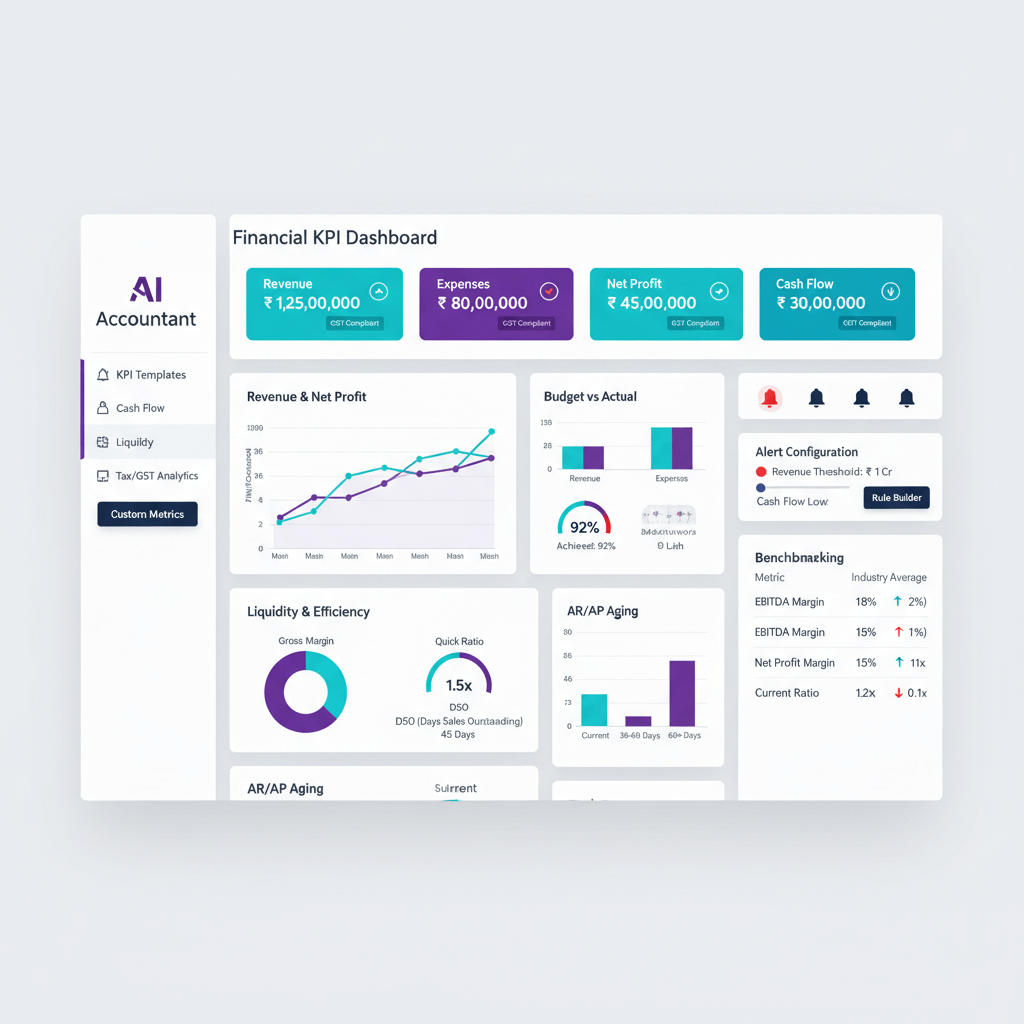
A financial KPI dashboard builder in India turns raw accounting data into actionable visuals that leaders and CAs can trust. Expect dashboards covering cash position, receivables aging, payables aging, working capital, runway calculations, DSO, DPO, plus GST impacts. India specific needs matter, because clean GST reconciliation requires visibility into input credit utilization, GSTR 2B matching rates, and compliance gaps, all synced cleanly with Zoho Books or Tally.
Global tools often miss local nuances. They may render beautiful charts, yet struggle with GST tracking or Tally’s data structures. To choose wisely, consider guidance on financial KPIs and metrics, and explore KPIs and metrics for finance departments, then map these concepts to India’s compliance realities.
The best India focused dashboards normalize bank narrations, surface GST mismatches, show vendor and customer compliance, and keep the workflow simple for busy finance teams.
Core Features to Evaluate
Custom metric creation
Formula builders should calculate DSO, cash conversion cycles, GST mismatch rates, and runway metrics with dimensions for organization, vendor, customer, category, and period. Visual builders balance power with usability, while pre built India KPI templates save time. If you go the BI route, DAX driven engines can help, yet they often need specialist skills. For comparative evaluation, see kpi dashboard software.
Real time KPI tracking
Hourly or daily refresh is sufficient for most SMEs, true millisecond updates rarely add value. More important, the tool must ingest bank feeds, normalize narrations, and track open invoices and bills, so cash and working capital stay trustworthy.
Alert configuration dashboard
Set warnings for cash dropping below 30 days runway, receivables overdue exceeding 20 percent, and unexpected GST mismatch spikes. Route alerts by role, choose channels like email, Slack, and WhatsApp, schedule appropriately, and apply noise controls to prevent fatigue.
KPI benchmarking tools
Benchmark across entities, branches, and periods, then read trends rather than snapshots. India’s expectations vary by sector, payment culture, and seasonality, so choose tools that reflect local context.
Types of Solutions and Trade offs
- Purpose built finance tools: Platforms like AI Accountant offer India ready KPIs, native Zoho/Tally integrations, and GST specific metrics, setup in days with minimal maintenance. Trade off, ultra custom visuals may be limited, yet for most SME needs, this path delivers value fastest.
- General BI tools: Power BI, Tableau, Klipfolio, and Looker provide maximum flexibility, with rich formulas and visuals, but they demand time, expertise, and custom integrations for GST tracking.
- ERP native dashboards: Zoho Analytics or Tally add ons integrate seamlessly, yet often have basic alerting, limited real time, and constrained cross platform views.
- Spreadsheets: Ultimate flexibility, but no automation, fragile version control, and degraded performance as data scales. Great for analysis, not for operational dashboards.
Integration and Data Quality Considerations (India First)
Deep Zoho Books and Tally sync is foundational, pull masters, bills, invoices, journal entries correctly, then consider write back options to keep a single source of truth.
Bank and credit card ingestion hinges on narration normalization, Indian statements vary widely, so standardization is essential for accurate cash calculation and payment pattern detection.
GST data integration means purchase registers matched to GSTR 2B, tracking input credit utilization, and surfacing vendor compliance patterns early, otherwise KPIs ignore critical risk.
Multi organization support is non negotiable for CA firms, each client needs tailored access and categorization rules, with consolidated, yet controlled views when appropriate. For secure access by user, see row level security for finance dashboards.
Clean masters, properly categorized transactions, and reconciled bank statements, together, are what make dashboards reliable.
Buyer Checklist and Demo Script
- Ask vendors to build your KPIs live, DSO, DPO, cash runway, GST mismatch rate, category spend variance.
- Probe update cadence for “real time”, confirm how quickly changes reflect, and how bank reconciliation impacts open invoices and bills.
- Configure sample alerts on the spot, cash below 30 days, receivables overdue above 20 percent, test routing and channels.
- Benchmark scenarios, across organizations and quarters, vendor payment patterns, and collection trends.
- Verify Zoho/Tally sync specifics, and GST reconciliation support, then confirm secure access models with row level security for finance dashboards.
- Review certifications, encryption, data residency, backups, and disaster recovery.
- Estimate total cost of ownership, including setup, training, ongoing admin, not just licenses.
High Value Use Cases
CA firm partners
Use multi client views for cash oversight, GST filing deadlines, mismatch alerts, and benchmarking across sectors, then share best practices with lagging clients for advisory up lift.
SME finance heads
Run daily operations with cash visibility via cash position tracking, DSO and aging guide collections, vendor payment schedules balance relationships and liquidity.
Founders and business owners
Traffic light indicators, simple trends, and branch or product comparisons reveal where to act, monthly alert digests keep the signal high, and exception based reporting prevents noise.
Top Financial KPI Dashboard Builder Options for Indian Businesses
- AI Accountant AI Accountant, India first dashboards for cash and working capital across Overview, Receivables, and Payables, deep Zoho/Tally integration with bidirectional sync, robust GST reconciliation, near real time via configured syncs and bank ingestion, plus multi organization support and period benchmarking.
- Power BI, extensive customization via DAX, flexible integrations, capable of custom GST dashboards, yet needs technical expertise and maintenance.
- Zoho Analytics, seamless for Zoho Books users, quick starts with pre built finance reports, constraints on cross platform integration and advanced alerting.
- Tableau, powerful interactive visuals at scale, steeper learning curve, licensing costs may challenge smaller teams.
- Klipfolio, cloud dashboards focused on real time tracking and APIs, India specific integrations may require added configuration.
- FreshBooks, simple dashboards for freelancers and very small teams, limited advanced KPIs and multi entity support.
For broader perspective, read Best Financial KPI Dashboard Builder in India and explore related picks in financial dashboard software India.
Implementation Roadmap
Weeks 1 to 2, foundation setup, connect Zoho or Tally, validate masters and chart of accounts, ingest recent bank and card statements, confirm accurate transaction reflection, then define initial KPIs, cash, DSO, DPO, working capital.
Weeks 3 to 4, dashboard configuration, build role specific views, configure custom formulas, track GST mismatches, construct vendor and customer aging, test against manual reports, set period comparisons and cross org views.
Weeks 5 to 6, alerts and optimization, pilot critical alerts, tune sensitivity, train users on practical usage, not every feature, emphasize how to interpret metrics and act.
Ongoing, governance and evolution, monthly reviews for data quality and calculation validation, gather feedback, add KPIs gradually, document sources, formulas, thresholds, so continuity survives team changes.
Pricing, ROI, and Success Metrics
Quantifiable benefits arrive quickly, hours saved on manual reporting, 20 to 30 hours monthly for typical SME teams, faster month end through continuous issue visibility, improved GST compliance, optimized input credit, and shorter collection cycles when aging is visible daily.
Pricing models vary, purpose built platforms price per organization or user, BI tools lean on per user licensing, some charge by data volume or API calls, so compare license costs against setup, training, and maintenance overheads.
Success metrics include, report generation time down 70 to 80 percent, month end closes reduce by 2 to 3 days, DSO and DPO improvements, GST mismatches trending downward, faster alert response times, and real user adoption. For ROI planning, benchmark with kpi dashboard software ideas, then map them to India needs.
Risks and Mitigation
- Data latency, set expectations around hourly refresh, millisecond updates rarely help, if needed, provide manual refresh for specific, critical metrics.
- Data hygiene, standardize categorization, normalize narratives, audit regularly, assign ownership explicitly, do not leave it to chance.
- Alert fatigue, start with few, high signal alerts, adjust thresholds as you learn, aim for action prompting alerts, not noise.
- Integration breaking, choose stable, well documented connections, monitor sync health proactively, maintain backup procedures for critical KPIs.
Next Steps
Document pain points and must have metrics, use the checklist during demos, and favor India first solutions that understand GST, Zoho/Tally sync, and multi entity needs. Perfect is the enemy of good, choose a platform that handles 80 percent of needs well, expand later. For deeper dives, see Best Financial KPI Dashboard Builder in India, explore a KPI data dictionary for CAs, and confirm daily cash hygiene via cash management dashboard India before scaling customizations.
FAQs
What differentiates an India specific financial KPI dashboard from a global one?
India specific builders embed GST reconciliation, GSTR 2B matching, and TDS tracking, they integrate natively with Zoho Books and Tally, and they support multi organization views for CA firms. Global tools may need custom work to reach this level. For a purpose built example, consider AI Accountant.
For SME clients, what “real time” update frequency should I ask vendors to demonstrate?
Hourly or daily refresh is sufficient for finance decisions, focus on accuracy via narration normalization and clean categorization, rather than chasing millisecond updates. During the demo, test how changes in books reflect and how bank reconciliation impacts KPIs in near real time.
Can a CA team handle custom metric creation without a BI specialist?
Yes, modern India first tools provide visual formula builders for DSO, working capital, and margin ratios. Extremely complex models may still benefit from BI expertise, but start simple, validate against manual reports, and iterate inside AI Accountant style visual builders.
Do benchmarking tools add value for single entity clients?
Absolutely, period comparisons, vendor and category tracking, and cohort style analyses reveal trends you cannot see in static reports. Compare this month to last, quarter to prior quarter, and track vendor payment behavior shifts.
My ERP lacks alerting, how will alerts work in a dashboard platform?
Dashboard tools monitor calculated metrics independently, then send notifications via email, Slack, or WhatsApp. You set thresholds, recipients, and schedules, without changing ERP settings. Route by role, and tune sensitivity to reduce false positives.
We run India and global entities, can one dashboard handle both GST and VAT?
Choose platforms that support multi currency and multi tax regimes by organization. You can track GST for Indian books, VAT or sales tax for international entities, then consolidate at the group level with normalized dimensions and controlled filters.
What is a realistic implementation timeline for a mid size CA practice?
Basic KPIs and dashboards, 2 to 3 weeks, custom setup for complex calculations, 6 to 8 weeks. The longest step is not connectivity, it is defining requirements, cleaning masters, and training staff. Start with cash, DSO, DPO, working capital, then expand.
How do I validate Zoho Books and Tally sync to avoid hidden mismatches?
Run a master and transaction audit in week one, compare vendor and customer masters, verify chart of accounts alignment, ingest recent bank statements, and reconcile against source books. For playbooks, review data pipeline from books to dashboards.
What KPIs should trigger alerts first to avoid fatigue?
Begin with high signal metrics, cash runway below 30 days, receivables overdue above a defined threshold, and GST mismatch spikes beyond tolerance. Add notifications gradually once you know patterns, keep routing role specific, avoid blasting every metric to everyone.
How do I prove ROI to a CFO who is skeptical about dashboard spend?
Baseline current report preparation hours, month end close time, DSO, GST mismatch rates, and alert response times. After rollout, track improvements monthly for a quarter, then quarterly. Use a simple scorecard, target a 70 to 80 percent reduction in reporting time, 2 to 3 days faster close, and downward mismatch trends, supported by clean cash visibility in cash management dashboards.
What controls should I set for user access across multiple client entities?
Implement role based permissions, maker checker enforcement for sensitive actions, restrict access to critical ledgers, and run periodic access reviews. For a blueprint, see row level security for finance dashboards alongside a formal access policy.
How do I keep narratives clean when ingesting Indian bank and card feeds?
Standardize payer names, decode UTR and RRN references, tag modes like UPI or NEFT consistently, and enrich narrations with GSTIN or PAN when available. This lifts reconciliation match rates, stabilizes cash KPIs, and reduces suspense balances for audit readiness, which tools such as AI Accountant automate.

Rohan Sinha is a fintech and growth leader building aiaccountant.com, focused on simplifying accounting and compliance for Indian businesses through automation. An IIT BHU alumnus, he brings hands-on experience across 0 to 1 product building, growth, and strategy in B2B SaaS and fintech.