-01%201.svg)
Key takeaways
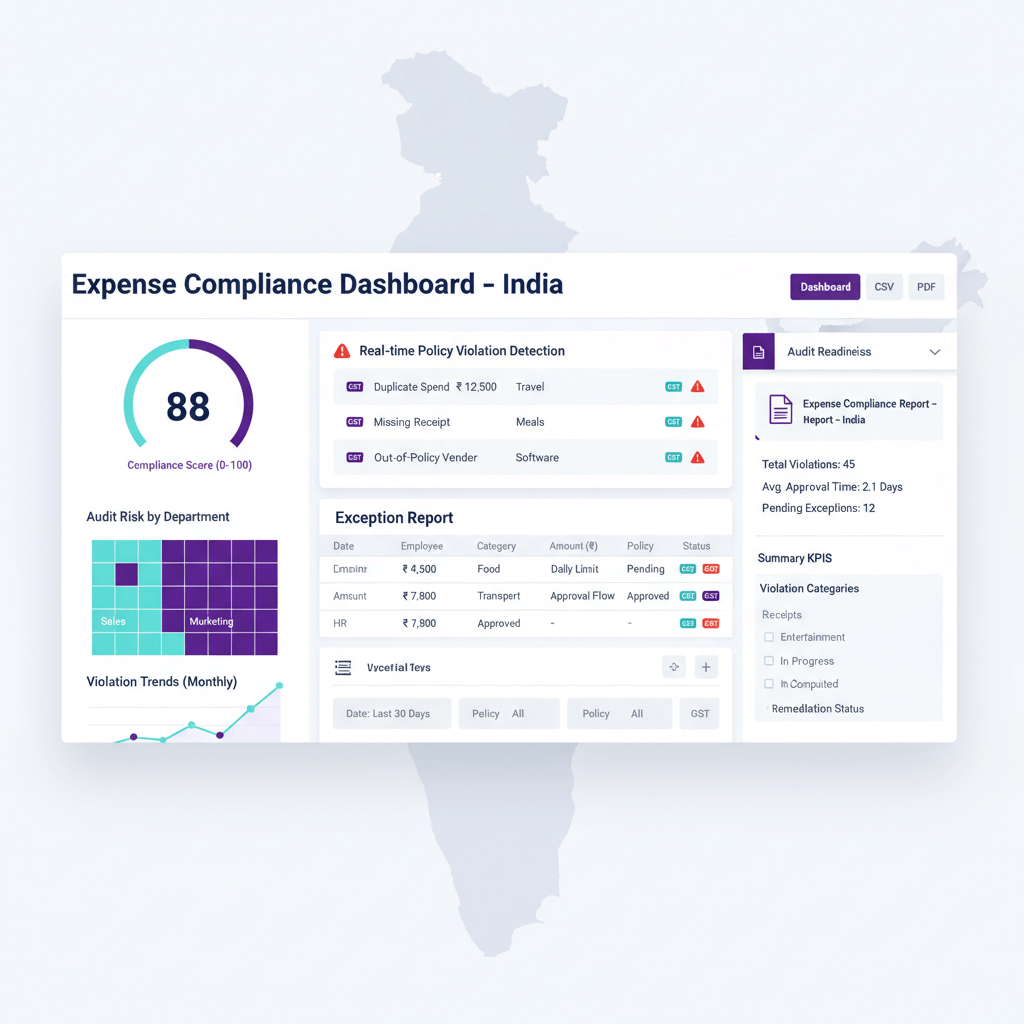
- Establish real-time expense compliance monitoring that continuously checks GST ITC eligibility, TDS correctness, and internal policy adherence, preventing costly disallowances and audit observations.
- Design a transparent compliance score for expenses, starting at 100 and deducting points by violation severity, to give instant visibility across employees, teams, vendors, and months.
- Normalize fragmented data from cards, UPI, reimbursements, and vendor bills using OCR, deduplication, and master mapping, then run detection rules for documentation, tax, policy, and financial control.
- Use exception reporting with owner assignment and due dates, daily and weekly cadences, and audit-ready evidence packages linked to Tally or Zoho entries for swift resolution.
- Integrate specialized tools that parse Indian bank statements, automate GST and TDS checks, and sync bi-directionally with accounting systems for accurate books.
- Adopt audit risk identification with a structured risk library, heatmaps, and targeted sampling to focus effort on high-exposure areas.
- Roll out a 90-day implementation plan, from foundation and configuration to expansion and full deployment, ensuring training and maker-checker controls.
Introduction
Expense compliance monitoring India means continuously verifying business expenses, including corporate cards, UPI payments, reimbursements, and vendor bills, against GST and TDS requirements, and internal policies. Done well, it prevents GST ITC denials, TDS penalties under Section 40(a)(ia), audit observations, and cash leakages from duplicates or bogus claims.
This guide provides a step-by-step framework for policy violation detection, a compliance score for expenses, audit risk identification, and exception reporting, with real-time integration to Tally and Zoho, enabling proactive control rather than reactive firefighting.
Foundational perspectives are detailed in PKC India’s auditing expense management and industry views on continuous monitoring in IBM Think, compliance monitoring.
The Indian Expense Compliance Landscape
Statutory Requirements That Shape Expense Monitoring
Indian businesses operate across multiple statutory lenses. GST compliance demands ITC eligibility verification, vendor GSTIN validation, and reverse charge mechanism tracking. TDS and TCS deductions require careful monitoring across sections, while Income Tax disallowances under Sections 37 and 43B add complexity. FEMA documentation for foreign exchange transactions, CSR documentation standards, and the MSME 45-day rule further shape expense monitoring needs. See PKC India’s auditing expense management for statutory nuance.
Internal Policy Frameworks
Beyond statutes, companies enforce per diem caps, travel class limits, MCC restrictions, weekend spend rules, approval hierarchies, and documentation standards like original GST-compliant invoices. These internal policies safeguard against wasteful spending, while aligning with regulatory compliance, as discussed in PKC India’s auditing expense management.
Systems Reality in Indian SMBs
Most SMBs rely on Tally or Zoho Books, yet expense data arrives from cards, UPI and QR, wallets, petty cash, and employee reimbursements. Fragmentation and over 50 Indian bank statement formats make standardization challenging. A practical overview appears in expense reimbursement automation India and PKC India’s auditing expense management.
Common Pain Points
- Fragmented data, delayed approvals, and manual checks let duplicates and inflated claims slip.
- Missing e-invoices compromise ITC, ghost vendors drain resources, personal expenses get misclassified.
- Compliance risk rises when documentation is incomplete or tax calculation is inconsistent, a pattern highlighted in PKC India’s auditing expense management.
Key Definitions for Expense Compliance
Expense Compliance Monitoring India
Continuous, data-driven review of expenses for GST and Income Tax adherence, plus internal policy fit, including real-time irregularity detection. It transforms reactive audits into proactive control systems. See PKC India’s auditing expense management and IBM Think, compliance monitoring.
Policy Violation Detection
Automated flagging of breaches like missing GST invoices, TDS mismatches, or policy excesses such as unapproved MCC spends, catching violations before they become audit findings. Reference: PKC India’s auditing expense management.
Compliance Score for Expenses
A composite 0 to 100 metric aggregating documentation quality, tax adherence, and policy compliance, per employee, team, vendor, or month, providing instant compliance visibility. See the Volopay article on expense report compliance.
Audit Risk Identification
Pattern-based flagging of high-exposure areas like ITC denial risks or Section 43B lapses for targeted sampling. Details in PKC India’s auditing expense management.
Exception Reporting
Actionable lists of outliers with owners and due dates for review, transforming data into decisions. Explore PKC India’s auditing expense management and the Volopay article on expense report compliance.
Data Foundation: What to Capture and Normalize
Essential Data Sources
Capture data from bank and card statements, UPI exports, employee claims, vendor invoices, master data files, and travel booking systems. Each source adds context for compliance checks and risk scoring, per PKC India’s auditing expense management.
Critical Data Fields
- Firm and vendor GSTIN, invoice dates and numbers, HSN and SAC codes, tax breakup, TDS section and rate.
- Payment mode and MCC, approver trail, attachments, and voucher references.
- These fields power automated rule checks, as emphasized in PKC India’s auditing expense management.
Data Normalization Process
Parse PDFs and images via OCR, deduplicate using exact and fuzzy matching, and map vendors to master records. Categorize ledgers using expense category automation India, and link payments to bills to create a single source of truth. Background reading: PKC India’s auditing expense management.
Quality Control Checks
- Set OCR confidence thresholds.
- Validate GSTIN against government status APIs.
- Verify date consistency, detect duplicates, and flag anomalies.
- These controls ensure data accuracy before rules run, per PKC India’s auditing expense management.
Policy Violation Detection: Rulebook and Patterns
Rule Categories and Severity Levels
- Documentation, Critical: Missing GST invoice, handwritten bills without GSTIN, e-invoice non-compliance.
- Tax, High: ITC-ineligible personal spends, TDS short-deduction versus section, unaccrued RCM.
- Policy, Medium: Per diem exceedance, premium travel class, weekend MCC liquor purchases, split bills.
- Financial Control, High: Duplicates, round-tripping, inflated claims.
Reference: PKC India’s auditing expense management.
Scoring Methodology
Start at 100. Apply penalties by severity, for example, Critical minus 40, High minus 25, Medium minus 10. Use ML to find outliers with peer group comparisons and seasonality. Guidance in PKC India’s auditing expense management and the Volopay article on expense report compliance.
Advanced Detection Patterns
- Novel merchant appearances and rapid sequences of small transactions indicating policy circumvention.
- Unusual MCC activity in weekends, and partial billing to avoid review thresholds.
- See examples in the Volopay article on expense report compliance.
“Detection rules are most effective when paired with clean master data, clear ownership, and timely resolution.”
Designing a Compliance Score for Expenses
Score Dimensions and Weights
Build across five dimensions, Documentation quality 30%, Tax correctness including GST and TDS 30%, Policy adherence 20%, Approval completeness 10%, Vendor compliance 10%. For vendor due diligence, reference vendor risk assessment tools India. Frameworks in PKC India’s auditing expense management and Volopay’s expense report compliance.
Calculation Formula
Base 100. Apply penalties, minus 40 for missing GST on ITC claims, minus 25 for TDS errors, minus 10 for late approvals, minus 5 for MCC breaches. Keep it transparent so employees understand how actions impact compliance, as advised in the Volopay article on expense report compliance.
Score Rollups and Thresholds
- Roll up by employee, department, vendor, and month.
- RAG thresholds, Green 90+, Amber 75 to 89, Red below 75.
- Use dashboards to prioritize attention.
Practical Applications
- Link scores to incentives, embed on executive dashboards, support audit preparation, and trace to ledger entries.
- See governance recommendations in PKC India’s auditing expense management.
Audit Risk Identification: Mapping to Objectives
Risk Library Development
- ITC denials, Section 40(a)(ia) exposure, related-party gaps, Section 43B misclassifications, and FEMA documentation.
- Map each risk to audit objectives and regulatory requirements.
- Reference library design in PKC India’s auditing expense management.
Risk Heatmaps
Visualize concentration by entity, function, and vendor to direct resources effectively, an approach highlighted in PKC India’s auditing expense management.
Sampling Strategies
Apply 100% review for Critical violations, then analytics-driven sampling for unusual spikes, seasonality, or outlier vendors. See PKC India’s auditing expense management.
Evidence Package Assembly
Compile attachments, reconciliations, and audit trails linked directly to Tally or Zoho entries, accelerating audit and regulatory reviews, as advocated in PKC India’s auditing expense management.
Exception Reporting: Templates and Cadences
Core Exception Types
- Missing GST on ITC: Invalid invoice or GSTIN.
- TDS mismatch: Rate versus section or vendor classification.
- Duplicates: Exact and fuzzy matches across sources.
- Out-of-policy spends: Weekend MCC violations, split bills, premium travel classes.
- RCM gaps: Triggered vendors without accrual recognition.
- High-risk merchants: First-time or novel merchants.
Reference templates in PKC India’s auditing expense management.
Reporting Cadences
- Daily reports for accountants focusing on documentation gaps.
- Weekly summaries for managers highlighting policy violations.
- Monthly dashboards for CFOs showing trends and scores.
- Include owner assignments, due dates, and direct links to source documents in all reports, as guided by PKC India’s auditing expense management and the Volopay article on expense report compliance.
Pro tip: Pair exception queues with SLAs and maker-checker controls to ensure fast closure, consistent documentation, and traceability.
Workflow Blueprint: People, Process, Tools
People and Roles
- Maker-checker separation for entry and approval.
- Policy and tax reviewers for specialized checks.
- Internal or external auditors for periodic independent review.
- Clear role definition prevents gaps and overlaps, see PKC India’s auditing expense management.
Process Flow
- Ingest data from multiple sources.
- Normalize to a standard format.
- Detect violations and calculate scores.
- Conduct reviews and approvals.
- Sync to accounting books.
- Generate dashboards for management.
Structured flows reduce misses, as described in the Volopay article on expense report compliance.
Tool Selection
Consider specialized solutions that fit Indian context. For example, AI Accountant specializes in Indian bank statement parsing, automated GST and TDS detection, compliance scoring, and Tally or Zoho integration, with ISO 27001 and SOC2 Type 2 certification. Alternatives include QuickBooks, Xero, FreshBooks, and Zoho Expense, with core accounting on Tally and Zoho Books. See PKC India’s auditing expense management and the Volopay article on expense report compliance.
Integrating Specialized Tools
Key Integration Capabilities
- Parsing PDFs and CSVs of Indian bank statements, automated ledger mapping, GST and TDS sections.
- Rule engines for duplicates, MCC violations, and RAG scoring for real-time compliance.
- Dashboards, audit-ready exports, and bi-directional sync with Tally and Zoho for accurate books.
- Security aligned with ISO 27001 and SOC2 Type 2, as discussed in PKC India’s auditing expense management and the Volopay article on expense report compliance.
Implementation Checklist: 90-Day Rollout
Weeks 1-2: Foundation
Inventory expense policies and compliance rules, map all data sources including banks, cards, and reimbursements, establish connections with Tally or Zoho Books. Foundation steps in PKC India’s auditing expense management.
Weeks 3-4: Configuration
Configure violation rules and scoring algorithms, select a pilot department for initial rollout, test and tune. See configuration pointers in the Volopay article on expense report compliance.
Weeks 5-8: Expansion
Add remaining data sources, fine-tune deduplication based on pilot feedback, launch exception reports for the pilot group. Reference practices in PKC India’s auditing expense management.
Weeks 9-12: Full Deployment
Roll out dashboards to management, establish SLAs for exception resolution, train users, and execute a dry-run audit. Final rollout guidance in PKC India’s auditing expense management.
Case Study: Mumbai-Based SMB Transformation
Before Implementation
A 200-employee Mumbai manufacturing firm struggled with manual checks. They missed ITC documentation on 30% of eligible expenses, and TDS errors affected 15% of vendor payments. Audit prep took three weeks of overtime. Source perspective, PKC India’s auditing expense management.
After Implementation
Within three months, compliance scores exceeded 92, policy violations dropped by 60%, ITC documentation reached 100%, and monthly audit packages were generated automatically. The finance team shifted to strategic analysis, and vendor payment cycles improved. See summaries in PKC India’s auditing expense management and the Volopay article on expense report compliance.
Common Pitfalls and How to Avoid Them
Over-Alerting
Too many alerts create noise, reduce responsiveness. Add context rules, for example, project exceptions, to cut false positives. See Volopay’s expense report compliance.
Missing Ownership and Timelines
Exceptions without owners get ignored. Embed owner assignments and due dates directly into exception reports, as emphasized in PKC India’s auditing expense management.
Static Scoring Models
Update scoring weights and thresholds quarterly. Business conditions change, therefore models must adapt. Guidance in the Volopay article on expense report compliance.
Poor Vendor Data Quality
Invalid GSTINs create risk. Implement automated GSTIN validation, and keep vendor masters clean, a best practice in PKC India’s auditing expense management.
Conclusion and Next Steps
This framework delivers comprehensive expense compliance monitoring India through automated detection, real-time scoring, audit risk identification, and exception reporting. Integrated with Tally and Zoho Books, it cuts compliance leaks, and reduces audit stress.
Begin by testing your expense data against these checks, you will likely uncover gaps. Then tune violation rules to your industry and policies. Invest in training and clear accountability, and commit to continuous improvement. With the right combination of people, process, and tools, Indian SMBs can achieve world-class compliance while reducing manual effort and audit anxiety.
Frequently Asked Questions
As a CA, how should I structure a GST ITC validation workflow for expenses, including e-invoices and vendor GSTIN checks?
Establish a maker-checker flow where makers attach GST-compliant invoices, and checkers validate GSTIN via government status APIs. Automate e-invoice detection and match IRN where applicable. Use rule engines to flag ITC-ineligible categories, for example, personal or blocked credits. An AI-driven platform like AI Accountant can parse invoices, verify GSTINs, and auto-flag exceptions with owner assignments.
What TDS controls should I implement to prevent Section 40(a)(ia) disallowance on vendor payments?
Map each vendor to the applicable TDS section, rate, and threshold, then enforce deduction at booking or payment per your policy. Reconcile challans and Form 26Q, and auto-flag short-deductions or missed deductions. A compliance score should deduct points for TDS mismatches, driving timely correction. Tools like AI Accountant can detect section-rate mismatches and create exception queues.
How do I compute a practical compliance score for expenses that auditors will accept?
Start at 100, define severity-based penalties, for example, Critical minus 40 for missing GST on ITC claims, High minus 25 for TDS errors, Medium minus 10 for policy breaches, and smaller deductions for late approvals. Maintain audit trails for every deduction with links to vouchers and attachments. Roll up by employee, vendor, and month, and use RAG thresholds to guide action. This mirrors best practice discussed in the Volopay expense report compliance article.
What data fields are non-negotiable for robust expense compliance in India?
Firm and vendor GSTIN, invoice number and date, HSN and SAC, tax breakup, TDS section and rate, payment mode and MCC, approver trail, and proof attachments. These enable automated GST and TDS checks, policy validation, and forensic duplicate detection. AI Accountant can scan and extract these fields from PDFs and images via OCR with confidence scoring.
How should a CA plan exception reporting cadences for accountants, managers, and CFOs?
Daily reports for documentation and tax exceptions to accountants, weekly summaries highlighting policy violations to managers, monthly dashboards covering trends, scores, and unresolved items to CFOs. Every exception needs an owner, a due date, and a link to source documents. This keeps resolution focused and measurable.
How do I integrate Tally or Zoho Books with a real-time detection engine without disrupting existing processes?
Use a bi-directional sync that ingests vouchers and ledgers, runs detection off-platform, then posts clean entries or exception tags back. Keep maker-checker intact, and add a review step before final posting. Pilot with one department, tune rules, then scale. AI Accountant offers Tally and Zoho connectors with granular sync controls.
What sampling strategy should I use during internal audits alongside automated 100% checks?
Review 100% of Critical exceptions automatically, then apply analytics-driven sampling for normal transactions based on vendor risk, amount bands, seasonality, and anomaly scores. This narrows human review to high-exposure areas, improves auditor confidence, and reduces time spent on low-risk items.
How do I prevent duplicate and round-tripping claims across fragmented payment channels?
Run exact and fuzzy matching on vendor names, amounts, dates, invoice numbers, and MCC patterns across cards, UPI, reimbursements, and vendor bills. Link payments to bills and receipts, and enforce one-to-one mapping. Use anomaly detection for rapid small-amount sequences. AI Accountant’s rule engine can flag duplicates and suspicious sequences in real time.
Which internal policy controls materially reduce audit findings without creating alert fatigue?
Set MCC blacklists, per diem caps, and weekend restrictions, then include contextual overrides for specific projects and roles to reduce false positives. Add time-bound approval SLAs, and throttle informational alerts in favor of actionable exceptions with clear owners. Quarterly reviews of scoring weights and thresholds keep alerts relevant.
How can a CA build an audit-ready evidence package for statutory inspections?
Bundle invoice attachments, GSTIN validation results, TDS computation sheets, payment-to-bill links, and approval trails, all traceable to Tally or Zoho entries. Include exception logs with resolution notes and timestamps. Generate exports that auditors can navigate by vendor, period, and risk category. AI Accountant can produce these packages from its exception and scoring modules.
What is the recommended 90-day rollout plan for an SMB implementing expense compliance monitoring?
Weeks 1-2, inventory policies and map data sources, connect Tally or Zoho. Weeks 3-4, configure rules and scoring, run a pilot. Weeks 5-8, add sources, tune deduplication, launch exception reporting. Weeks 9-12, roll out dashboards, set SLAs, train users, and conduct a dry-run audit. Keep governance clear with maker-checker and ownership matrices.
How do I treat MSME 45-day payment rules within expense compliance workflows?
Tag MSME vendors, monitor invoice due dates, and flag payments approaching or crossing 45 days. Include this as a compliance score dimension, for example, vendor compliance, with minor deductions for late payments, and escalate exceptions for follow-up. This ensures regulatory adherence and better vendor relations.
Can AI help differentiate personal versus business spends when employees use corporate cards and UPI?
Yes, pattern recognition on MCC, time of day, weekend behavior, and merchant history can flag likely personal spends. Combine rules with peer group baselines and anomaly scores, then route to approvers for confirmation. AI Accountant’s card and UPI ingestion can apply these checks and assign exceptions to the right owner.
What governance should I set for changes to scoring models and violation rules?
Maintain a change log, review rules quarterly, and run backtests on historical data to calibrate weights. Seek sign-off from finance leadership and internal audit, then communicate changes to employees to preserve transparency. Keep audit trails of versions used in each period for defensibility during audits.

A results-driven finance and sales professional with hands-on experience through finance internships and a fast-paced sales role. With a strong interest in accounting and business finance, Harsh focuses on turning complex topics into clear, practical takeaways for founders and finance teams.