-01%201.svg)
Key takeaways
- Expense category automation in India slashes categorization time by up to 75% and pushes accuracy above 90%, even with messy UPI and IMPS narrations.
- A hybrid model combining AI pattern recognition with deterministic category mapping rules delivers speed, auditability, and GST compliance in one workflow.
- Real time expense analytics and spend pattern recognition surface duplicates, budget overruns, and anomalies before month end, not weeks after.
- Workflows sync directly with Tally, posting vendor details and GST splits automatically so ledgers stay clean without manual entry.
- Most CA firms and SME finance teams achieve payback within 60 days through time saved, better ITC recovery, and fewer errors.
- If your team still classifies transactions by hand, AI Accountant's bookkeeping automation can handle the volume while you focus on judgment calls and client advisory.
Automatic Expense Classification and Vendor Mapping Rules: What's New in 2026
In 2025, most AI categorization tools for Indian businesses handled common bank formats and standard GST codes. By 2026, the bar has moved significantly. ICAI's own Smart Expense Booking Automation now demonstrates 90% accuracy with 80% reduction in manual processing for firms handling 1,000 or more expenses per month, saving 100 to 150 hours monthly. That benchmark has become the industry standard, not an outlier.
The biggest operational shift in 2026 is the move toward email and document triggered workflows. Expense bills arriving via email are now auto extracted, classified, and queued for approval without anyone opening a spreadsheet. Policy thresholds (for example, ₹1 lakh for auto approval) are enforced at the point of ingestion, not at month end review. This matters most for CA firms managing 20 or more clients and SME finance teams processing high volumes of vendor invoices.
What happens if you ignore these changes? Firms still relying on manual classification face compounding risks:
- Missed ITC claims due to incorrect or late GST code assignment, which GST portal reconciliation checks now flag more aggressively.
- Audit findings from inconsistent vendor mapping, especially where founder classification and category mapping overlap.
- Slower month end closes that cost real money in delayed reporting and partner review cycles.
If you have not reviewed your vendor mapping rules or expense categorization workflows since early 2025, now is the time. Audit your top 20 vendors for correct GST treatment, verify your category mapping rules reflect current policy thresholds, and test your Tally sync for accurate tax splits. Platforms like AI Accountant's GST reconciliation engine now handle multi GSTIN setups and flag mismatches before filing deadlines, making the transition from manual to automated less risky than ever.
The real cost of manual expense categorization in India
Every month, Indian businesses process thousands of transactions. Each one requires proper categorization for GST filing, audit trails, and financial reporting.
The challenge? Indian financial data is messy. UPI narrations are cryptic, vendors appear in many formats, GST rates vary by category, and TDS adds another layer. Reimbursements versus business expenses often blur the lines.
Manual classification consumes up to 60% of finance time. Errors creep in, ITC gets missed, and month end drags. It is the definition of busy work.
"IMPS, UPI, NEFT, the narrations look familiar yet mean different things. Without context, automatic expense classification becomes guesswork, and guesswork hurts GST and audit confidence."
With expense category automation tuned for India, firms cut classification time by 75% while raising accuracy above 90%. That translates to faster closes and tighter compliance.
According to ICAI's Smart Expense Booking use case, firms processing over 1,000 expenses monthly save 100 to 150 hours each month by switching to automated classification. The savings compound as transaction volumes grow.
Understanding AI expense classification for Indian businesses
AI expense classification is not magic. It is pattern recognition trained on Indian financial data. Think of it as a smart assistant that has seen millions of Indian bank transactions and vendor invoices.
It knows that "SWIGGY" likely maps to meals and entertainment, that an 18% tax split often signals office supplies, and that "Cash" typically goes to petty cash ledgers.
The engine evaluates multiple signals together: vendor names, merchant category hints, narration tokens, payment modes, and recurrence patterns. High confidence items auto post. Low confidence items route to review. Every correction is a learning event.
What makes it India specific?
- Coverage across 50 and more bank statement formats.
- The ability to read Hindi and regional language narrations.
- Built in understanding of GST codes with ledger mappings.
Upload statements in PDF, JPEG, or CSV, attach bills, and sync directly to Tally with accurate vendors and tax splits.
Founder classification and category mapping become far simpler when the AI handles the initial sort and your team reviews only the exceptions. This is especially valuable for founders who wear multiple hats and cannot spend hours on ledger entries.
No more manual entry, fewer classification errors, more time for analysis.
That is the promise, and in practice, it holds.
Category mapping rules: the perfect hybrid approach
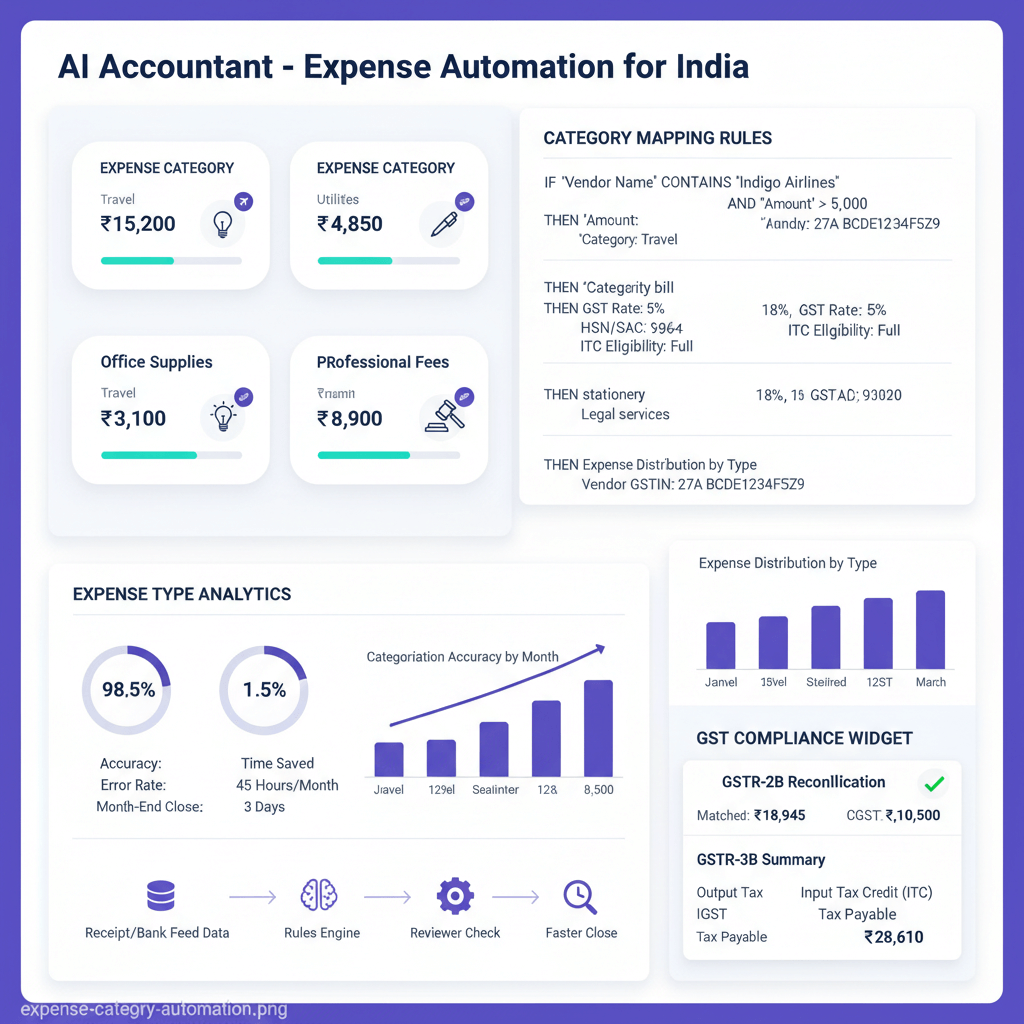
Pure AI is powerful, yet compliance requires firm guardrails. Vendor mapping rules in accounting provide deterministic control where policy demands it, while AI handles the long tail of transactions.
- Fuel: force map any narration containing "BPCL" or "HP PETROL" to fuel, with the right GST code.
- Travel: set rules across common booking platforms for consistent treatment.
- Staff welfare: define vendor patterns to ensure tax correct categorization.
- Advances: segregate by payment mode or amount thresholds.
A clear priority hierarchy decides the outcome. Client specific exceptions come first, then firm level rules, then AI. Every decision leaves an audit trail explaining whether a rule or the model applied.
The result? AI handles volume with accuracy, rules ensure compliance, and your team stays in control. This hybrid approach aligns with guidance from ICAI on maintaining audit trail integrity while adopting automation.
"Hybrid means speed without losing oversight, and compliance without manual drudgery."
Expense type analytics: real time visibility into spending patterns
Numbers tell stories only when you can see them in time. Expense type analytics converts raw transactions into clear, actionable views.
- Spot category spikes instantly: marketing trending up, office supplies over budget, travel costs outpacing plan.
- Drill into vendors: see top spend contributors with GST impact by category.
- Track budget versus actuals in real time, not weeks later.
- Connect to payables: monitor days payable outstanding and vendor attention lists.
Exports for partners and founders take seconds. Audit ready breakdowns are a click away.
Month end accelerates by 50%, and leaders make decisions while it still matters. For founders juggling multiple responsibilities, this kind of spend visibility replaces gut feeling with data.
Spend pattern recognition: your early warning system
Patterns hide in plain sight. Automated monitoring surfaces them quickly.
- Duplicate subscriptions and double charges get flagged automatically.
- Sudden category spikes trigger alerts with context.
- Recurring payments that should have stopped appear in exception queues.
- Foreign exchange fees and policy breaches are highlighted for review.
The reconciliation assistant matches transactions to invoices, finds missing documents, and prioritizes unreconciled items by amount, age, or risk.
Firms routinely see accuracy above 90%, time saved near 75%, and exception clearing rates around 80% within the first month. These numbers align with industry benchmarks for AI accounting tools in India as of 2026.
"This is not about policing spend. It is about stopping leakage, increasing ITC recovery, and making audits predictable."
Step by step implementation with AI Accountant
Getting started is straightforward, with measurable gains in a week.
Step 1: Data ingestion
Upload the last three months of statements in PDF, JPEG, or CSV. Attach bills, then link your accounting system for bi directional sync. Initial categorizations arrive within minutes.
Step 2: Configuration
Set up category mapping rules for compliance critical cases. Define approvals by expense type. Map common vendors to ledgers and configure GST across categories. Start with the top ten categories, then expand.
Step 3: Review and sync
Approve high confidence predictions, correct edge cases, and let the system learn. Post to ledgers with vendor details and GST splits intact, synced to Tally.
Step 4: Go live checklist
Test sample classifications, review exceptions, enable audit trails, and assign roles. Run in parallel for a week, compare outcomes, fine tune rules, and train the team.
Evaluation timeline
Week one shows visible time savings and rising accuracy, while analytics start surfacing insights. By month end, classification time drops sharply, accuracy hits target, and productivity jumps.
Measuring ROI and success metrics
Track a handful of metrics and the ROI becomes obvious.
- Manual effort down by 75% on average. Days compress into hours.
- Reconciliation speed up by 50%. Month end reduces from 15 days to 7 days.
- ITC recovery improves by 10 to 20%. Mismatches shrink toward zero.
- Error rates fall due to structured posting and duplicate detection.
Monitor processing time per statement, ITC recovery trend, exception aging, and expense leakage reduction.
A simple ROI model: hours saved multiplied by hourly cost, plus error reduction and compliance benefits. This yields payback for most firms in about 60 days. ICAI's own automation case studies corroborate these timelines, with firms saving 100 to 150 hours monthly once fully live.
Essential buyer's checklist for Indian businesses
Core capabilities
| Must have feature | Why it matters |
|---|---|
| AI expense classification | Understands messy UPI narrations, learns from corrections, increases accuracy over time |
| Category mapping rules | Gives deterministic control for compliance critical items and audits |
| Expense type analytics | Real time visibility into category trends, budgets, and vendor concentration |
| Spend pattern recognition | Flags anomalies, duplicates, and policy breaches automatically |
| Tally sync | Bi directional data flow with accurate vendors and tax splits |
| Indian bank coverage | Support for 50 and more bank formats with GST readiness |
Security and compliance
Look for ISO 27001 and SOC 2 Type 2, role based access controls, robust audit logs, and strong encryption at rest and in transit.
Implementation support
Evaluate onboarding quality, training resources, support responsiveness, escalation paths, and documentation depth.
Future roadmap
GSTN links for GSTR 2B and GSTR 1, Account Aggregator feeds for direct bank data, predictive cash flow, and multi entity consolidation. As of 2026, multi GSTIN handling and direct GSTN portal integration are becoming standard expectations, not premium features.
Vendor evaluation
Check stability, testimonials, pricing clarity, contract flexibility, and integration depth.
Real success stories from Indian businesses
A Bangalore CA firm managing 40 clients cut classification time to a fraction using hybrid rules and AI. Audit preparation became smoother, and the same team handles 30% more clients.
An SMB founder in Mumbai used expense analytics to expose an overrun in marketing and a spike in travel. Founder classification of spend categories helped rebalance the budget and improve profitability within a quarter.
A Delhi CFO used spend pattern recognition to eliminate duplicate software subscriptions worth ₹50,000 monthly. The team also stopped unauthorized categories worth ₹2 lakhs each quarter, paying back the system in the first month.
Comparing automation approaches: making the right choice
| Approach | Accuracy | Speed | Audit trail | Human effort | Best for |
|---|---|---|---|---|---|
| Manual process | Low, 60 to 70% | Very slow, 30 days and more | Poor | Very high | Tiny volumes |
| Rule based only | Medium, 70 to 80% | Slow, 7 to 10 days | Good | High | Simple categories |
| Semi automated | Medium, 80 to 85% | Medium, about 24 hours | Good | Medium | Growing businesses |
| Full AI, AI Accountant | High, 90% and above | Fast, under one hour | Excellent | Low | Scale operations |
Manual suits very small volumes. Rule based helps simple patterns. Semi automated is a bridge. Full AI delivers the strongest results with clear auditability.
Start where you are, scale quickly, and avoid the compounding cost of manual work.
FAQ
As a CA firm, how quickly can I expect accuracy to improve in the first 30 days, and what does a realistic learning curve look like?
Firms typically start near 80% accuracy in week one and cross 90% within 30 days, provided reviewers correct low confidence items consistently. AI Accountant updates its learning in real time, so each correction improves future predictions for similar vendors and narrations across your client base. ICAI benchmarks from 2026 confirm that 90% accuracy with 80% manual effort reduction is achievable at this volume (2026 update).
How does the system handle completely new or ambiguous vendors where narrations are cryptic or partial?
The model blends narration tokens, vendor strings, amounts, payment mode, MCC hints, and recurrence. If confidence remains low it flags the item for review. A reviewer approves the correct category, and AI Accountant learns that pattern. You can also add a deterministic vendor mapping rule immediately if the vendor is critical for compliance.
What is the workflow to push categorized entries with GST splits into Tally, including vendor mapping and ledgers?
Once approved, entries post with vendor, ledger, and GST code details. If a vendor is new, AI Accountant proposes a vendor record; otherwise it maps to an existing one. For Tally, the sync pushes voucher type, tax breakup, and line items so that ITC and ledgers are correct without manual touch.
Can I enforce firm level category mapping rules and still allow client specific exceptions in a multi client CA setup?
Yes, rule priority runs client exception first, then firm level rules, then AI. This lets you maintain global compliance policies while honoring client specific nuances. For example, a client wide rule to classify specific travel platforms differently due to internal policy or contracts.
How does founder classification work when the same person handles both personal and business expenses?
Automatic expense classification engines separate founder transactions by looking at payment source, vendor patterns, and narration context. Transactions from personal accounts that match known business vendors can be flagged for reimbursement treatment. Rules can enforce document attachment requirements before posting, keeping personal and business ledgers clean.
What ROI benchmarks do CA firms and CFOs typically see within the first quarter of adoption?
Expect 60 to 75% reduction in manual effort, 50% faster reconciliation and close, and 10 to 20% better ITC recovery. Many firms report payback within 60 days, driven by time savings, fewer penalties, and the removal of duplicate or wasteful spend. ICAI's automation case study shows firms saving 100 to 150 hours per month at scale (2026 update).
Transform your financial operations today
Late nights spent classifying transactions can stop. Manual errors disappear, and GST headaches ease. Expense category automation in India is now a necessity for scale, accuracy, and compliance.
The technology exists, the ROI is proven. Whether you are a CA handling multiple clients, a CFO craving real time visibility, or a founder who wants sharper insights, automation frees your team to apply judgment where it matters most.
Start with a month of data, measure the difference, then scale confidently.
Ready to explore an India first approach? Visit aiaccountant.com and see how AI Accountant delivers AI powered categorization, analytics, and seamless ledger sync.
The future of Indian financial management is about working smarter, not harder, and it is available today.

A results-driven finance and sales professional with hands-on experience through finance internships and a fast-paced sales role. With a strong interest in accounting and business finance, Harsh focuses on turning complex topics into clear, practical takeaways for founders and finance teams.