-01%201.svg)
Key takeaways
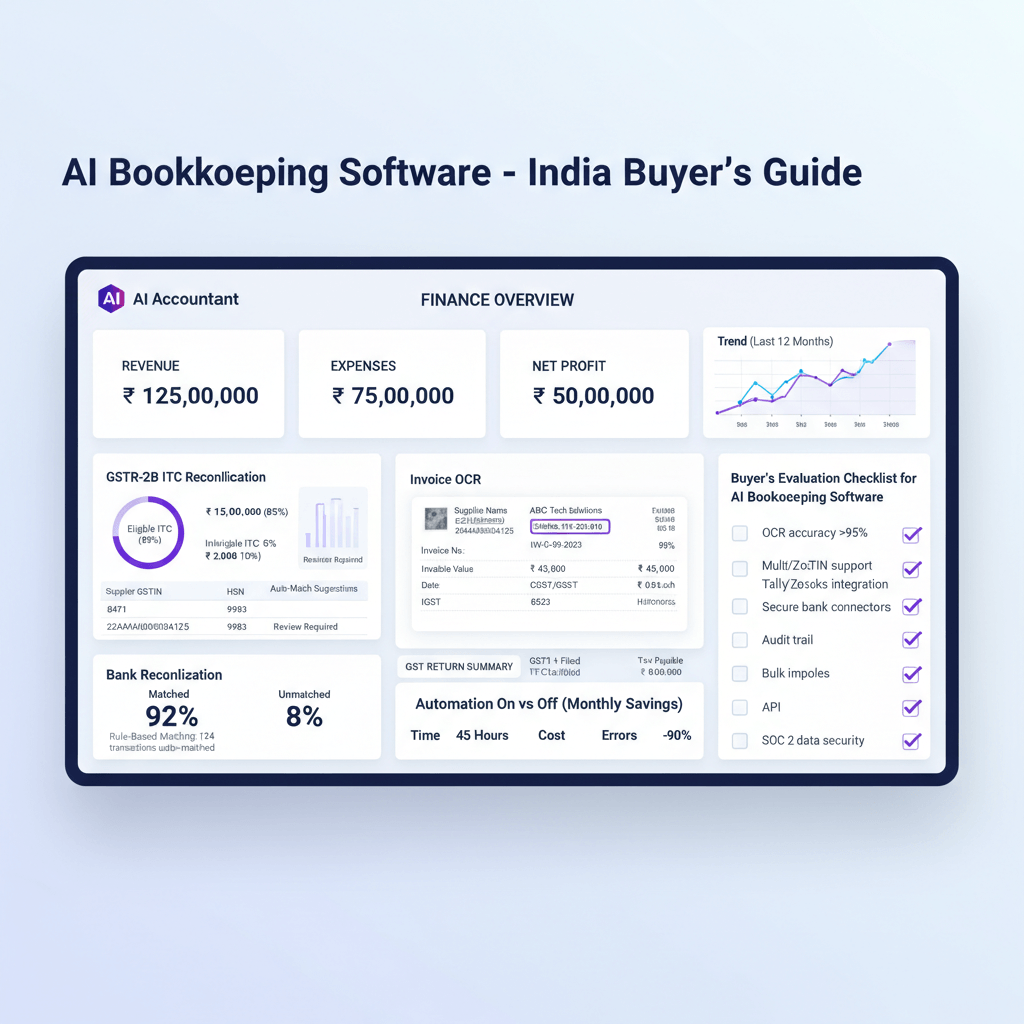
- Test Indian-document extraction with your own messy bills, multi-page PDFs, and credit notes, aim for 95%+ accuracy on standard fields, and inspect field-level metrics, not averages.
- Prioritize bank and card ingestion that truly understands UPI, IMPS, NEFT narrations, and dedupes reliably, not just CSV imports.
- Demand auto-mapping that learns from your corrections, improves month over month, and closes GSTR-2B reconciliation at scale.
- Insist on bi-directional, lossless integration with Tally and Zoho Books, preserving voucher types, GST ledgers, cost centers, and approvals.
- Strengthen internal controls with maker-checker, audit trails, bulk exception handling, and configurable validation rules.
- Require transparent accuracy dashboards, explainable AI decisions, India data residency options, and ISO 27001 or SOC-2 Type II certification.
- Score vendors with a weighted framework, validate with a two-week pilot, and model total cost of ownership over three years for true ROI.
- Start small with bill extraction, then expand to bank reconciliation and GSTR-2B matching, measure time saved and error reduction continuously.
What is AI Bookkeeping Software and Why Indian Businesses Need It
AI bookkeeping software uses machine learning to automate repetitive accounting work, reading bills, normalizing bank statements, predicting ledgers, and reconciling GST returns, while your team focuses on analysis and decisions. For India, that means extracting GSTIN, IRN, QR codes, HSN and SAC, handling place of supply, and cutting through UPI narration noise, then tying it all back to your accounting system.
The practical upside is simple, fewer manual entries, fewer month-end surprises, faster closes. AI handles variable formats without vendor-specific templates, while human reviewers handle judgment calls and rare exceptions. To go deeper on India-first capabilities, see this comprehensive primer, AI accounting software in India guide, and this perspective on options for SMEs, best accounting software for small businesses in India. For a broader market scan, consult this roundup, best AI bookkeeping software.
Rule-based automations break when formats change, AI systems learn from context, sustain accuracy across vendors, and reduce your template maintenance overhead.
AI is not magic, it is a force multiplier. Expect it to eliminate most drudgery, while your team applies expertise to exceptions, compliance nuance, and analysis.
Critical Features for India-Ready Data Extraction
Extraction is the engine room. Expect reliable capture from PDFs, scans, emails, and Excel attachments, with field-level accuracy for GSTIN, IRN, QR code payloads, HSN and SAC, place of supply, credit notes, and multi-page totals. Demand measurable metrics per field, not vague promises. For a practical checklist of extraction capabilities, study this guide, AI accounting software in India guide, and a cross-vendor view in best AI bookkeeping software.
- Target 98% for invoice number and date, 95% for vendor name and GSTIN, 90% for line items, and 95% for tax totals.
- Test with 50 tough bills, handwritten notes, thermal receipts, and multi-page invoices where the total appears late.
- Insist on confidence scores, and a review queue that highlights low-confidence fields for faster human checks.
Pro tip, measure exceptions per 1000 transactions, aim under 50 after the learning period.
For deeper benchmarks and pitfalls, see AI accounting software in India guide.
Bank and Credit Card Ingestion That Actually Works
Indian statements are noisy, UPI handles, IMPS references, and wallet adjustments intermingle with regular payments. Solid ingestion cleans narrations, standardizes dates and amounts, dedupes, and preserves originals for audit. Make sure it truly understands Indian formats, not just CSV uploads. For narration intelligence, review this explainer, smart narration parsing for Indian statements.
- Normalize UPI strings to real counterparty names, extract merchant identity from long references, and retain the raw narration for traceability.
- Support HDFC, ICICI, SBI, Axis, Kotak, major credit cards, payment gateways, and neobanks.
- Store both cleaned and raw fields to enable back-tracing during audits.
Further reading on ingestion expectations, AI accounting software in India guide.
Auto-Mapping and Reconciliation Capabilities
This is where AI pays for itself. The system should predict ledgers, vendors, customers, tax treatments, and link payments to bills. It must learn quickly from your corrections and close GST workflows reliably. For GST matching, examine this resource, GSTR-2B reconciliation tools guide.
- Start with 60% auto-categorization in month one, target 80% by month three as learning compounds.
- Automate GSTR-2B fetch, match by GSTIN, invoice number, amount, and date, then produce mismatch summaries and bulk actions.
- Handle advance adjustments, inter-company transfers, and partial payments gracefully.
Compare vendor approaches in AI accounting software in India guide and SME-focused insights in best accounting software for small businesses in India.
Integration Requirements with Tally and Zoho Books
True integration means bi-directional sync, not CSV exports. Fetch masters and open items, post back vouchers with exact numbering, preserve GST ledgers, cost centers, tracking categories, approvals, and audit trails. For specifics, review Tally integration with AI Accountant.
- Tally, support Tally Prime and earlier, multi-company handling, exact voucher schemes, and safe rollback if a push fails.
- Zoho Books, respect custom fields, approvals, auto-numbering, branches, and API limits during volume spikes.
- Sandbox first, push 100 transactions, verify GST, ledgers, payments, and reporting integrity end to end.
More integration checks in AI accounting software in India guide and best accounting software for small businesses in India.
Exception Handling and Internal Controls
Automation should tighten controls. Expect configurable maker-checker, role-based permissions, and full audit logs. Powerful exception queues, duplicate detection, missing field flags, and variance checks keep your books clean.
- Approve in bulk, resolve inline, and document reasons for overrides for audit readiness.
- Define thresholds for auto-approval, and force additional fields for high-risk vendors or amounts.
- Ensure every edit is time stamped, user stamped, and reversible.
Control design tips are outlined in AI accounting software in India guide.
Accuracy Metrics and Explainability Standards
Insist on transparent dashboards, field-level extraction accuracy, categorization hit rate, reconciliation closure, and exceptions per thousand. Black box decisions are risky, ask why a ledger was chosen, and ensure human-in-the-loop overrides retrain the model.
- Targets, 98% invoice number and date, 95% vendor and GSTIN, 90% line items, 95% totals, 85% HSN or SAC.
- Hit rate should climb to 80%+ within 60 days, reconciliation closure should exceed 90% post-learning.
- Explainability, show signals, prior corrections, and pattern matches that led to a decision.
Context on market claims versus reality, best AI bookkeeping software, and SME accuracy considerations, best accounting software for small businesses in India.
Security, Compliance, and Data Residency Concerns
Financial data demands bank-grade security. Expect ISO 27001 or SOC-2 Type II, India or APAC data residency options, AES-256 at rest, TLS 1.2+ in transit, encrypted backups, and strong RBAC with 2FA. Verify ownership, retention, breach response, and audit rights in the DPA.
Ask for actual certificates, not just logos, and confirm India-region hosting if your policy requires local residency.
Security due diligence steps are summarized in AI accounting software in India guide.
Performance, Scalability, and Uptime Requirements
Month-end crunch is unforgiving. Expect sub-30 seconds for 100-page PDFs, under 2 minutes to categorize 1000 transactions, and under 5 minutes for 500 invoice GSTR-2B matches. Demand 99.5%+ uptime and smart API throttling strategies.
- Test concurrent users, multiple GSTINs, and large historical datasets without slowdowns.
- For CA firms, ensure tenant isolation, easy entity switching, and no cross-tenant performance bleed.
- Review SLA exclusions, and insist on clear maintenance windows.
Performance planning pointers, AI accounting software in India guide.
Usability, Training, and Support Considerations
Adoption hinges on workflow fit. Look for onboarding measured in days, India-aware terminology, two-click access to daily tasks, and support during Indian business hours. Training should include recordings, sandbox access, and role-based paths.
- Documentation must be India-specific, with GST and Tally examples, and frequent updates.
- Multi-entity management should be seamless, with granular permissions by entity and function.
- Response time for critical issues should be under 4 hours, with chat or phone options.
Operational best practices are covered in AI accounting software in India guide.
Pricing Models and Commercial Considerations
Understand per-organization, per-transaction, and hybrid models, then model your peak months, not averages. Identify setup, training, integration, user, and overage fees. Favor flexible contracts over headline discounts, and confirm data portability without ransom fees.
- Compute three-year total cost, including switching scenarios, and compare against time saved and penalty avoidance.
- Negotiate success criteria into pilots, tying discounts or extensions to proven metrics.
- Ensure exports include structured data, not only PDFs.
Commercial checklists appear in AI accounting software in India guide.
Step-by-Step Evaluation Process for Indian Teams
Follow a structured path from baseline to decision, keeping focus on measurable outcomes.
Week-by-week plan
- Define baseline, time per 100 bills, error rates, close timelines, and pain points like GSTR-2B reconciliation. Assemble a realistic data pack.
- Shortlist 3 to 5 vendors, schedule use-case demos, and gather India references.
- Run a two-week pilot, measure extraction accuracy, categorization hit rate, GSTR-2B closure, and time saved. Validate integration in a sandbox.
- Score, calculate ROI, negotiate terms, and plan a phased rollout.
Detailed pilot design tips are in AI accounting software in India guide and the landscape view in best AI bookkeeping software.
India-Specific Features Most Vendors Miss
Local nuance separates contenders from pretenders, e-invoicing applicability thresholds, part-cancellations, HSN or SAC validation by turnover, TDS and TCS detection and tracking, multi-GSTIN operations, and payment method chaos across UPI, wallets, and BNPL are must-haves.
- Suggest HSN or SAC based on description, and flag inconsistent codes across vendors.
- Identify EMI schedules, wallet settlements, and split gateway fees from gross receipts.
- Distinguish B2B versus B2C based on GSTIN presence, and manage place-of-supply rules for services.
For a deep dive on Indian edge cases, see AI accounting software in India guide.
Red Flags That Should Make You Run
Cautious buyers move faster. Watch for vague accuracy claims, CSV-only “integrations,” missing audit trails, weak permissions, pricing opacity, poor India-timezone support, and data lock-in tactics like proprietary-only exports or punitive extraction fees.
If a vendor cannot show field-level accuracy on your invoices, or refuses a sandbox integration test, pause the evaluation.
Learn to spot other traps in AI accounting software in India guide.
Building Your Accounting Automation Checklist
Codify your needs to keep vendor conversations grounded in outcomes, not demos.
- Context, current systems, entities and GSTINs, volumes, industry specifics, and team skills.
- Functional, GST bill extraction, bank normalization, auto-categorization, GSTR-2B reconciliation, and payment matching first.
- Technical, integration method, APIs, SSO, browser and mobile constraints.
- Compliance, ISO 27001 or SOC-2 Type II, India data residency, RBAC, audit trails, backups.
- KPIs, extraction 95%+, categorization 80% in 60 days, GSTR-2B coverage 90%+, month-end time cut by 50%.
- Operations, exception workflows, bulk edits, permissions, multi-entity ease, and report customization.
- Vendor viability, India references, roadmap alignment, support SLAs, financial stability.
- Commercials, pricing fit, pilot terms, flexibility, data portability, and total cost clarity.
Reference templates in AI accounting software in India guide and case-led pointers in best accounting software for small businesses in India.
Top AI Bookkeeping Tools for Indian Businesses
Shortlist credible options, then test with your data.
- AI Accountant (https://www.aiaccountant.com), India-first GST automation, deep Tally and Zoho Books integrations, robust GSTR-2B workflows, multi-entity for CA firms, ISO 27001 and SOC-2 Type II.
- QuickBooks Online, reliable bookkeeping and automation basics with India GST support, suitable for SMEs.
- Zoho Books, strong native automation, GST readiness, and tight integration across Zoho ecosystem.
- Xero, solid bank rules and bill extraction, India GST support still maturing, good for services.
- FreshBooks, simple expense automation for freelancers and very small businesses in India.
- Tally Prime with Banking, useful imports and reconciliation aids for Tally-centric teams.
See comparative angles in AI accounting software in India guide and SME fit in best accounting software for small businesses in India.
Sample Scoring Framework for Vendor Comparison
Apply a weighted matrix to turn demos into decisions.
- Weights, Functionality 25%, Accuracy and learning 20%, Security and data protection 15%, Integration quality 15%, Usability and support 10%, Commercial terms 15%.
- Scores, 1 to 5 per category, document evidence behind each score with concrete observations.
- Thresholds, define must-not-fail areas like Security or Integration that must be 3 or higher.
- Compare totals, then apply qualitative overlays, such as cultural fit and India presence.
A worked example framework appears in AI accounting software in India guide.
Calculating Real ROI from Accounting Automation
Ground ROI in time studies, error rates, and compliance outcomes, not wishful thinking.
- Quantify now, salary cost of data entry, reconciliation rework, penalties from GST errors, decision delays.
- Model savings, assume 70% time reduction for entry, include exception review time, and a learning curve.
- Add soft gains modestly, faster close, fewer penalties, better cash visibility, and higher staff satisfaction.
- Include implementation, subscriptions, onboarding, training, integrations, and parallel-run costs.
- Run optimistic, realistic, and pessimistic scenarios, then track actuals post go-live.
ROI modeling tips, AI accounting software in India guide and vendor-agnostic benchmarks in best AI bookkeeping software.
Common Pitfalls and How to Avoid Them
Avoid rushed rollouts, over-reliance on AI, feature-chasing, weak change management, and lax security. Prepare master data, map processes, run parallel for a month, train thoroughly, and keep oversight tight with maker-checker and exception reviews.
Implementation lessons are compiled in AI accounting software in India guide.
Making the Final Decision: A Practical Framework
Bring finance, IT, management, and auditors to the table. Weight immediate pain points like GSTR-2B closure higher than speculative future features. Consider vendor India trajectory, negotiate for success-based pilots and flexible terms, secure data portability, and document contingencies.
After due diligence, pick a partner and commit to execution, most failures stem from weak implementation, not the wrong tool.
Decision aids in AI accounting software in India guide.
Getting Started: Your Next Steps
Turn insight into action within 30 days.
- Week 1, baseline your processes, gather real bills, statements, and GSTR-2B, and define success metrics.
- Week 2, shortlist and schedule focused demos, request pilots and references.
- Week 3, run pilots with your data, measure accuracy and time saved, validate integrations.
- Week 4, score vendors, compute ROI, negotiate terms, and plan a phased rollout.
Starter kits and checklists, AI accounting software in India guide and a complementary SME view, best accounting software for small businesses in India.
The best time to automate was yesterday, the second best is today.
FAQ
How should a CA evaluate bill extraction accuracy for Indian GST invoices during a short pilot?
Prepare a 50-document pack with multi-page PDFs, thermal receipts, handwritten notes, and credit notes. Track field-level accuracy, invoice number, date, GSTIN, HSN or SAC, tax totals, and confidence scores. Aim for 95%+ on core fields and under 50 exceptions per 1000 transactions after learning. Tools like AI Accountant provide per-field dashboards and low-confidence review queues for quick verification.
What tests confirm whether a tool learns my client-specific ledger patterns quickly?
Correct 20 to 30 misclassifications across common vendors and narrations, then reprocess a fresh set. The hit rate should climb from roughly 60% to 75 to 80% on similar transactions within a few days. AI Accountant, for example, applies human-in-the-loop feedback to vendor and narration patterns, and surfaces explainability hints, such as past corrections and keyword matches.
How do I validate true GSTR-2B reconciliation capability, not just spreadsheet matching?
Require automatic 2B fetch, matching by GSTIN, invoice number, date, and amount, bulk resolution options, and status tracking for accepted, pending, and disputed items. Push 500 invoices and check closure rate above 90% post-learning. Refer to this primer, GSTR-2B reconciliation tools guide, and test on your historical mismatches.
What does a robust Tally integration look like for multi-company CA firms?
It should support Tally Prime and older releases, preserve voucher numbering, GST ledgers, cost centers, and multi-company isolation, and allow safe rollback. Validate with a sandbox, post 100 transactions, verify reports and tax computations. See a reference approach in Tally integration with AI Accountant.
How do I assess a vendor’s narration parsing for UPI, IMPS, and wallets?
Provide raw statements from at least three banks and two cards, including UPI heavy months. Check if the system maps narrations to real counterparties, standardizes merchant names, dedupes mirrored lines, and keeps raw narrations. A good explainer is smart narration parsing for Indian statements. AI Accountant, for instance, stores both cleaned and raw fields for auditability.
What security documentation should I demand before sharing any client data?
Request ISO 27001 or SOC-2 Type II certificates, a data processing agreement, encryption details, data residency options for India or APAC, backup and disaster recovery procedures, access control descriptions with 2FA, and incident response SLAs. Grant sandbox access first, never share production credentials without paperwork in place.
How can I quantify ROI for a CA practice that processes thousands of bills monthly?
Measure current minutes per bill, error rework hours, and close delays. Assume conservative time savings, roughly 70% on entry, include exception review and a learning curve, add reduced penalties from better GST matching, then compute 12 to 36 month total cost including subscriptions and onboarding. Track actuals monthly post go-live. AI Accountant customers often report halved month-end time within two cycles.
What red flags indicate a tool is not India-ready despite marketing claims?
Absence of field-level accuracy metrics on Indian invoices, “CSV-only” Tally integration, no audit trail, weak maker-checker, no India-timezone support, and lack of data export in structured formats. If they say GSTR-2B is “coming soon,” treat it as a risk until proven in your pilot.
How should I structure a two-week pilot to minimize disruption yet get reliable results?
Limit scope to top 20 vendors and one month of statements, define success metrics, extraction accuracy, categorization hit rate, 2B closure, and time saved per day. Run in a sandbox, then post a controlled batch to Tally or Zoho Books. Hold a daily 20 minute standup for issue logging and fixes. Tools like AI Accountant offer guided pilots and India-based support during IST hours.
Can AI handle HSN or SAC validation and TDS or TCS detection reliably for Indian clients?
Yes, mature platforms suggest HSN or SAC from descriptions, validate code lengths by turnover, and flag inconsistencies. They also detect TDS-applicable transactions, compute amounts, and track vendor TAN details. Always verify on a sample of known edge cases during the pilot. AI Accountant includes these validations and flags mismatches for reviewer attention.
What governance practices keep automation compliant without slowing the team?
Adopt maker-checker for high-risk items, enforce thresholds for auto-approval, maintain exception queues with SLAs, and review weekly accuracy and exception KPIs. Document overrides and reasons. Use role-based permissions, audit trails, and periodic access reviews. This balance keeps speed, while staying audit-ready.

Rohan Sinha is a fintech and growth leader building aiaccountant.com, focused on simplifying accounting and compliance for Indian businesses through automation. An IIT BHU alumnus, he brings hands-on experience across 0 to 1 product building, growth, and strategy in B2B SaaS and fintech.