-01%201.svg)
Key takeaways
- Great document management gives Indian finance teams clean books, faster month ends, and smooth audits.
- Centralise intake, validation, coding, approvals, posting, reconciliation, retention, and audit, so every document has a clear path.
- Use strong metadata, vendor or customer, GSTIN, invoice date, amount, HSN or SAC, status, for fast search and reliable automation.
- Adopt approvals, access control, and immutable logs to cut errors and prove compliance for GST, TDS, and Companies Act.
- Measure retrieval time, completeness, AP cycle time, and audit response speed, so leaders see tangible value in quarter one.
- For a managed, CA led route, AI Accountant pairs people with a dashboard, giving you a live repository, reconciliations, and compliance status.
Core concepts of document management for accounting
Think of document management as a relay race, where each bill, invoice, or challan moves from capture to validation to coding to approval to posting to reconciliation to retention to audit. When each baton pass is clear, your numbers stay trustworthy, your filings stay on time, and audits become simple.
- Capture. Pull files from vendors, customers, banks, gateways, and teams, via email, uploads, scans, mobile, or API.
- Validate. Confirm GST fields, amounts, dates, and legal names.
- Code. Map to GL account, cost center, project, and tax code.
- Approve. Route for checks and sign off with clear workflows.
- Post. Push entries into your accounting system and link the source file.
- Reconcile. Match to bank, PO, GRN, delivery, or payment.
- Retain. Store centrally with access control, backups, and logs.
- Audit. Enable fast search, export, and complete trails.
A good setup is centralised, with role based access, audit logs, version control, and strong search, so you can find a file in seconds by vendor, GSTIN, date, or amount. For a practical walkthrough tuned for Indian companies, see this guide from AI Accountant. For general DMS concepts, you can also review external primers from practitioners and vendors like RJ Young and Docsvault.
Simple rule: capture once, code once, approve once, then keep the source, the entry, and the trail tied together forever.
Types of accounting documents to manage and how to tag them
Most chaos comes from not knowing what to store, and which fields make search instant. Use this checklist.
Sales documents
- E invoices, tax invoices, credit and debit notes, delivery challans
- Tag with customer name, customer GSTIN, invoice number, invoice date, due date, HSN or SAC, state, status paid or unpaid
Purchase documents
- Vendor bills, purchase orders, goods receipt notes
- Tag with vendor name, vendor GSTIN, PO number, tax rate, cost center, project, due date, payment status
Expense documents
- Travel bills, subscription invoices, meal and petty cash slips, reimbursements
- Tag with employee name, expense category, trip or purpose, payment method, approval status
Bank and payment gateway documents
- Bank statements, UPI screenshots, RTGS or NEFT proofs, settlement reports
- Tag with account number, transaction date, period, amount, gateway name
Tax documents
- GST support for GSTR 1 and 3B, e invoice JSON and PDF, 2A or 2B reconcile files, TDS challans and returns like 26Q, 24Q, 27Q, payment proofs
- Tag with period, return type, ARN, filing status
Statutory and secretarial
- ROC filings, MSME returns, board and AGM minutes, director KYC, payslips, PF and ESI challans
- Tag with financial year, compliance type, due date, status filed or pending
Assets and inventory
- Asset purchase invoices, depreciation schedules, inventory valuation reports
- Tag with asset ID, serial number, acquisition date, location, warranty end date
Use metadata everywhere. Fields like counterparty, GSTIN, invoice number, period, and status power fast search and automation. See more DMS fundamentals from M Files and Docsvault.
Pain points in document management for accounting and why it breaks
- Siloed storage, files scattered across email, desktops, chats, and drives
- Inconsistent naming, the same vendor saved three ways, random file names
- No clear owner, month end becomes a scramble
- Manual data entry, typing errors, wrong GST capture, duplicate bills
- No workflow, bills paid without checks, weak trails
- Audit risk and penalties, missing bills, lost ITC, delayed filings
- Poor cash visibility, weak forecasts and ad hoc reporting
The fix is a central DMS with standard naming, required metadata, approvals, and role based access, as many external overviews note, for example this explainer and this summary.
Capabilities checklist for a good document management system
Central repository and security
- One source of truth with role based access, audit logs, encryption at rest and in transit
- Backups and restore plans, data residency options for India
Capture and extraction
- OCR for invoices and receipts
- Duplicate detection and version control
- Email intake and drag and drop uploads
Workflows and approvals
- AP and AR workflows with steps and rules
- E sign for approvals and vendor onboarding
- Bulk actions and batch updates
Smart search and metadata
- Search by vendor, GSTIN, invoice number, amount, period, or custom fields
- Saved searches and reusable views
Integrations
- Connect to Tally and Zoho, link banks and gateways
- Tie into e invoicing and GST systems
Compliance and audit readiness
- Retention rules by type, immutable logs, time stamps
- GST and TDS reconciliation support
Security hardening
- MFA, access reviews, regular backups and test restores
These reduce cycle time and errors, and make audits calm. See additional checklists from Ontra and MHC.
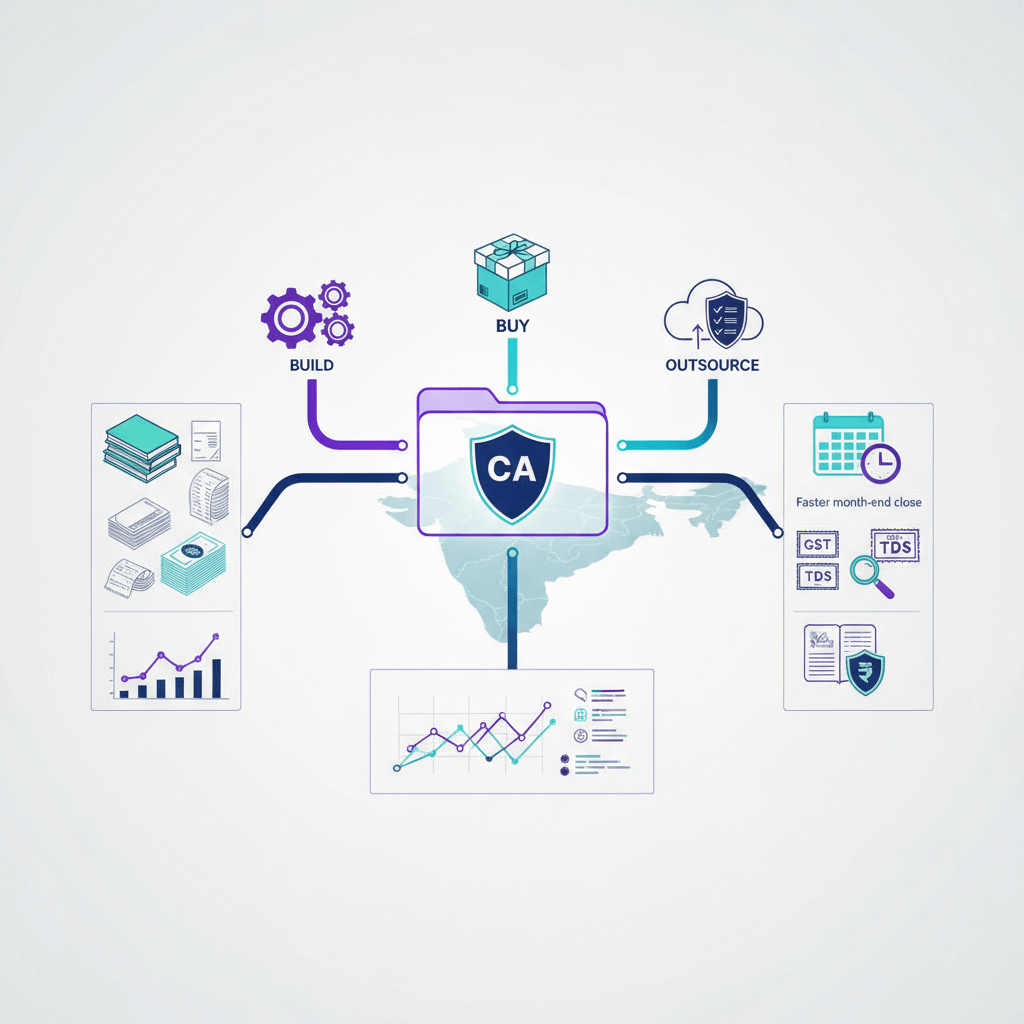
Build vs buy vs managed service for document management
Build a custom DMS
- Pros, full control and deep tailoring
- Cons, high cost, maintenance, security reviews, engineering bandwidth
Buy an off the shelf tool
- Pros, fast setup, proven integrations, support
- Cons, Indian GST and TDS fields may need customisation
Managed service that is CA led
- Pros, bundled processes and compliance execution, trained people, working repository, risk moved to experts
- Cons, less deep customisation than a full build
AI Accountant Virtual Accounting follows the CA led managed path. A dedicated CA team runs bookkeeping, GST, TDS, and income tax, while a dashboard gives you a live repository, bank analysis, compliance timelines, and a single place to chat with your CA team.
Implementation blueprint for document management for accounting
- Assess. Map all sources, email inboxes, vendor portals, WhatsApp, drives, bank portals, gateways, Tally exports. Note bottlenecks.
- Design taxonomy and naming. Folder tree by entity, year, month, type. Use patterns like Vendor underscore InvoiceNo underscore YYYYMMDD underscore Status. Document and share.
- Define metadata. Required fields for counterparty, GSTIN, invoice date, due date, amount, HSN or SAC, cost center, status. Use drop downs where possible.
- Configure intake. Central AP and AR inboxes, mobile capture, alerts on missing fields.
- Build workflows. Three way match for POs, exception rules for amount or tax mismatches, route to the right approver group.
- Integrate ledgers and banks. Connect your accounting system so posted entries link back to source files, pull bank statements for reconciliation.
- Set retention and backups. Retention rules per type, daily backups, monthly restore tests.
- Set access and auditor mode. Role based access, time bound auditor access with view only and export logs.
- Pilot one workflow. Start with vendor bills for one unit, fix naming and fields, expand after two sprints.
- Train and audit. Publish SOPs and short videos, assign owners with RACI, run a quarterly health check.
For background on DMS design patterns, explore this overview and this guide.
Compliance and retention rules for India within document management
Compliance is as important as speed. Set retention by type, and keep versions tamper evident. A practical India focused summary is here from AI Accountant, Records retention for India.
- GST documents, keep for at least seventy two months from the due date of the annual return for that year, retain longer if under audit or investigation, keep e invoice JSONs and IRNs with the invoice PDF.
- Companies Act books and vouchers, retain for eight years.
- Income tax, keep for six to ten years depending on assessments and notices.
- Digital copies, acceptable if clear, legible, timestamped, and logged.
- Retention by type, for example, seven years for TDS returns and challans, eight years for vouchers and ledgers, six to ten years for assessments and tribunal matters.
For general DMS compliance ideas, see this guide and this explainer.
Automation use cases that save time in accounting document management
- OCR with coding, read vendor invoices and code to GL, cost center, GST codes, flag missing GSTIN or wrong tax rates.
- Two or three way matching, match invoice to PO and GRN, raise exceptions for quantity or price mismatches.
- Auto link payments, attach bank proof to the bill entry, close the loop in AP and AR.
- GST reconciliation, match vendor bills to GSTR 2B, flag mismatches to protect ITC.
- Vendor portals, let vendors upload and see status, reduce email threads.
- Close completeness gates, block period close until all expected documents are in and matched.
See a practical automation overview from AI Accountant, Invoice automation for accounting, and general DMS articles by M Files and Docsvault.
Metrics and OKRs to prove the value of document management
- Retrieval time, find any document in under two minutes.
- Completeness, reduce missing documents to under five percent of expected.
- AP cycle time, post and pay vendor bills within seven days of receipt, auto match rate over eighty percent.
- Close speed, cut month end close days by thirty to fifty percent in two quarters.
- Audit outcomes, zero critical findings, respond to all sample requests within one business day.
- GST and ITC, raise ITC recovery and keep recon variances under one percent.
Leaders value visible progress, so publish these monthly with trends. For context, see this primer and this guide.
Common pitfalls in document management and how to avoid them
- Inconsistent naming, fix with a strict template and validation at upload.
- No clear owner, use a RACI so each step has an owner and an approver.
- Treating cloud storage like a DMS, a drive is only storage, a DMS adds metadata, workflows, and audit trails.
- Weak training, short SOPs, refreshers, and simple videos keep adoption high.
- Security gaps, enforce MFA, review access quarterly, test backups and restores.
Further reading: Ontra on DMS benefits, M Files overview.
Tool selection criteria for document management in accounting
Indian compliance fit
- Native fields for GSTIN, HSN or SAC, and TDS sections
- Support for GST and TDS recon files
Integrations
- Connectors for Tally, Zoho Books, and common ERPs
- Bank and gateway feeds
Workflow and search
- Flexible approvals and exceptions
- Fast search with metadata and saved views
Security and trust
- SOC 2 or ISO certifications, MFA, encryption, strong logs
Cost and scale
- Low total cost of ownership, scale with your growth
Tools to explore for accounting and document workflows:
- AI Accountant
- QuickBooks Online
- Xero
- Zoho Books
- TallyPrime
- FreshBooks
- M Files
- Microsoft SharePoint
- SAP Concur
How AI Accountant Virtual Accounting brings document management for accounting to life
AI Accountant runs a CA led managed service with a dashboard that acts as the control room for your finance operations.
- Central repository, invoices, bills, challans, returns, and statements in one place with clean metadata.
- Live financials, revenue, expenses, profit or loss, and balances at a glance.
- Category and cash views, track categories, cash flow trends, burn, and runway.
- Bank analysis, reconcile banks and gateways, spot unusual items, attach proofs to entries.
- Compliance calendar, GST, TDS, ROC, and income tax dates and filing status in one view.
- AI insights and alerts, nudges on missing bills, duplicates, and tax mismatches.
- Team communications, chat with your CA team inside the dashboard so context stays with the record.
Mini case: a seed stage startup moved from email to a central repository with three way match. Month end dropped from twelve days to six, ITC recovery improved through 2B tracking, and the next audit had zero critical findings.
Practical extras you can copy and use
Folder taxonomy starter
- Entity
- Financial year
- Month
- Type, Sales, Purchases, Expenses, Bank, Tax, ROC, Payroll, Assets
File naming pattern
- Vendor underscore InvNo underscore YYYYMMDD underscore Status
- Customer underscore InvNo underscore YYYYMMDD underscore Paid or Unpaid
- Bank underscore AccountNo underscore YYYYMM
Metadata fields checklist
- Counterparty name, GSTIN, invoice number, invoice date, due date, amount, HSN or SAC, cost center or project, status
AP approval workflow
Intake to coding to approver to finance review to post to payment to archive.
Retention map starter
- GST and e invoice, seventy two months from annual return due date
- Companies Act vouchers, eight years
- TDS returns and challans, seven years
- Income tax assessments and orders, ten years
Thirty sixty ninety rollout plan
- Day one to day thirty, assess, design taxonomy and metadata, set intake and naming
- Day thirty one to day sixty, integrate accounting and banks, pilot AP, fix gaps
- Day sixty one to day ninety, roll out to AR and expenses, train users, set auditor access
A friendly wrap up
Document management for accounting does not need to be complex, it needs to be consistent. Start with a clear taxonomy and naming, add metadata, build simple workflows, connect your ledger and bank, set retention and access, then measure cycle time and missing documents until they drop.
If you want a done for you path, AI Accountant pairs a CA led service with a dashboard that keeps documents, numbers, and compliance in one place, so you get speed, control, and calm.
FAQ
How should a CA structure intake so vendor bills, e invoices, and challans do not get lost across email and WhatsApp
Set a single AP intake address, for example ap at yourcompany, auto forward WhatsApp files to it, and connect it to your DMS. Enforce required metadata at intake, vendor, GSTIN, invoice date, invoice number, and amount, so nothing enters the queue without minimum data. AI Accountant sets these gates by default, so your CA team never chases basics.
What metadata fields are non negotiable to make GST and TDS reconciliation painless for Indian entities
Counterparty name, GSTIN, invoice number, invoice date, due date, amount, HSN or SAC, tax rate, place of supply, and status. For TDS, capture section, rate, base amount, and challan reference. With these, GSTR 2B and TDS return checks become quick, and AI Accountant can auto flag mismatches.
How do founders get real time visibility into burn and runway without waiting for a fresh spreadsheet each week
Use a DMS linked to your ledger and banks, so posted entries carry their source files and feed dashboards. With AI Accountant, bank feeds, AP and AR statuses, and category views update continuously, so burn and runway are visible without manual refreshes.
Can scanned copies satisfy Indian GST or income tax scrutiny, or do we need physical vouchers
Clear, legible, timestamped digital copies with immutable logs are generally acceptable. Keep e invoice JSON, IRN, and the PDF together, and retain per Indian rules, for example seventy two months for GST records. AI Accountant stores these with trails that demonstrate integrity.
What is a practical approval workflow that balances control and speed for vendor payments
Intake, auto coding, preparer check, approver review by amount threshold, finance review, posting, payment, archive. Add three way match for PO backed purchases, PO to GRN to Invoice. Exceptions for tax code or price variance route to finance. AI Accountant templates this flow so founders only see items above set limits.
How do we prevent duplicate invoices and wrong GST rates from slipping into books
Use duplicate detection on vendor plus invoice number plus date, and validate GST rate by HSN or SAC and place of supply. OCR with rules removes most errors before approval. AI Accountant’s CA team reviews exceptions, while the system blocks duplicates from posting.
What retention policy should we set across GST, Companies Act, and income tax, so audits never stall
GST, seventy two months from annual return due date, longer if under inquiry, Companies Act vouchers, eight years, income tax, six to ten years depending on assessments. Map retention per document type in your DMS, archive but keep searchable. AI Accountant ships these defaults and runs monthly restore tests.
For a startup on Tally or Zoho Books, what integrations matter most for a working document trail
Two way links between entries and source files, bank statement and gateway feeds, e invoicing bridge, and GST data exchange for 2B recon. AI Accountant connects ledger and banks, so every posted line has its proof one click away.
How should finance heads measure the ROI of a DMS rollout in the first ninety days
Track retrieval time under two minutes, completeness above ninety five percent, AP cycle time under seven days, auto match rate above eighty percent, audit sample turnaround under one business day, and ITC variance under one percent. AI Accountant reports these monthly so value is visible.
Build, buy, or use a CA managed service, what is the lowest risk path for a small Indian company
For most small teams, a CA led managed service is fastest to value, because you get process, people, and a repository on day one. Buy makes sense if you have an internal finance ops lead, build only if you have engineering and compliance bandwidth. AI Accountant follows the CA managed model to reduce risk and time to benefit.
How do we grant auditors safe, read only access without exposing payroll or board minutes
Create auditor roles with time bound, view only rights, and mask sensitive folders like payroll or secretarial. Log views and exports. AI Accountant provides an auditor mode with scoped access and export logs, so you keep control while giving speed.
Can an AI enabled Virtual Accounting service really improve ITC recovery rates, any example
Yes. By reconciling vendor bills to GSTR 2B daily, auto flagging missing or mismatched GSTIN, and nudging vendors before month end, recovery improves. For example, AI Accountant clients have recovered missed invoices surfaced by 2B mismatches, raising ITC and avoiding interest later.