-01%201.svg)

Key takeaways
- Managed accounting services in India means a CA led team runs your books, reconciliations, GST, TDS, and income tax every month, delivering reconciled financials, MIS packs, challans, and e filing receipts on a fixed schedule.
- Unlike outsourced tasks or standalone bookkeeping, managed accounting owns the full cycle and the outcomes, including monthly close, compliance filings, and audit readiness, all backed by SLAs and maker checker controls.
- Founders never post entries or compute returns. The CA team does the work; an AI dashboard gives real time visibility into status, exceptions, and upcoming deadlines.
- Standard scope covers bookkeeping, bank and GST reconciliation, GSTR 1 and 3B filing, TDS returns, advance tax, payroll statutory submissions, and monthly MIS with cash flow and variance views.
- Firms that track reconciliation accuracy and filing timeliness through automation cut month end close time significantly and face fewer surprises at year end audit.
- If your finance team spends more time chasing documents than reviewing numbers, a managed model with automated GST reconciliation can shift that balance quickly.
Managed Accounting Services in India: What's New in 2026
Several regulatory shifts since early 2025 have changed how managed accounting engagements operate day to day in India.
The biggest workflow change is around e invoicing. Until March 2025, the e invoicing threshold under GST sat at ₹5 crore aggregate turnover. From 1 April 2025, CBIC notifications brought this down further, pulling a much larger pool of SMEs into the e invoicing net. For managed accounting providers, this means invoice validation and IRN generation are now part of the standard monthly cycle for clients who were previously exempt. If your provider is not already handling this, you are at risk of rejected invoices and blocked ITC for your buyers.
On the TDS side, the Finance Act 2025 rationalized several TDS rates and raised thresholds for sections like 194A (interest) and 194 (dividends), effective from April 2025. The operational impact: TDS computation logic in your books needs updating, and prior year templates may over deduct or under deduct. Businesses that ignore these changes face interest under Section 201(1A) or unnecessary cash flow drag from excess deductions. Details are available on the Income Tax Department portal.
For firms processing hundreds of vendor bills monthly, matching purchase registers against GSTR 2B has become more granular. The GST portal now surfaces more line item level mismatches, making manual reconciliation even more painful. This is where automated vendor bill matching directly reduces the reconciliation burden. Managed providers who pair CA expertise with automation are closing months faster and catching ITC mismatches before they become notice triggers.
What to do now:
- Confirm your managed accounting provider has updated TDS rate tables and e invoicing workflows for FY 2025 26.
- Check that GSTR 2B reconciliation is happening at line item level, not just summary matching.
- If you crossed the new e invoicing threshold, ensure IRN generation is live before the next filing cycle.
What exactly are managed accounting services in India
Managed accounting services in India means a CA led team operates your day to day accounting and ongoing compliance, then returns reconciled books, MIS, challans, and e filing receipts to you on a set schedule. It is continuous service, not a one time assignment.
Industry explanations consistently describe managed accounting as ongoing operations delivered by specialists, with regular deliverables back to the business. For a primer on how the model is structured, see the ICAI resource library for professional standards governing such engagements.
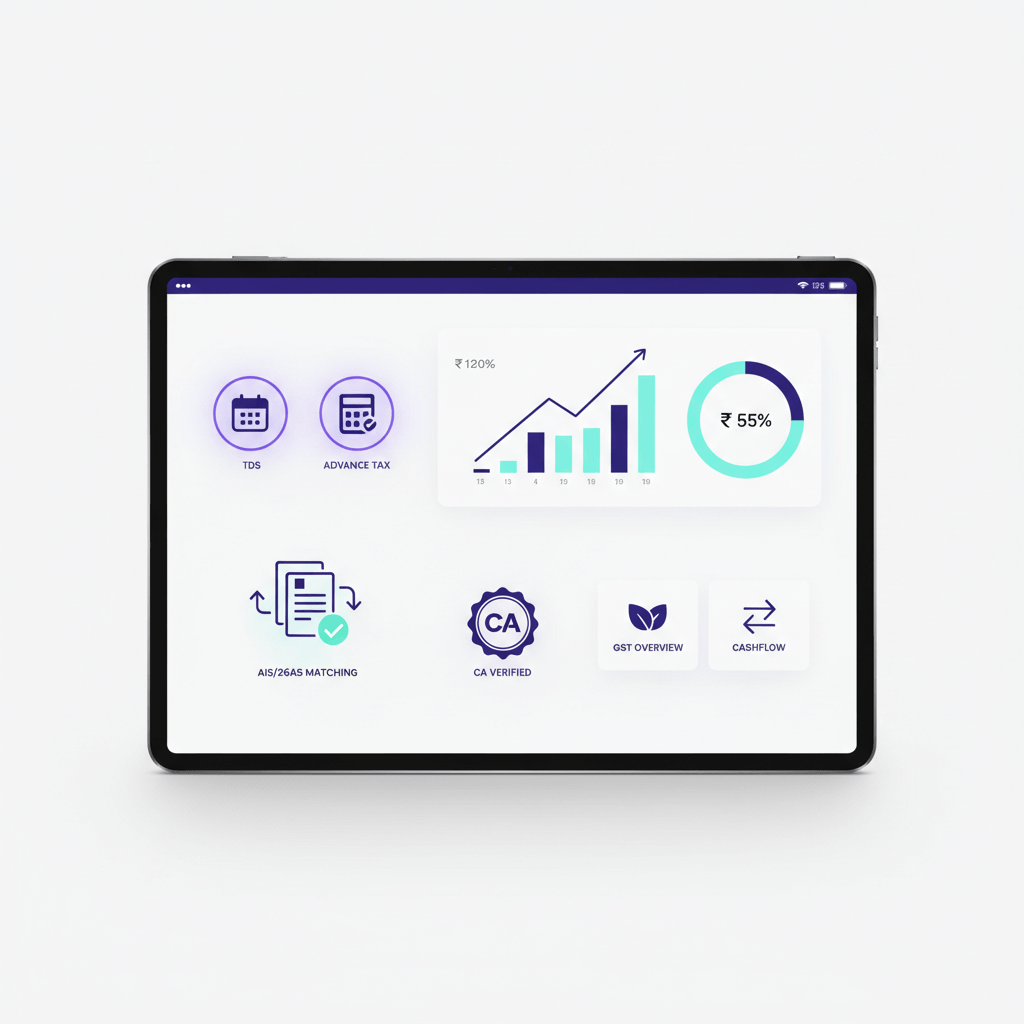
In a modern virtual setup, your team shares documents through a secure portal. The CA team processes and reconciles everything. An AI dashboard gives you real time status, exceptions, and approvals, without asking your founders to post entries or compute returns.
Think of it as having a full accounts department on call, without the hiring, training, and attrition headaches. The provider owns the process, not just individual tasks.
Managed accounting, one clear statement
Managed accounting services in India is an end to end accounting and ongoing compliance model where a CA led team operates your bookkeeping, reconciliations, GST, TDS, payroll, and income tax cycles every month and quarter. The team maintains controls, prepares returns, takes approvals, files on time, and hands back reconciled books, MIS packs, challans, and e filing receipts, with accountability measured through periodic deliverables.
Managed vs outsourced vs bookkeeping
- Managed accounting is proactive. It owns the full cycle, including books, reconciliations, compliance, and monthly close with insights. It runs on controls and SLAs.
- Outsourced accounting in a task sense is reactive. It takes narrow assignments such as only payroll processing or a single return filing. It does not own the process or the MIS output.
- Bookkeeping records transactions and ledger entries. It does not run compliance or the monthly close, and does not produce MIS or variance analysis.
Bottom line: managed accounting adds ownership of outcomes, not just activities.
A simple way to remember it: bookkeeping is recording, outsourcing is delegating a task, and managed accounting is handing over the entire accounting function with accountability for results.
Typical scope: what is included
The scope translates the idea into weekly, monthly, and quarterly work, so you always know what gets done and when.
- Bookkeeping and general ledger
- Vendor and customer ledgers, including vendor invoice matching
- Bank reconciliation and cash reconciliation
- Fixed asset accounting and depreciation schedules
- GST compliance
- GSTR 1 and GSTR 3B preparation and filing
- GSTR 2B reconciliation with purchase register and books
- Input tax credit checks and reversals where needed
- E invoicing and IRN generation for applicable businesses
- TDS filing
- Computation and challan generation
- Quarterly returns: 24Q for salaries and 26Q for non salary payments
- Income tax
- Advance tax workings and payments on quarterly dates
- ITR filing coordination and tax audit support where applicable
- Monthly close and MIS
- Trial balance, profit and loss statement, balance sheet
- Cash flow and variance views for spend and revenue
- Payroll and statutory submissions where agreed
- PF, ESI, Professional Tax filings and deposits
These inclusions are standard across managed models in India. The GST portal publishes updated filing requirements and due dates that your provider should track automatically.
Out of scope: what is not included
Clarity on exclusions prevents misaligned expectations.
- Company secretarial work and MCA filings
- Litigation and complex dispute handling before tribunals
- Advanced international tax or transfer pricing studies
- ERP implementation or large system migration projects
- Inventory operations and physical stock control
- High level CFO strategy unless specifically contracted
Make sure your engagement letter lists these exclusions clearly. It saves both sides from confusion later.
How the engagement runs: onboarding to filings
Onboarding
- Set data access for GSTIN and TAN portals
- Collect prior period records, opening balances, vendor and customer masters
- Map the chart of accounts to your reporting and MIS needs
Document flow
- Share vendor invoices, receipts, and bank statements through a secure portal
- Use maker checker workflows so one person posts and another reviews
- Maintain a documented audit trail for every entry and filing
Processing cycles
- Monthly bookkeeping and monthly close
- Monthly or quarterly GST filings with client approvals
- Quarterly TDS filings with client approvals
- Monthly PF, ESI, Professional Tax deposits and filings
- Annual ITR and audit coordination
Communication
- A single point of contact for queries and approvals
- Status dashboards or portals for progress tracking and pending items
- Periodic review calls and alerts ahead of filing cut offs
The AI dashboard shows what is pending, what is cleared, and what is due next, while the CA team does the work behind the scenes.
Roles and responsibilities split
Getting this split right from day one is what separates a smooth engagement from a frustrating one.
- Provider
- Records transactions from source documents
- Performs reconciliations for bank, GST 2B, and TDS
- Prepares and files compliance returns after client approval
- Compiles MIS and closes the month on schedule
- Business
- Supplies source documents such as vendor bills and bank statements on schedule
- Gives statutory sign off for GST returns, TDS returns, and ITR
- Sets policies for revenue recognition, expense categorization, credit limits, and approval thresholds
- Supports notice responses with facts and context
Approval checkpoints should be defined early, and evidence retained for audit and reviews. The ICAI standards on quality control provide a useful reference for how such engagements should be governed.
Compliance calendar alignment in India
The service follows India's statutory deadlines and adjusts whenever the government notifies changes.
- GST
- GSTR 1 is generally due by the 11th of the following month
- GSTR 3B is due on the 20th, 22nd, or 24th depending on state and turnover category
- Monthly or quarterly options apply under the QRMP scheme
- TDS due dates
- Quarterly returns by 31st of April, July, October, and January
- TDS deposit by the 7th of the following month
- PF, ESI, Professional Tax
- Deposits and filings typically by the 15th of the following month
- Income tax
- Advance tax on quarterly dates: 15 June, 15 September, 15 December, 15 March
- ITR due dates by entity category
- Tax audit due dates for companies and other applicable classes
For the latest due dates and any extensions, always check the GST portal and the Income Tax Department website directly.
Quality controls and audit readiness
- Maker checker review for every ledger entry and filing
- Automated reconciliations for bank statements, GST 2B, and TDS with variance review
- Document retention with a clear, timestamped audit trail
- Cloud security practices for access control and backups
- Periodic internal reviews so year end audit preparation is smooth
These practices are core to any managed model. Without them, you are essentially paying for bookkeeping with extra steps. The difference between a good provider and an average one often comes down to how disciplined their controls are.
Expected outputs and deliverables
You should expect clear, repeatable outputs that leadership can rely on every single month.
- Periodic deliverables
- Trial balance
- Profit and loss statement
- Balance sheet
- Cash flow statements
- MIS pack with variance analysis and key financial ratios
- Compliance evidence
- Challans and e filing receipts for GST, TDS, PF, ESI, PT, and ITR
- Reconciliations
- Bank reconciliation statement
- Vendor and customer ledger reconciliation
- GST 2B reconciliation with purchase register
- TDS ledgers matched with Form 26AS and AIS
- Year end support
- Year end schedules and working papers for audit and ITR
If your provider is not handing you these every month without you chasing, that is a red flag worth addressing.
AI dashboards for visibility, not DIY accounting
The AI dashboard is your window into progress and accuracy, not a replacement for a CA. It shows what is pending, what is cleared, the health of reconciliations, next due dates, and any exceptions that need your attention.
Your CA team still prepares workings, validates GST 2B against your purchase register, computes TDS, reconciles bank and ledgers, drafts returns, and files only after your approval.
This keeps control with professionals, while giving founders comfort and transparency without adding workload.
FAQ
What does a CA led managed accounting model actually do for me every month
A CA led model records transactions from your source documents, reconciles bank, vendor, customer, GST 2B, and TDS, prepares and files GST and TDS returns after your approval, and closes the month with trial balance, profit and loss, balance sheet, and MIS pack. You receive challans, e filing receipts, and reconciled ledgers as evidence every month.
Is managed accounting different from hiring a bookkeeper or outsourcing only GST filing
Yes, managed accounting owns the full monthly and quarterly cycle and is accountable for outcomes, while a bookkeeper records entries and a narrow outsourcing arrangement handles a single return. Managed service delivers reconciled books, MIS, and compliance proofs on a predictable schedule with SLAs.
What part does the AI dashboard play, and will my founders need to post entries
The AI dashboard shows status, exceptions, and due dates, and tracks approvals and SLAs. Your founders do not post entries or compute taxes. The CA team does the work and uses the dashboard to keep you informed and in control.
How do approvals work so I stay compliant but also in control
The service defines approval checkpoints for GST and TDS filings, along with monthly close sign off. You review summaries and workings via the portal, approve, and the CA team files and archives challans and receipts. Statutory responsibility stays with you, while the provider does the heavy lifting.
What controls protect accuracy and audit readiness
Maker checker workflows, automated reconciliations for bank, GST 2B, and TDS, documented trails of filings and approvals, and periodic internal reviews. These controls reduce errors and make year end audits smoother. (2026 update) Providers are also now validating e invoicing IRN data as part of standard monthly controls for clients above the revised threshold.
Which activities are normally out of scope in managed accounting
Company secretarial and MCA filings, complex litigation and tribunal representation, transfer pricing and advanced international tax, ERP implementations, inventory operations, and high level CFO strategy are typically excluded unless specifically agreed in the engagement letter.
How is managed accounting priced, and how do I evaluate value versus an in house accountant
Pricing usually anchors to monthly transaction volume, number of statutory registrations (GSTINs, TANs), and complexity of payroll and MIS requirements. Evaluate value by looking at SLA adherence, reconciliation accuracy, filing timeliness, audit readiness, and MIS clarity. An AI supported CA team often delivers more predictability and fewer surprises than a small in house setup.