-01%201.svg)
Key takeaways
- Multi-client AP chaos stems from fragmented intake, messy vendor masters, and manual validation, fix these with a single workflow that centralizes intake, automates extraction, and enforces validations.
- Upfront controls like GSTIN validation in AP workflow, duplicate checks across clients, and TDS detection collapse month-end firefighting into routine exception handling.
- Tight accounting integration matters, use Integration with Tally and Zoho Books sync for masters, ledgers, taxes, and attachments to keep books audit ready.
- Correctly applied TDS, IRN verification, and MSME payment tracking prevent interest, penalties, and non deductible expenses under Section 43B(h).
- AP automation saves 60 to 70% processing time, reduces errors by 90%+, and shortens closure cycles by 40%, freeing senior staff for advisory work.
- You can pilot in one week and scale within twelve weeks, with ROI realized in three to four months through time savings alone.
- AI Accountant offers multi client management, bulk bill ingestion, validations, and native India compliance, with direct sync to Tally and Zoho Books.
The real cost of manual AP processing at scale
Fifty clients processing fifty vendor bills each month means 2,500 invoices scattered across email, WhatsApp, and shared drives. Every invoice demands GSTIN checks, e invoice IRN validation for eligible entities, and section wise TDS calculations. One wrong GSTIN blocks ITC, an incorrect TDS section invites penal interest, and a missed MSME due date risks non deductible expenses. Multiply that by fifty books and the cost is not just time, it is compliance risk and credibility.
Outcome, 70% of staff time goes into repetitive entry and validation, while advisory that clients actually value gets sidelined.
Vendor masters drift, duplicates creep in, addresses go stale, and Excel trackers end up outdated. Month end becomes a marathon, not a close. Staff churn rises because qualified CAs did not sign up for data entry at midnight.
What AP automation actually means for CA firms
Automation is not merely scanning PDFs, it is a deliberate workflow that captures, validates, approves, posts, and reconciles, across dozens of clients with Indian compliance built in.
Core components of multi client AP management
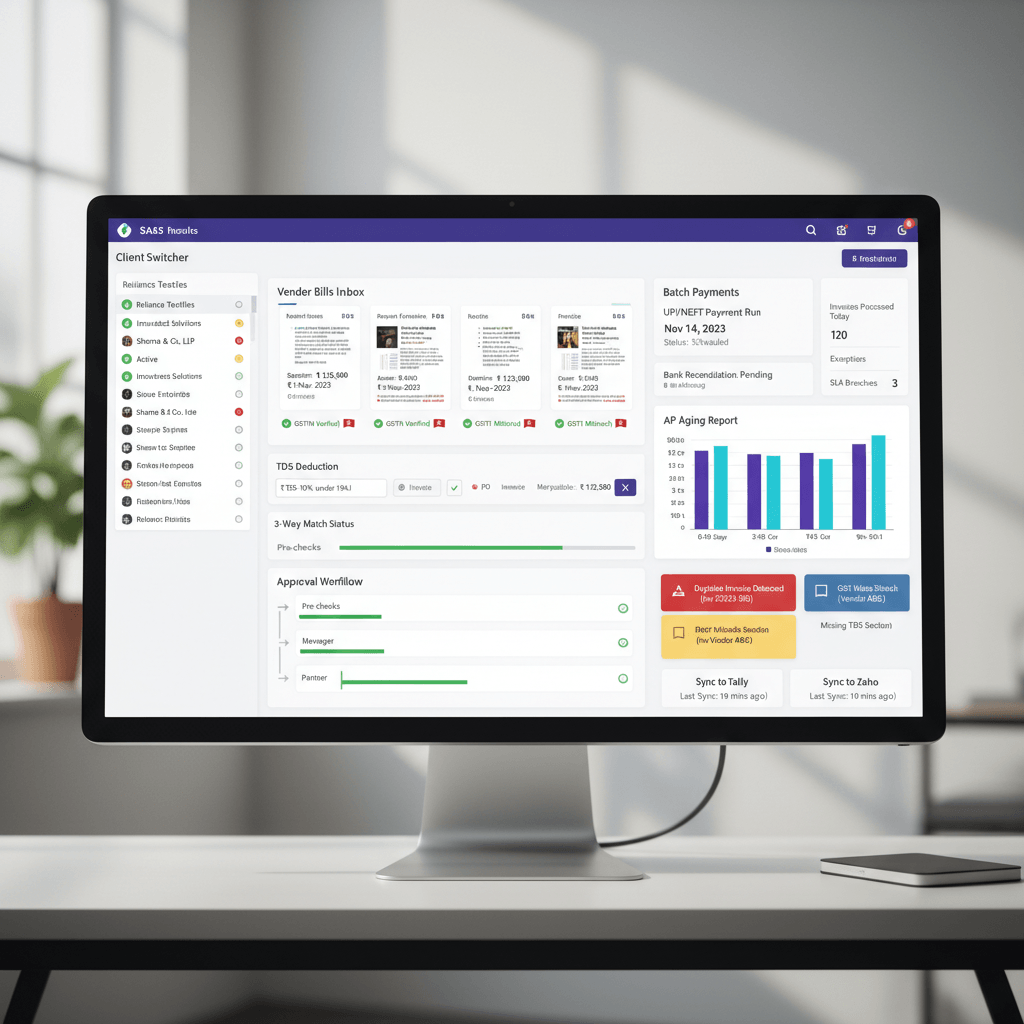
- Intelligent intake across PDFs, images, Excel, and WhatsApp forwards, with AI extraction of GSTIN, invoice meta, tax splits, and line items.
- Validation gates for GSTIN, address matches, duplicate detection across all clients, and automated TDS section suggestions.
- Configurable approval flows per client, with two level or department wise routing, and a single review queue for your team, on web and mobile.
- Accounting sync that respects each client’s ledgers and tax logic, using Integration with Tally and Zoho Books, including attachment carryover.
- Compliance as a first class citizen, proactive MSME due date tracking, IRN validation where applicable, and GSTR 2B reconciliation status at scale.
Automation shifts your team from data entry to exception handling, from end of month rescue missions to real time control.
Building your CA firm AP scalability framework
Standardization with flexibility
Set clear intake channels with dedicated email addresses per client, shared folder naming conventions, and business WhatsApp that forwards to a central inbox. Build template libraries for common bills, and define crisp SOPs for exception overrides with audit friendly notes. The goal is consistency without forcing clients to abandon workable habits.
Technology stack that fits India
- AI Accountant, multi org AP built for CA firms, bulk bill capture, vendor validations, GST reconciliation, and direct sync to Tally and Zoho Books.
- CashFlo, comprehensive AP with strong GST compliance and AI OCR.
- Volopay, bill processing plus payment execution for end to end visibility.
- Clear AP, compliance heavy workflows with multi level approvals.
- Zoho Books, native AP automation if you already run on Zoho.
- RazorpayX, vendor management, approvals, and payouts with bookkeeping connectors.
Choose platforms that treat Indian requirements as native, not an afterthought, including TDS rules, GSTR 2B matching, and MSME timelines.
Step by step process to manage vendor bills for 50 clients
Step 1, centralized intake
Define primary and fallback submission methods per client, route all invoices into labeled folders, and enforce simple naming like ClientCode_Vendor_InvoiceNo_Date. Share a short checklist for complete and legible documents.
Small refinement, massive downstream clarity.
Step 2, bulk ingestion and extraction
Upload mixed format batches, let OCR capture fields at scale, and use standardized Excel import templates with row level error flags so a single bad line does not stall an entire batch.
Step 3, validation gates
Run automatic checks for GSTIN against master data and government records, address matches to protect ITC, cross client duplicate detection, and TDS suggestions based on vendor nature and service type. Allow justified overrides with notes.
Step 4, review queue management
Route exceptions by complexity and role, enable side by side document and data views, and use bulk edits where common corrections apply. Keep comments attached for audit trails.
Step 5, posting to books
Sync approved invoices straight to Tally or Zoho Books with correct ledgers, taxes, cost centers, and attachments intact. Respect client specific chart of accounts and custom fields.
Step 6, payment linking
Auto match bank entries to open bills using amount and date proximity, handle partials and advances, and allocate split payments cleanly.
Step 7, month end reconciliation
Run GSTR 2B matches per client, surface reasons for mismatches, and export audit ready packs with aging, vendor summaries, and tax working papers.
Step 8, multi client visibility
Use firm wide dashboards to see due dates, cash needs, and exception hotspots across clients, then drill down to vendor or category for advisory insights.
India specific compliance considerations
GST input tax credit management
ITC depends on clean vendor masters and exact matches in GSTR 2B, so build real time validations into intake rather than discovering gaps during returns. For clients above the e invoice threshold, verify IRN to keep the chain compliant.
TDS calculation complexity
Professional services go to 194J, contractors to 194C, rent to 194I, and bases often exclude GST. Maintain vendor wise TDS profiles, auto suggest sections, and track cumulative thresholds. Use a repeatable engine rather than ad hoc calculations, for example through TDS rules built into your AP system.
MSME payment tracking
Flag MSME vendors, track the 45 day clock, trigger alerts at 30, 40, and 44 days, and store written agreements for extended terms. Month end views should identify at risk expenses for 43B(h) adjustments before returns are due.
ROI metrics, making the business case
Time savings
Manual processing takes five to seven minutes per invoice, at 2,500 invoices that is 208 to 291 hours per month. Automation brings this under two minutes, a 60 to 70% cut. Month end closure drops about 40% through continuous validations.
Error reduction
Data entry error rates of 3 to 5% turn into dozens of monthly fixes, while automated extraction plus validations delivers 99%+ accuracy. Cleaner posts reduce GSTR 2B mismatches and increase ITC realization.
Staff productivity
Shift senior staff from routine checks to advisory, vendor negotiations, and cash planning. Satisfaction rises when work is analytical, not clerical.
Client value delivery
Close by the fifth not the fifteenth, provide real time payables views, and maintain clean audit trails year round.
Implementation roadmap, four weeks from pilot to scale
Week 1, foundation
Select 5 to 10 pilots across complexity types, audit vendor masters, validate GSTINs, de duplicate, and map SOPs and success metrics.
Week 2, configuration
Stand up intake channels, load three to six months of historicals for pattern learning, set validation rules, and configure approvals with escalations.
Week 3, team training
Train on review queues and bulk edits, run a mock month end, create quick reference guides, and document edge case playbooks.
Week 4, go live
Process current month invoices first, monitor accuracy and throughput, push to books, run the first GSTR 2B match, then refine rules. Scale remaining clients in batches over the next eight weeks.
Visible wins build momentum, publish time saved and exception rates weekly to keep partners and staff invested.
Common concerns and practical solutions
What if OCR misses something important
Modern OCR is highly accurate on structured fields, and low confidence extractions are routed to human review. More importantly, validation gates catch mismatches before posting, so errors do not reach the books.
How do we protect client data
Choose vendors that hold ISO 27001 and SOC 2 Type II certifications, use encryption at rest and in transit, enforce role based access, and maintain exhaustive audit logs and backups.
Will the team resist change
Lead with personal benefits, less drudgery and more analysis, train hands on, appoint internal champions, and phase the rollout so confidence grows with results.
What about unusual invoice formats
Design for the 95% that follow patterns, keep a documented manual path for edge cases with approvals, and continuously train the system on new layouts.
Beyond cost savings, strategic value for CA firms
From compliance to advisory
Spend analytics, vendor term optimizations, and payment prioritization become routine deliverables when data is clean and timely. Clients feel the difference.
Scalability without proportional hiring
The same infrastructure handles more clients with marginal effort, enabling profitable growth in smaller accounts and better margins in larger ones.
Data driven client insights
Benchmarks across your portfolio highlight outliers and risks, while anomaly detection flags fraud signals and looming cash gaps early.
Getting started, your next steps
Assess your baseline honestly, define success metrics, select an automation platform that fits India first needs, pilot with 10 to 20% of clients, and communicate results early and often. If you want a ready made stack for CAs, evaluate AI Accountant with sample data from two or three contrasting clients.
The path forward
Managing payables for 50+ clients does not require weekend marathons. The tools exist, they understand India specific compliance, and they plug into Tally and Zoho Books. The only question is how quickly you turn that capability into capacity. Start with a small pilot, prove the time savings, and scale with confidence.
You did not become a CA to be a data entry expert, you became one to guide businesses. AP automation gives you back the time and energy to do exactly that.
FAQ
How can a CA firm centralize invoice intake without forcing every client to change their habits
Set up dedicated email addresses per client as the primary route, mirror these with shared Drive folders for uploads, and use a business WhatsApp that forwards to the inbox. The AP system should monitor these channels, auto sort by client, and reject incomplete files with a checklist. Tools like AI Accountant support multi channel capture so clients continue with minimal friction while your team gets standardization.
What is the best way to validate GSTINs at scale and avoid ITC reversals
Build validation into ingestion, not month end. As invoices arrive, auto check the GSTIN against official records and your vendor master, flag mismatches immediately, and pause posting until corrected. Use a workflow modeled on GSTIN validation in AP workflow, then lock ITC eligibility only after a successful 2B match.
How do we automate TDS selection across 194C, 194J, and 194I without misclassification
Maintain vendor profiles with nature of services, PAN status, and MSME flags, then let the AP engine auto suggest sections and rates while excluding GST from the base where applicable. For example, TDS logic in AI enabled tools like AI Accountant applies correct sections by vendor type, tracks cumulative thresholds, and allows authorized overrides with notes.
How can we ensure IRN verification for e invoices without adding more steps
Use API based checks during validation, if the client is within e invoice ambit, the system should verify IRN and QR metadata when the bill is ingested, not after posting. Failed checks route to exceptions so accountants focus only on outliers.
What is the most reliable way to track MSME 45 day limits across many clients
Flag MSME vendors in the master, start a timer on invoice acceptance, and trigger alerts at defined intervals, for example 30, 40, and 44 days. At month end, surface at risk items for 43B(h) adjustments. Platforms like AI Accountant maintain documentation of agreed payment terms to defend deductions.
How do we post to Tally or Zoho Books without breaking each client’s custom ledgers and tax logic
Use bidirectional master sync, pull ledger names, tax groups, and cost centers first, then push approved invoices with mapped ledgers and tax treatments. Attach the invoice PDF to the entry, and preserve custom fields. A tested connector, such as the Integration with Tally approach, keeps the books clean and audit ready.
What throughput improvements should partners expect in the first month
For 2,500 monthly invoices, expect a 40 to 50% reduction in processing time within four weeks if you enforce centralized intake and validation gates. As templates and vendor profiles stabilize, hitting 60 to 70% time savings by month three is realistic, with error rates dropping below 1%.
How do we handle exceptions like foreign currency invoices or bills without GSTINs
Create a documented exception path, for example manual review plus finance approval with justification notes, then train the system on these cases over time. The goal is not zero manual work, it is to keep exceptions under 5% while the main flow runs touchless.
What change management steps reduce resistance in a CA team
Start with a pilot team that is tech friendly, show quick wins in saved hours, celebrate those wins, and provide hands on training with clear SOPs. Rotate champions into other teams and phase rollout by client batches. Tools like AI Accountant make the learning curve gentler with familiar accounting mappings.
Is cloud security good enough for sensitive client invoices and vendor data
Yes, provided you choose vendors with ISO 27001 and SOC 2 Type II certifications, granular role based access, encryption in transit and at rest, and full audit logs. These controls typically exceed what small on premise setups can sustain, and they simplify statutory audit evidence.
How do we quantify ROI for partners who demand numbers before approval
Track three metrics, average minutes per invoice, number of validation exceptions, and days to month end close. Baseline them for two cycles, then re measure after pilot. Most firms see 60%+ time savings, 90% fewer data entry errors, and a closure reduction of four to six days by month three. Add soft gains such as fewer client escalations and smoother audits.
Can we start with only five clients and expand later without rework
Absolutely, design your templates, SOPs, and validation rules during a small pilot, then clone them for new clients with minor tweaks. Systems such as AI Accountant support multi org setups, so you manage all clients from one login while preserving client specific logic.