-01%201.svg)
Key takeaways
- Architecture firms juggling hundreds of vendor bills monthly need a digital workflow that captures GST, TDS, project codes, and cost codes without manual chaos or compliance risk.
- AI powered OCR tuned for Indian invoice formats, including handwritten site bills, can achieve over 90% first pass accuracy, cutting processing time by up to 80% and errors to under 1%.
- Smart approval thresholds, escalation rules, and one click sync to Tally eliminate re typing and keep bills moving even when partners travel or project managers are on site.
- Real time dashboards with aging analysis, vendor scorecards, and project profitability views give finance teams and CAs the clarity they need to act, not just report.
- Firms that delay digitization face compounding penalties: blocked ITC, TDS interest, duplicate payouts, and AP aging that strains vendor relationships and cash flow.
- Tools like AI Accountant's vendor bill matching help architecture firms operationalize India specific GST and TDS compliance at scale, from extraction to Tally posting.
Digital Vendor Bill Management for Architecture Firms: What's New in 2026
The gap between firms still running manual AP and those using AI has widened sharply. In 2025, most mid size architecture practices relied on email trails and spreadsheet trackers for bill processing. By early 2026, AI powered invoice tools report over 90% first pass extraction accuracy on diverse formats, up from roughly 70 to 75% just a year ago. That jump means fewer bills need manual correction, and cycle times have dropped by 50% or more in documented cases across construction and architecture analogs.
On the compliance front, the GST portal continues tightening e-invoicing requirements, and GSTR 2B reconciliation tolerances are narrower. Firms above the applicable turnover threshold now face auto populated returns that leave little room for data mismatches. If your vendor master has stale GSTINs or inconsistent names, you will see ITC blocked at filing time, not months later during audit. The cost of inaction is concrete: interest at 18% per annum on wrongly claimed ITC, plus penalties under CBIC circulars for non compliance.
Who does this hit hardest? Architecture firms processing 200 or more vendor bills monthly with mixed formats (PDFs from consultants, handwritten site receipts, Excel from material suppliers). If your team still keys GST data manually into Tally, every bill is a compliance lottery ticket. Here is what to do now:
- Audit your vendor master for PAN, GSTIN, and bank detail accuracy before the next filing cycle.
- Pilot AI extraction on your highest volume project to benchmark first pass yield and cycle time.
- Configure threshold based approvals so bills under ₹10,000 route straight to finance, freeing partners from low value sign offs.
Firms adopting automated bookkeeping workflows are seeing AP aging align to negotiated terms within the first quarter, while GST filings stabilize without last minute scrambles.
Why vendor bill volume hits architecture firms differently
Architecture firms handle a sprawling vendor ecosystem: consultants, material suppliers, site contractors, SaaS subscriptions, travel vendors, printers, and model makers. Bill flow is irregular. It spikes around milestones, pours during site work, and clusters near month end.
Each format varies. GST rates and TDS sections differ. A single mismatch risks Input Tax Credit and invites notices. What worked at fifty bills collapses at five hundred. Excel threads break, WhatsApp trails vanish, and signatures become bottlenecks.
Recent case studies from construction firms with similar vendor ecosystems confirm that AI scaled smoothly for variable invoice volumes without degradation, handling spikes that would overwhelm manual teams. The lesson is clear: architecture AP needs systems designed for irregular, multi format, high compliance workloads.
Irregular volume and fragmented formats are not just messy, they are a compliance risk. GST and TDS accuracy depends on consistent documentation and review at every stage.
What good bill documentation means
Good vendor documentation is a complete packet, not only the invoice.
- System generated invoice, linked to a Purchase Order or Work Order with agreed scope and rates.
- Evidence of completion: delivery notes, site measurement sheets, or consultant timesheets.
- Accurate GST data: GSTIN, place of supply, HSN or SAC, tax breakup. Matching GSTR 2B on the GST portal matters for ITC.
- Clear TDS mapping: Section 194C for contractors, 194J for professional services, 194I for rent.
- Project and cost codes for visibility into profitability and budget control.
- Payment terms and mode (bank transfer, UPI, or cheque) stated upfront.
- Approval trail: who verified quantity, who validated GST, who gave final approval.
The current reality versus a digital workflow
Most firms still run on Word or email POs, WhatsApp invoices, printed packets, and manual Tally entry. Approvals stall when principals travel. Documents go missing. GST codes get keyed wrong. TDS is calculated at the last minute. Vendors keep calling for status. Finance scrambles at filing deadlines.
Industry research shows that manual accounting processes consume up to 40% of AP team capacity on tasks that AI can handle, like data extraction, vendor matching, and ledger coding. That is time your finance team could spend on analysis and vendor negotiation.
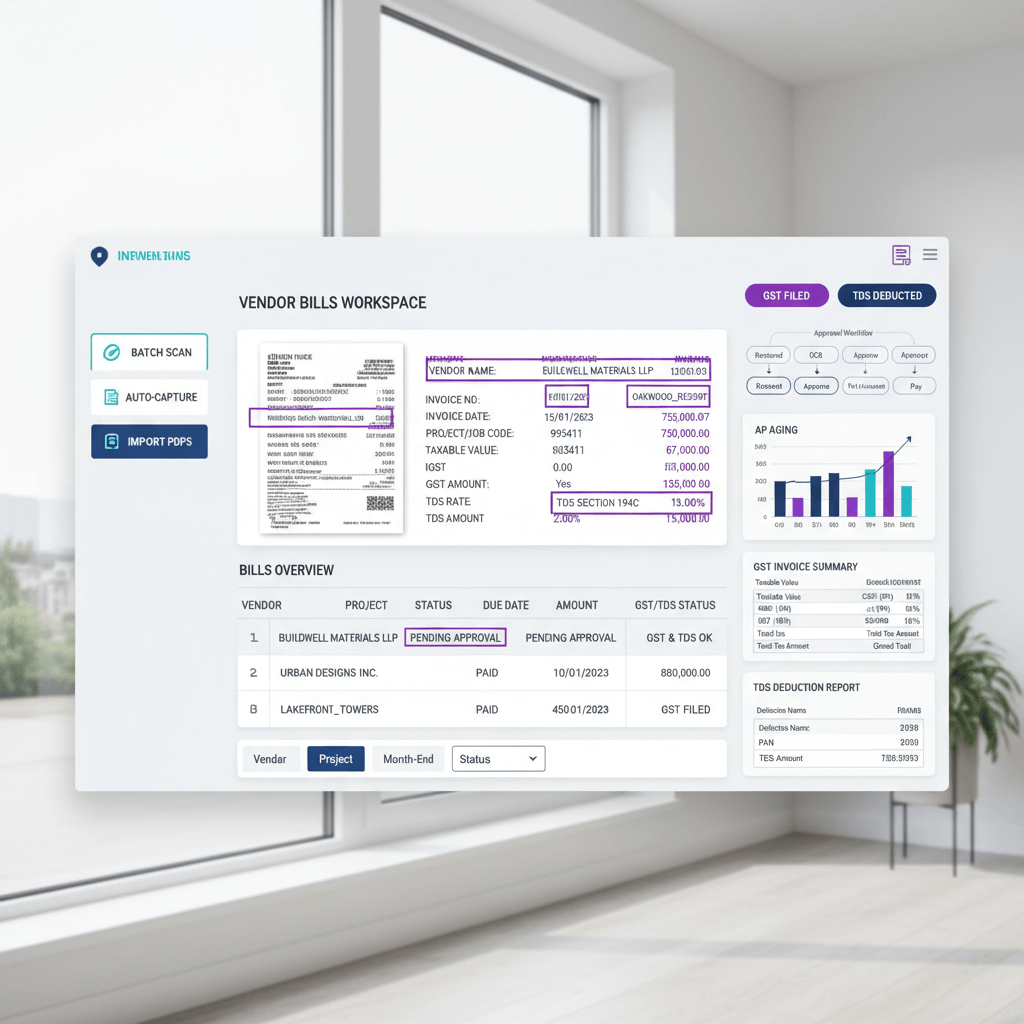
Shift to a digital intake and workflow. Every bill enters one system. OCR and AI extract data automatically. The Project Manager validates completion and tagging. Finance checks GST and TDS. Partners approve by thresholds. Approved bills sync to Tally without re typing.
Documents stay linked, searchable, and audit ready. Payment schedules follow due dates. Vendor visibility improves, and your team stops fielding "where is my payment?" calls.
Critical challenges when volume scales
- Format fragmentation: PDFs, images of handwritten bills, Excel sheets, and subscription emails all require different handling. Multi format OCR with AI learning addresses this, but setup matters.
- Duplicates and partial payments create confusion and risk double payouts. Multi parameter matching (vendor, invoice number, amount, date, plus image hashing) catches these before posting.
- GST complexity grows: wrong GSTINs, name mismatches, address variations, and potential ITC loss. Real time GSTIN validation against government data is no longer optional.
- Multi project allocations turn tedious. Splitting line items across projects and cost codes invites errors without locked dropdowns and auto coded fields.
- Approval delays multiply with busy project managers and traveling partners. Threshold based auto routing and time bound escalations keep throughput high.
- Reconciliation pain increases. Bank transfers without clear tags and ledger mismatches cost hours every month.
Building your digital vendor bill management system
Centralize your intake channels
- Create a dedicated AP email and auto forward to your bill management system.
- Scan physical bills immediately at reception. Store the digital copy, not the paper.
- Enable mobile uploads for site supervisors with project tagging at source.
- Support bulk ingestion during month end rushes to avoid processing queues.
- Enforce file naming discipline: VendorID_ProjectCode_InvoiceNo_YYYYMMDD for faster retrieval.
Standardize data extraction and validation
- Use OCR tuned to Indian formats. Read invoice numbers, dates, GSTIN, tax breakup, and totals from PDFs, scans, and even handwritten receipts.
- Validate GSTIN checksum and match with government data. Flag mismatches early, before the bill reaches approval.
- Detect duplicates by vendor, invoice number, amount, and date before posting. Image hashing adds another layer for bills uploaded from multiple channels.
- Check PO linkage and tolerance. Validate scope and rates against the original order.
- Standardize vendor master: PAN, bank account, and name consistency across all bills.
- Use fuzzy matching to resolve vendor name inconsistencies, especially for site contractors who invoice under slightly different names.
Implement smart classification and tagging
- Mandatory project codes for every bill. Use a simple and memorable taxonomy with locked dropdowns, not free text.
- Cost codes by category: design fees, structural consultation, electrical materials, site labour.
- Track retention and advance amounts distinctly to avoid confusion in payments.
- Specify payment mode and terms at upload.
- Mark GST applicability and any Reverse Charge Mechanism implications.
- Auto suggest TDS section: 194J for professionals, 194C for contractors, 194I for rent.
Design your approval workflow
- Upload with supporting documents and notes by the project team.
- Review within twenty four hours. Validate work completion and tagging.
- Finance approval within twenty four hours. Confirm GST, TDS, and ledger mapping.
- Auto sync to accounting after approval. No manual re typing of vendor invoices.
- Threshold rules: small bills (under ₹10,000) skip to finance, mid range needs project manager plus finance, large bills (above ₹1,00,000) need partner sign off, retention releases need special authorization.
- Escalations and reminders at forty eight and seventy two hours keep items moving when people are busy.
Ensure seamless accounting integration
- One click posting to Tally with vendor, ledger, GST, TDS, and project codes intact.
- Prepare for GSTR 2B matching. Flag mismatches proactively before filing deadlines.
- Automate TDS computation, challans, and certificate tracking per Income Tax Department guidelines.
- Reverse sync payment status back to the bill system for vendor visibility.
Build comprehensive dashboards
- Aging analysis by vendor, project, and amount for cash flow prioritization.
- Days Payable Outstanding by vendor category for adherence to terms.
- Month wise payment trends to catch cash flow stress early.
- Critical bills surface automatically: large pending approvals, near due dates, disputed invoices.
- Vendor scorecards for documentation quality, compliance reliability, and on time submission rates.
Create robust storage and audit trails
- Versioned documents with timestamps and change reasons.
- Immutable logs of who did what and when, including comments and approval decisions.
- Lightning fast search by vendor, invoice number, project, amount, GSTIN, or date range.
- Retention aligned with statutes. GST documents kept for seven years as required under CBIC regulations and archived appropriately.
Essential tools for digital vendor management
- AI Accountant, purpose built for Indian SMBs and CA firms, reads multiple formats including handwritten bills, supports bulk uploads, and offers four stage workflow automation. With OCR trained on Indian bank formats and one click Tally sync, it fits architecture firms managing complex GST and TDS.
- Tally Prime, the compliance gold standard in India, needs add ons or manual processes for high volume AP automation.
- Zoho Books, strong for accounting and GST compliance, limited bill workflow automation compared to specialized tools.
- QuickBooks Online, good for smaller firms with international work, basic bill features, limited Indian GST and TDS depth.
- Xero, cloud native with integrations, Indian localization still evolving.
- FreshBooks, simple for small teams, not ideal for multi project allocations and Indian compliance.
Implementing your digital workflow, practical steps
- Start by consolidating your vendor master database. Collect PAN, GSTIN, TDS category, and payment terms. Deduplicate and standardize naming.
- Define your project and cost code taxonomy. Simple enough to remember, detailed enough to analyze. Then train everyone.
- Establish clear intake channels. Route bills only to the AP email. Enable scanners and mobile uploads. Stop WhatsApp submissions.
- Configure an approval matrix by amount thresholds and bill types. Encode rules into your automated system.
- Create a comprehensive bill documentation checklist. Enforce mandatory fields and supporting attachments. Reject incomplete packets.
- Run a pilot on one high volume project for two to four weeks. Measure cycle time, error rate, and user feedback. Refine before expanding.
- Connect accounting carefully. Test sync mappings for vendor, ledger, GST, TDS, and project fields. Confirm posting accuracy. Set up error logs and retry mechanisms.
- Train for intent. Explain why each step matters for compliance and efficiency. Document common scenarios and exceptions.
- Monitor performance from day one: cycle time per bill, first pass yield, duplicate detection rate, and manual intervention frequency.
- Review monthly with finance, project managers, and your CA. Iterate continuously based on dashboard data.
Measuring success, key metrics
- Cycle time per bill, receipt to posting. Aim for a fifty percent reduction within three months.
- First pass yield: percent of bills processed without rework. Target over 90% with mature AI extraction.
- Posting speed: percent posted within forty eight hours. Improves vendor satisfaction and reduces payment inquiry calls.
- PO matching rate: reveals procurement discipline upstream.
- GST and TDS error rate: fewer corrections mean stronger compliance and lower penalty risk.
- Duplicate detection effectiveness: catching even one duplicate pays for the system many times over.
- AP aging improvement: bring DPO in line with agreed vendor terms.
- Automation percentage: target at least seventy five percent auto population of fields. Leading tools now approach 90% on structured formats.
Common pitfalls and how to avoid them
- Missing GST details: solve with vendor onboarding checklists and instant GSTIN validation against government data. Reject invalid data early, before it enters your workflow.
- Handwritten site bills: solve with mobile capture. Attach measurement sheets. Use OCR to extract what it can, then complete gaps in finance. Maintain the original image in the audit trail.
- Duplicate uploads: solve with system checks across vendor, invoice number, amount, and date, plus image hashing for bills arriving from WhatsApp and email simultaneously.
- Inconsistent project tagging: solve with locked taxonomy and dropdowns, not free text fields.
- Approval bottlenecks: solve with amount based auto approvals, time bound reminders at forty eight hours, and escalation at seventy two hours.
- Integration failures: solve with pre go live testing, error logs, and reliable retry mechanisms. Test every field mapping before going live.
- Change resistance: solve with early adopters, quick wins on one pilot project, and clear communication of benefits.
Real world impact, a case study
A mid size architecture firm processed three thousand vendor bills yearly. Manual Tally entry, email approvals, and WhatsApp coordination led to GST corrections at month end, rushed TDS calculations, and AP aging beyond seventy five days. Project profitability surfaced only at year end.
After adopting AI Accountant, bill cycle time dropped by fifty percent. Manual classification reduced by seventy five percent through automation. AP aging aligned to negotiated terms. Vendor payments became predictable. GST filings stabilized without last minute scrambles.
Most importantly, real time project profitability enabled faster corrective decisions. Similar results have been documented in 2025 across mid size construction firms using AI powered invoice processing, with teams reporting error elimination on structured formats and smooth scaling during milestone driven billing spikes.
The path forward
Digital vendor bill management is not about fancy tools alone. It is about process clarity, compliance discipline, and consistent adoption. Define standards for documentation and approvals. Choose tools that understand Indian GST and TDS. Roll out gradually. Measure relentlessly. Keep refining.
Your goal is simple: free your team from mundane data entry, improve cash flow visibility, strengthen vendor relationships, and make better project decisions faster. The firms that master this today will operate leaner and scale easier tomorrow.
FAQ
How should a CA set up TDS section 194J for consultant invoices in AI Accountant, then push to Tally Prime without double entry?
Configure the vendor category as professional services in AI Accountant, map the TDS section to 194J with the applicable rate and threshold, and validate PAN and GSTIN during upload. On sync, TDS ledger mapping and the 194J deduction carry into Tally Prime automatically. The payment entry in Tally updates the bill status back in AI Accountant, ensuring no duplicate work.
What is the recommended three way match for architecture POs, GRNs, and invoices, and where does AI Accountant fit?
Use the PO as the commercial baseline, a site measurement or delivery note as receipt proof, and the vendor invoice as the financial document. AI Accountant binds these in one packet, validates rates against the PO, checks quantity variance tolerances, and flags exceptions before finance approval. Approved entries sync cleanly to Tally.
How do I ensure correct GST place of supply for inter state consultant invoices, so GSTR 2B matching and ITC remain intact?
Capture the project location and the consultant's registration state in the vendor master, then validate the place of supply at upload. AI Accountant enforces GSTIN checksum, compares invoice state codes to the project entity, and flags mismatches before approval. This reduces ITC loss and reconciliation headaches during GSTR 2B review.
What workflow thresholds should I configure, for example auto approve bills under ₹10,000 and escalate above ₹1,00,000?
Set three tiers: low value (under ₹10,000) auto routes to finance for compliance checks, mid value requires project manager review plus finance approval, and high value (above ₹1,00,000) needs partner approval. AI Accountant supports amount based rules, time bound reminders at forty eight hours, and escalation at seventy two hours to keep throughput high.
Can AI reliably process handwritten site bills from contractors?
Yes, modern OCR tuned for Indian formats can extract key fields from handwritten bills, though accuracy depends on legibility. Best practice is to capture the image via mobile, attach measurement sheets as supporting evidence, and let AI extract what it can. Finance completes any gaps, and the original image stays in the audit trail for compliance. (2026 update)
How can a CA audit approvals quickly during scrutiny, without digging through email trails?
Use immutable digital logs that record who uploaded, reviewed, and approved each bill, with timestamps and comments. Search by vendor, invoice number, or amount and retrieve the full packet in seconds. This replaces the need to reconstruct approval chains from scattered emails during any GST or income tax scrutiny.
What KPIs should a CA track weekly to prove AP digitization ROI for an architecture firm?
Track cycle time per bill, first pass yield (target over 90%), percent posted within forty eight hours, GST or TDS correction rate, duplicate detection count, and automation percentage (target 75% or higher). These KPIs surface in real time dashboards, letting you intervene quickly and document ROI for the firm. (2026 update)

Rohan Sinha is a fintech and growth leader building aiaccountant.com, focused on simplifying accounting and compliance for Indian businesses through automation. An IIT BHU alumnus, he brings hands-on experience across 0 to 1 product building, growth, and strategy in B2B SaaS and fintech.