-01%201.svg)
Key takeaways
- Echo Mission is a capable automation tool, but Indian CA firms and SMEs should evaluate depth of Tally and Zoho Books integrations, GST workflows, and multi-organization performance before shortlisting.
- For India-first needs like GSTR-2B matching at scale, transaction intelligence that learns per client, and high-volume bank statement processing, AI Accountant often proves more reliable.
- Pricing clarity matters, assess total cost of ownership including document volumes, bank lines, GST modules, and seasonal spikes, not just per-user fees.
- Always run a 2-4 week proof of concept on real data, validate OCR accuracy on Indian invoices, error handling, and reconciliation speed under load.
- Security and compliance are non-negotiable, confirm ISO 27001, SOC-2 Type II, India data residency, and granular access controls.
Understanding Echo Mission: A Quick Overview
Echo Mission positions itself as an AI-powered accounting automation platform, designed to reduce manual work in AP, bank reconciliation, and ledger mapping. Firms in India typically use it for automating accounts payable, transaction matching, and connecting with ERPs like Tally or Zoho Books.
The pitch is compelling, free your team from data entry so they focus on analysis and advisory. In practice, execution quality, integration depth, and India-specific capabilities determine whether the promised time savings show up on your month-end calendar.
Pro tip: Vendor capabilities evolve quickly, confirm features and certifications directly with each provider before you decide.
If you are comparing head-to-head, read this dedicated analysis: echo mission vs ai accountant for a nuanced, India-first view.
Essential Checklist for Evaluating Echo Mission Alternatives
Use this India-specific framework to test any echo mission alternative india on real workflows, not slideware.
Integration depth
Go beyond basic connectors, verify full masters sync with Zoho Books and Tally, bi-directional data flow, and robust error handling. Superficial integrations create reconciliation drift and rework.
AP and bills automation
Test OCR accuracy on Indian invoices and e-invoices, validate bulk Excel imports against formats your vendors actually send, and confirm GSTIN validation plus vendor mismatch detection.
Bank statement processing
Check normalization across Indian banks, performance on 50,000+ lines, and duplicate, split, and transfer recognition. For context, see this bank statement OCR tool guide to frame your tests.
Transaction mapping intelligence
Look for AI that learns from your ledger patterns, handles payment-to-bill linking, split entries, and bulk edits without breaking your audit trail.
GST reconciliation capabilities
GSTR-2B matching is essential, evaluate status tracking, credit notes, and bulk reconciliation speed. A helpful primer is this GSTR-2B reconciliation tools overview.
Multi-organization support
CA firms need quick client switching, role-based access, and per-org learning. If you manage dozens of entities, treat this as a top-tier requirement.
Dashboards and reporting
Confirm real-time visibility into payables, receivables, cash position, and working capital, not just static month-end reports.
Security and compliance
Insist on ISO 27001, SOC-2 Type II, least-privilege access, and India data residency. Request documentation and test MFA and audit logs.
Support and onboarding
Expect India business hours support, clear SLAs, and a 2-4 week proof of concept that demonstrates measurable time savings.
Pricing structure
Model for 5,000 bills and 50,000 bank lines monthly, include seasonal spikes, GST modules, and OCR overages to understand true cost.
Echo Mission vs AI Accountant: Feature-by-Feature Analysis
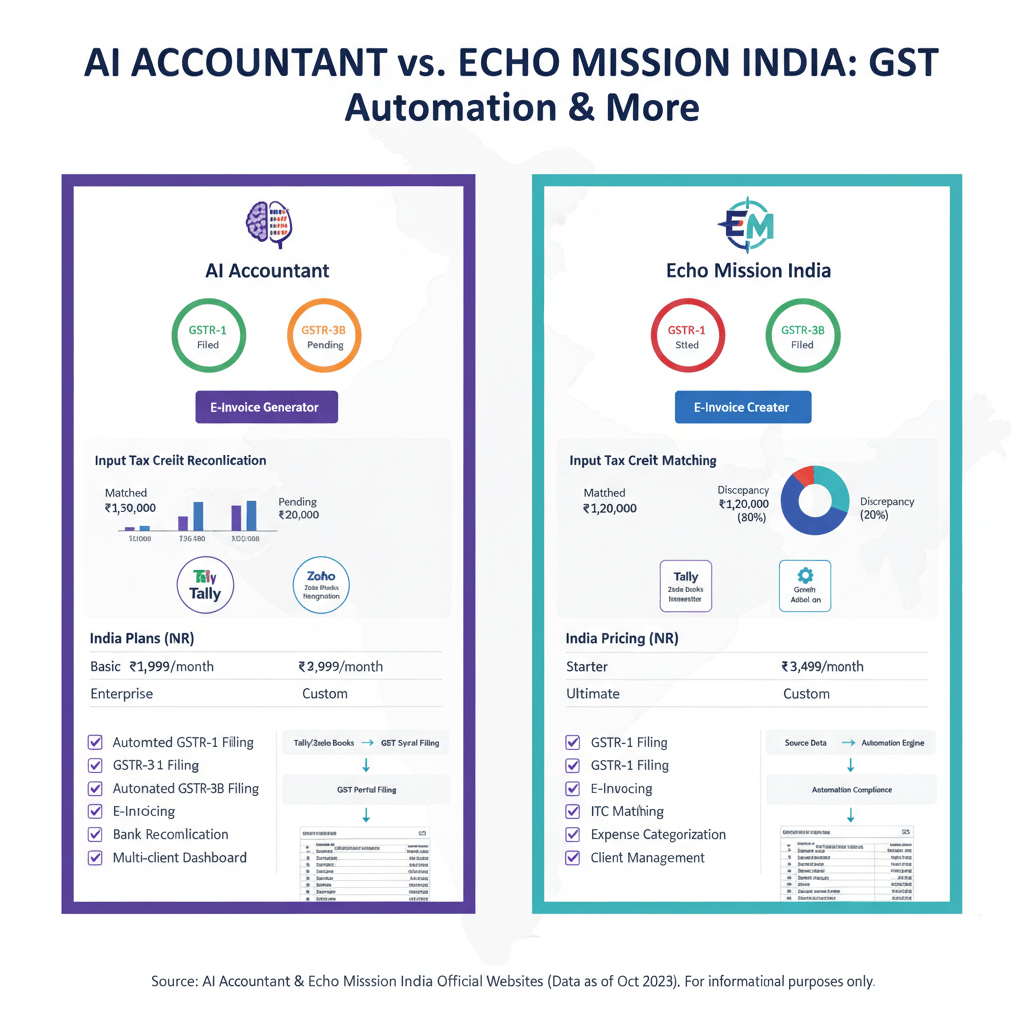
For a deeper comparison, see the full breakdown: echo mission vs ai accountant. Below is a practical summary grounded in Indian use cases.
AP and bills processing
Echo Mission: Standard OCR, accuracy varies on complex Indian invoice formats.
AI Accountant: High-accuracy OCR tuned for Indian layouts, bulk Excel imports that match real vendor templates, proactive GSTIN mismatch detection.
Bank statement handling
Echo Mission: Adequate for basic volumes.
AI Accountant: Normalizes multi-bank formats at scale, stable beyond 50,000 lines per month, smooth performance during peak closings.
Transaction intelligence
Echo Mission: Basic ledger linking.
AI Accountant: Context-aware predictions, clean split handling, fast bulk fixes, strong exception queues.
Zoho Books and Tally integration
Echo Mission: Connectivity present, depth varies by setup.
AI Accountant: Deep masters sync, bi-directional flow, graceful failures, and clear retry mechanisms.
GST reconciliation
Echo Mission: Covers standard workflows.
AI Accountant: Scales GSTR-2B matching, robust status tracking, credit note handling, and auditability.
Multi-organization management
Echo Mission: Limited information publicly available.
AI Accountant: Built for CA firms, per-org learning, bulk client onboarding, widely adopted by 100+ CA firms.
Security
Echo Mission: Verify certifications directly.
AI Accountant: ISO 27001 and SOC-2 Type II, bank-grade encryption, India data residency.
Echo Mission Pricing India: What to Expect
Pricing varies by vendor and volume, but you can triangulate realistic budgets with a few benchmarks.
Common pricing models
SMB tools run per-user, AI-native platforms often use volume tiers, and enterprise solutions offer custom quotes. Expect add-ons for advanced OCR and GST modules.
Total cost considerations
For 5,000 bills and 50,000 bank lines monthly across multiple orgs, budgets commonly sit between sub-$200 and low hundreds, depending on feature depth and support levels.
Hidden costs to watch
Implementation, training, internal change management, custom integrations, and the opportunity cost of delays. A time-to-value target of 2-4 weeks is reasonable.
Top Accounting Automation Tools for Indian Businesses
- AI Accountant — India-first automation, deep Zoho Books and Tally integrations, GST reconciliation, and multi-org support for CA firms.
- QuickBooks Online — Popular globally with decent India localization, may require GST supplements.
- Xero — Strong automation for services businesses, limited manufacturing depth in India.
- FreshBooks — Simple for freelancers and small teams, minimal multi-entity features.
- Sage Business Cloud — Enterprise breadth with India compliance modules, steeper learning curve.
- Wave Accounting — Free tier for micro-businesses, basic automation only.
Match tool capabilities to your specific workflow constraints, not generic feature grids.
Making the Right Choice: Decision Framework
Choose Echo Mission when
Your needs are simple, single-entity, and you can live with basic automation without deep GST or multi-org demands.
Choose AI Accountant when
You run Zoho Books or Tally at the core, reconcile GST at scale, manage many clients, and need reliable dashboards for cash and working capital. Scale history of 300M+ processed transactions offers confidence.
Quick assessment questions
- High monthly GST volume? Favor AI Accountant.
- CA firm with 20+ clients? Multi-org features become decisive.
- Only basic AP automation needed? Echo Mission might suffice.
- Budget constraints under $200 monthly? Pilot both on real data.
Migration Path: Moving from Echo Mission or Spreadsheets
Week 1: Preparation
Collect recent bills, bank statements, purchase registers, and GSTR-2B files, document pain points and manual time.
Week 2: Setup and sync
Connect Zoho Books or Tally, align chart of accounts, configure roles, run sample flows.
Week 3: Parallel run
Process live transactions in both systems, target 50-75% manual effort reduction, track discrepancies.
Week 4: Optimize and go-live
Refine mappings, train users, finalize support routes, switch confidently.
Real-World Success Stories from India
CA firm, Mumbai: 20+ SME clients, month-end reduced by 50% using multi-org workflows and automated GST reconciliation.
Retail SME, Bangalore: GST mismatches dropped 75%, faster payments improved vendor relations and cash clarity.
Manufacturer, Pune: 10,000+ monthly transactions automated, 80% manual entry reduction, instant payables visibility.
Security and Compliance Considerations
Data encryption
End-to-end encryption, at rest and in transit, with modern cipher suites.
Certifications
ISO 27001 and SOC-2 Type II signal control maturity, request current reports.
Access controls
Role-based permissions, MFA, audit logs, and least-privilege defaults.
Data residency
Ensure Indian data remains in India, confirm backup regions and DR posture.
Backup and recovery
Automated backups, tested restores, and documented RPO/RTO objectives.
Integration Deep Dive: Zoho Books and Tally
Zoho Books
Masters sync for customers, vendors, items, and COA, bi-directional bills, payments, JEs, and conflict resolution with clear logs.
Tally
Ledger and voucher sync, multiple versions including Prime, GST-compliant structures, batch processing for volume.
Error handling
Graceful retries, exception queues, human-in-the-loop review, and searchable logs.
Advanced Features for Power Users
- Machine learning customization: Per-organization learning that adapts categorization and mapping over time.
- Workflow automation: Custom approvals, routed exceptions, and SLA-based escalations.
- API access: Data extraction, custom integrations, and specialized reporting connectors.
- Bulk operations: High-volume edits and rule-based processing that hold up during seasonal spikes.
Support and Training Considerations
Onboarding: Milestone-based, India business hours coverage, 2-4 week time-to-value.
Training: Videos, India-context documentation, and recurring advanced webinars.
Community: User forums, knowledge base, and rapid product iteration based on feedback.
Future-Proofing Your Choice
Scalability: Can it handle 10x volume without slowing down?
Innovation: Continual upgrades, better AI over time, faster reconciliations.
Stability: Vendor health, customer growth, and Indian market focus.
Flexibility: Adapts to regulatory shifts, new document types, and custom fields without breakage.
Common Pitfalls to Avoid
- Underestimating implementation and change management, allocate time for training and process tweaks.
- Accepting surface-level integrations, always test with your real data.
- Optimizing only for sticker price, measure ROI via time saved and errors avoided.
- Skipping pilots, a 2-4 week proof with real volumes is your insurance policy.
Conclusion: Your Next Steps
For most Indian CA firms and SMEs, especially those on Tally or Zoho Books, AI Accountant emerges as a strong echo mission alternative india thanks to India-first OCR, deep integrations, GST reconciliation at scale, and multi-org maturity.
Action plan:
1) Shortlist two vendors, including AI Accountant.
2) Bring real invoices, bank statements, and GSTR-2B for a 2-4 week pilot.
3) Measure effort reduction, reconciliation speed, and error rates.
4) Model total cost with seasonal spikes, then decide confidently.
The right platform transforms month-end from firefighting to foresight, freeing teams to advise on cash, working capital, and growth.
FAQ
How should a CA firm evaluate an echo mission alternative india for GSTR-2B matching at scale?
Run a pilot using last quarter’s 2B files, include credit notes and amendments, and measure match rates, exception queues, and time-to-closure. AI Accountant typically completes bulk reconciliation faster due to optimized 2B parsing and status tracking.
What depth of Tally and Zoho Books integration should I insist on before migrating?
Insist on full masters sync, bi-directional bills, payments, and journals, plus clear error logs and retry flows. AI Accountant’s integrations feel native, which reduces reconciliation drift and manual patchwork.
Can an Echo Mission alternative handle 50,000+ bank lines monthly without timeouts?
Ask for a load test on your heaviest month, include multi-bank formats, duplicates, and transfers. AI Accountant’s normalization pipeline is built for Indian bank exports, sustaining performance during peak close.
How do I compare OCR accuracy for Indian invoices objectively?
Prepare a labeled test set across GST slabs, discounts, multi-quantity lines, and round-offs, then compare field-level precision and recall. Track GSTIN capture and vendor detection, areas where AI Accountant is tuned for Indian layouts.
What pricing model works best for multi-entity CA firms with seasonal spikes?
Volume-based tiers with seasonal flexibility avoid surprise overages. AI Accountant commonly supports pilots that reveal true steady-state and peak costs before you commit.
How quickly can my team get to value, assuming we move from spreadsheets?
With a structured 4-week plan, most firms hit 50-75% manual time reduction in the first cycle. Parallel runs in Week 3 de-risk go-live, a pattern AI Accountant implements frequently.
What security proofs should I collect from any Echo Mission alternative?
Request ISO 27001 and SOC-2 Type II reports, data flow diagrams, encryption specs, and data residency details. Validate MFA, RBAC, and audit logs in a sandbox.
Will the AI learn different ledger behaviors for each client I manage?
It should. Per-organization learning prevents cross-client noise. AI Accountant separates models per entity, improving accuracy for CA firms handling diverse industries.
How do I judge dashboard usefulness for management reporting?
Dashboards must show receivables, payables, cash, and working capital in real time, with drilldowns to source documents. During pilots, test whether leadership questions can be answered in minutes, not days.
What are the red flags during a proof of concept that mean I should walk away?
Slow bank normalization on real exports, weak GSTIN validation, frequent integration failures without clear logs, and opaque pricing for OCR overages. If support cannot resolve blockers within pilot timelines, reconsider.
How do I plan change management so staff adoption does not stall?
Define roles early, run short trainings, invite super-users to shape workflows, and set measurable weekly wins. AI Accountant’s onboarding playbooks often shorten the learning curve for finance teams.
Can I maintain an audit trail while doing bulk edits and exceptions?
Yes, provided the platform preserves version history, user stamps, and reason codes. AI Accountant’s exception queues keep edits transparent, essential for statutory and internal audits.

Rohan Sinha is a fintech and growth leader building aiaccountant.com, focused on simplifying accounting and compliance for Indian businesses through automation. An IIT BHU alumnus, he brings hands-on experience across 0 to 1 product building, growth, and strategy in B2B SaaS and fintech.