-01%201.svg)
Key takeaways
- ClearTax is compliance-first, great for GST returns and e-invoicing, AI Accountant is bookkeeping-first, built to automate AP, bank ingestion, reconciliation, and sync with Zoho Books and Tally.
- AI Accountant unifies bills extraction, bank and card normalization, predictive ledger mapping, GST 2B recon, and dashboards, reducing month-end work by 70% or more.
- Teams often run AI Accountant for books automation, and keep ClearTax for GST filing during transition, this coexistence delivers quick time to value.
- Real TCO drops by 50%+ when replacing multi-tool stacks with a single platform, accuracy improves, closes speed up, audit trails strengthen.
- India-first fit matters, AI Accountant handles vendor floods, GSTIN mismatches, ambiguous bank narrations, and inter-company transfers reliably.
- Pilot in days, go live in 2 to 4 weeks, start with one or two entities, expand fast once the patterns stabilize.
TL;DR Verdict
ClearTax excels for GST return workflows and compliance stacks, it is built for tax filing first, bookkeeping second. AI Accountant dominates end-to-end bookkeeping automation, from AP extraction to bank and credit card ingestion, transaction mapping, GST 2B recon, Zoho and Tally sync, dashboards, and multi-entity management. Quick win, book a 20 minute fit check to run your own data and validate the match.
ClearTax at a Glance: Compliance-First Platform
ClearTax focuses on a GST compliance stack, including e-invoicing, vendor compliance, and analytics. It shines for return filing like GSTR-1, GSTR-3B, and GSTR-9, IMS and ITC reconciliation, and direct GSTN uploads. For daily bookkeeping however, AP posting depth is limited, bank ingestion is basic, month-end categorization is manual, native sync back to Zoho Books or Tally is not the priority. If you need to process 500 vendor bills by tomorrow, ClearTax works best as a compliance add-on, not your core books engine.
If you are researching options, explore these independent roundups, ClearTax alternatives for GST, TDS, and income tax filing, best alternative to ClearTax for GST filing, and ClearTax alternative assessments.
What is AI Accountant and Where It Fits
AI Accountant is AI powered bookkeeping automation for CA firms and finance teams in India. It handles bulk AP OCR, bank and credit card ingestion with normalization, predictive mapping and matching, bi directional sync with Zoho Books and Tally, purchase side GST 2B reconciliation, operational dashboards, and multi entity controls. India first design means it respects Zoho and Tally masters, catches GSTIN mismatches, and learns local bank narration patterns. The value is simple, cut manual work by 70%, lift accuracy near perfect, and close faster with live visibility.
ClearTax vs AI Accountant: Head-to-Head Features
AP and Bills Automation
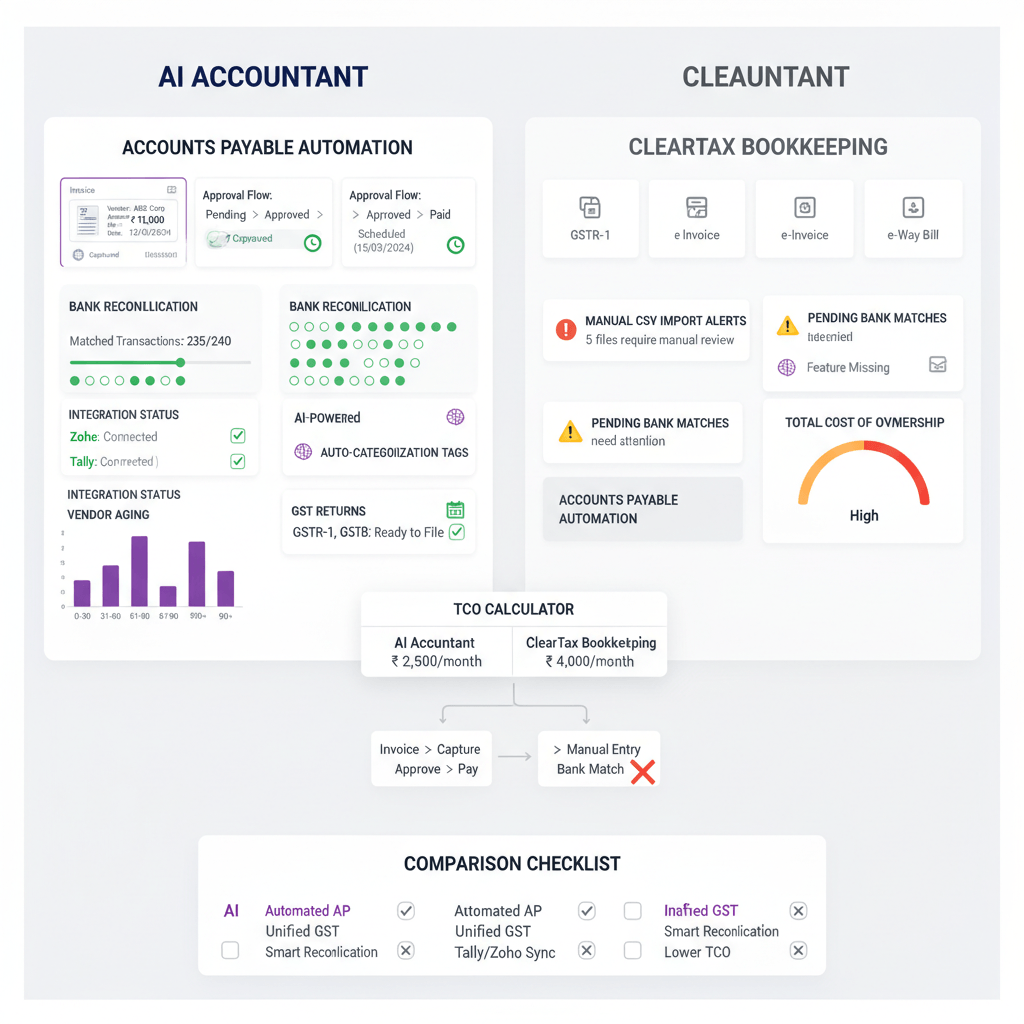
ClearTax supports vendor compliance tracking, yet bulk bill extraction, vendor mismatch handling, and validation rules remain limited for day to day posting. AI Accountant ingests hundreds of PDFs, images, and spreadsheets at once, extracts fields with OCR, flags GSTIN, name, and address mismatches, and enforces validation before posting, resulting in cleaner ledgers with fewer corrections.
Bank and Card Ingestion
ClearTax provides basic statement import, normalization and smart categorization usually stay manual. AI Accountant offers deep normalization, see bank statement parser for India, it harmonizes date formats, decodes cryptic narrations, detects splits and transfers, and learns user patterns to improve auto classification over time.
Transaction Mapping and Month-End
ClearTax emphasizes GST specific reconciliation, not holistic month-end categorization. AI Accountant delivers predictive ledger and vendor mapping for Tally and Zoho, bulk edits, and automatic bill and invoice linking, payments and receipts are matched to open documents with audit trails.
GST Handling
ClearTax leads in filing, e-way bills, and e-invoicing. AI Accountant focuses on purchase side reconciliation, explore GSTR-2B reconciliation tools overview, it ingests purchase registers, JVs, credit notes, and 2B data, then tracks reconciliation status at scale for review and resolution.
Zoho and Tally Integrations
ClearTax does not natively drive bookkeeping sync with Zoho or Tally. AI Accountant runs bi directional sync, masters flow in from your accounting system, processed documents and entries push back automatically, no duplicate entry, no fragile CSV cycles.
Dashboards
ClearTax Specta is strong on compliance analytics. AI Accountant delivers operational views, cash today, AR aging, AP due this week, working capital, category wise spend, all updating in real time as transactions are processed.
Multi-Org and Access Control
Both support multi client contexts, AI Accountant adds deeper multi entity operations, role based access, rapid entity switching, and org specific learning so each client’s books improve independently.
Security
ClearTax offers standard protections. AI Accountant brings enterprise grade security, ISO 27001, SOC 2 Type II, encryption in transit and at rest, and permission controls aligned to finance workflows.
Bottom line, if your priority is throughput and accuracy in daily books, AI Accountant replaces multiple point tools, then you can keep or simplify your compliance stack as needed.
ClearTax Specta Alternative: Beyond Basic Analytics
Teams exploring Cleartax Specta alternatives usually want more than charts, they want ingestion speed, learning categorization, risk flags, and reliable posting back to accounting systems. AI Accountant delivers bulk ingestion, ML normalization, mapping that connects transactions to the right ledgers and vendors, and seamless push to Zoho Books and Tally. Result, fewer manual tags, faster closes, and audit ready trails.
Consider 500 vendor bills per month, Specta gives analytics, AI Accountant extracts, validates, links to POs, and posts to Tally automatically. That is the difference between insight and action.
Fewer clicks, fewer errors, faster outcomes.
ClearTax Bookkeeping Alternative: Solving India-Specific Pain Points
India specific realities, vendor bill floods at month end, GSTIN mismatches, cryptic bank narrations, and inter company transfers. AI Accountant uses bulk operations and ML suggestions to auto map 90% or more of transactions, flags the rest for review, and keeps exceptions visible.
Before AI Accountant:
- 20 to 30 hours monthly on manual entry
- 5% categorization error rate
- Three day close delay
- Spreadsheet chaos for reconciliation
After AI Accountant:
- 2 to 4 hours monthly on review and exceptions
- Less than 1% errors
- Same day preliminary close
- One system for traceability
A Bangalore CA firm with 15 entities cut month-end from three days to half a day, then reinvested time into advisory mandates.
Single Platform vs Multiple GST Tools: The Real Cost Analysis
Multiple tools create hidden costs, duplicate entry across ClearTax, Tally, and bank recon add ons, import export breaks, reconciliation drift, and compounding license fees. A single platform flow, bills to posting to GST 2B recon, becomes one truth, with fewer logins and lower TCO. For more context, see roundups of ClearTax alternatives and software suggestions for ClearTax alternatives.
Scenario, three entities, 5,000 transactions monthly
- Multi tool stack, licenses about ₹1.2 lakhs yearly, manual effort about ₹1.2 lakhs, opportunity costs about ₹50,000, total about ₹2.45 lakhs.
- AI Accountant, license about ₹80,000, reduced manual effort about ₹24,000, minimal opportunity cost about ₹10,000, total about ₹1.14 lakhs.
Net, about 53% annual savings, while accuracy and speed both improve.
Proof Points for Decision Makers: Why Teams Trust AI Accountant
Processed 300 million plus transactions, trusted by 450 plus customers, and 100 plus CA firms. Growth is steady, transaction ingestion up about 30% month on month. Security is certified, ISO 27001 and SOC 2 Type II. India centric fit is evident, Zoho and Tally native flows, GST recon built for local rules. Customer stories show 75% time reduction on bills, weekend work eliminated in peak months, and duplicate payments caught in week one.
Implementation and Migration Path: Getting Started Fast
Day 1, Connect and Sync
Connect Zoho Books or Tally, AI Accountant pulls masters, customers, vendors, ledgers, and chart of accounts, no manual setup.
Week 1, Pilot Core Features
Upload a set of vendor bills, import last month’s bank statements, review extraction and categorization, refine mapping rules.
Week 2, Add GST Reconciliation
Ingest GSTR 2B, purchase registers, JVs, and credit notes, review mismatches, set resolution patterns.
Weeks 3 to 4, Full Rollout
Add remaining entities, configure dashboards, train team members, schedule recurring imports. Go live in two to four weeks is typical.
Who Gets the Most Value from AI Accountant
- CA firms with multi client volume, the time savings multiply while maintaining central oversight.
- SME finance teams on Zoho Books or Tally, seeking shorter closes and fewer errors.
- Founders who want live dashboards, cash position and collections in real time.
- Growing companies hitting complexity walls, scaling volume without adding headcount.
Best ROI appears above 1,000 transactions monthly, below that, manual may suffice, above that, automation becomes essential.
Pricing and ROI Framing: Understanding the Value
- Direct savings, about 70% less time on data entry and rework.
- Avoided costs, one platform replaces three to four point tools.
- Business value, faster closes, fewer surprises, decisions on current numbers.
Most teams see ROI in three to six months. Hidden gains include shorter audits, lower stress in busy season, and the ability to onboard more clients without hiring.
Risks, Limits, and Coexistence Strategies
- AI Accountant does not file returns, pair it with your filing tool, for example ClearTax, for complete coverage.
- Very complex custom approvals may need adaptation, keep the process lean where possible.
- Transition tip, run AI Accountant for daily books, keep ClearTax for filings over one or two cycles, then optimize further once confidence builds.
Comparing Top Bookkeeping Software Alternatives
- AI Accountant for unified bookkeeping automation, AP and AR processing, bank reconciliation, GST 2B recon, and native Zoho or Tally integration.
- Zoho Books for cloud accounting with basic automation, good inside Zoho ecosystems.
- QuickBooks for global familiarity and reports, limited local integrations.
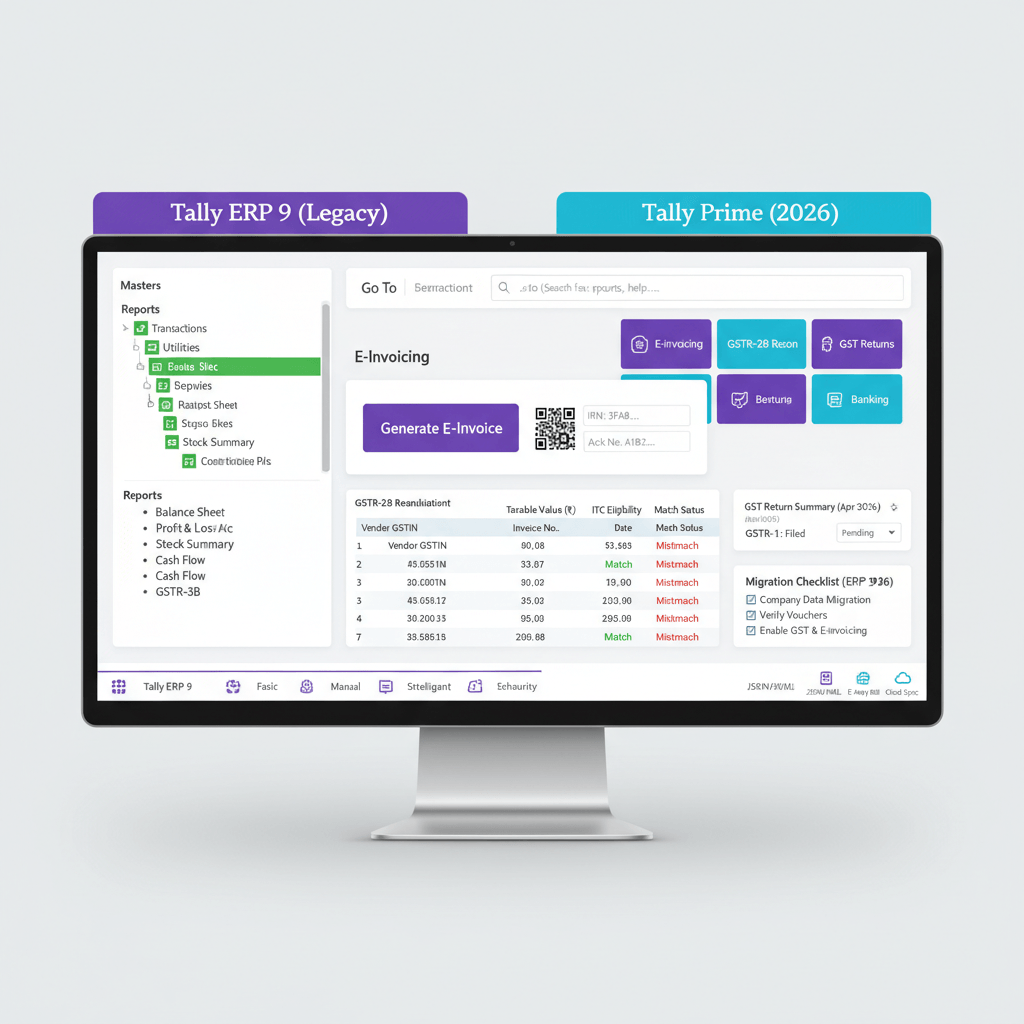
- Tally Prime for India’s standard ledger system, requires add ons for automation.
- FreshBooks for service oriented simplicity, basic automation.
- Xero for cloud flexibility, limited India specific depth.
Next Steps: Test with Your Own Data
Theory is useful, proof with your data is decisive. Book a 20 minute fit check, bring sample bills and statements, watch extraction and categorization live, validate edge cases, and get a clear yes or no on fit. No scripts, just outcomes.
FAQ
As a CA evaluating a ClearTax bookkeeping alternative India, how do I decide between staying compliance first versus moving to bookkeeping first automation?
If your bottleneck is filing, ClearTax stays strong. If your bottleneck is AP posting, bank recon, and month end speed, AI Accountant as a bookkeeping first platform will unlock larger gains. Many CAs run AI Accountant for daily books, then continue filing with ClearTax, this coexistence often becomes the long term stack.
How does AI Accountant learn Tally ledger mappings without breaking my existing chart of accounts, and can I audit the rules?
AI Accountant learns from historical transactions, then suggests mappings you can approve or bulk edit. Every suggestion carries an explanation and confidence score, admins can lock rules, view change logs, and export mapping dictionaries for audit.
Can AI Accountant post GST split, RCM, and ITC eligibility correctly into Tally, and how are edge cases handled?
Yes, the engine parses GST components, RCM applicability, and ITC flags based on vendor and item patterns, it posts compliant splits to Tally and flags anomalies for review. Edge cases like missing GSTIN or address mismatches surface as exceptions that reviewers can resolve once, then convert into rules.
Does AI Accountant support SBI, HDFC, ICICI, Kotak, and co operative bank statements, and what about scanned PDFs?
Yes, native parsers cover major Indian banks and many regional formats, scanned PDFs are OCR processed, then normalized. For unusual layouts, a quick template configuration enables repeatable parsing going forward.
For GSTR 2B reconciliation, can I push vendor status notes back into Zoho Books, and what audit trail is maintained?
Reconciliation status, vendor notes, and document links can sync back to Zoho Books, while AI Accountant keeps a full trail, source files, extracted fields, decisions, and user actions, making audits faster and cleaner.
How should a CA firm compute TCO when comparing a ClearTax plus spreadsheets stack against AI Accountant, any benchmark hours?
Sum licenses across tools, add manual hours per month for AP entry, bank recon, and month end categorization, then add delay costs from slower insights. Benchmarks show 15 to 20 hours saved per entity monthly with AI Accountant once rules stabilize, which typically happens within the first month.
What OCR accuracy can I expect on Indian vendor bills, and how does human in the loop work in AI Accountant?
Well formatted bills often reach 95% plus field accuracy, complex layouts land in the 90% range initially. Exceptions are routed to reviewers, corrections feed back to the model and rules, lifting accuracy quickly over the first few cycles.
Our CA practice runs monthly close for 20 entities, can juniors review exceptions in AI Accountant without risking master data?
Yes, role based access limits who can edit masters or approve postings. Juniors can clear exceptions and propose mappings, seniors can batch approve and push to Tally or Zoho. Org specific learning keeps clients isolated.
What is a realistic implementation timeline if we start Monday, can we be live before the next 3B?
Connect and sync on Day 1, pilot AP and bank ingestion in Week 1, add GST 2B recon in Week 2, then scale entities in Weeks 3 to 4. Many firms run first live postings in the first week, and complete the first 3B period with reconciled, cleaner data shortly after.
How does AI Accountant handle inter company transfers, contra, and suspense accounts, can I define rules once?
Rules detect likely contra or inter company flows using narration patterns, counterparties, and amounts. You can set templates for common transfers, map suspense clearing logic, and monitor unresolved items through exception queues.
Do we get exports and APIs for statutory audit working papers, and will the system retain document links for evidence?
Yes, exports include entries with line level tax splits, mapping notes, and reconciliation outcomes. Document links, source bills, and bank statement snippets remain attached for end to end traceability during audits.
What security and data residency assurances does AI Accountant provide for Indian finance teams?
AI Accountant is ISO 27001 certified and SOC 2 Type II verified, data is encrypted in transit and at rest, access is role based, and India residency options are available for sensitive datasets. This meets typical enterprise and CA firm due diligence needs.

Rohan Sinha is a fintech and growth leader building aiaccountant.com, focused on simplifying accounting and compliance for Indian businesses through automation. An IIT BHU alumnus, he brings hands-on experience across 0 to 1 product building, growth, and strategy in B2B SaaS and fintech.