-01%201.svg)
Key takeaways
- Vendor expense management in India demands automation that understands GST, TDS, e-invoicing, MSME interest, and reliable Tally or Zoho sync, manual workflows cannot keep up as volumes grow.
- Evaluate five pillars, supplier invoice tracking with OCR and three-way matching, vendor payment automation with TDS and vendor payment scheduling, expense allocation to vendors with intelligent ledgers, cost center mapping, deep integrations and controls.
- A practical AP flow, capture, validate, approve, sync to books, pay with TDS, reconcile, monitor DPO and ageing, this delivers real time visibility and compliance.
- Tools range from manual plus Tally, ERP add ons, fintech AP platforms, to AI powered systems, in India, AI tools like AI Accountant often strike the best balance between automation and local compliance.
- A 30 day rollout works, clean vendor masters, pilot invoice capture, pilot payment runs, then scale, track metrics like processing time, first time match rates, and duplicate prevention.
- Watch for pitfalls, GST 2B mismatches, missed TDS, MSME interest, duplicate payments, wrong allocations, unreconciled bank entries, and inconsistent cost center mapping.
What Vendor Expense Management Means in India
Vendor expense management in India goes beyond simple bill payment, it is a complete system for supplier relationships, compliance, and visibility across GST, TDS, MSME rules, e-invoicing, and reconciliations with your bank and books.
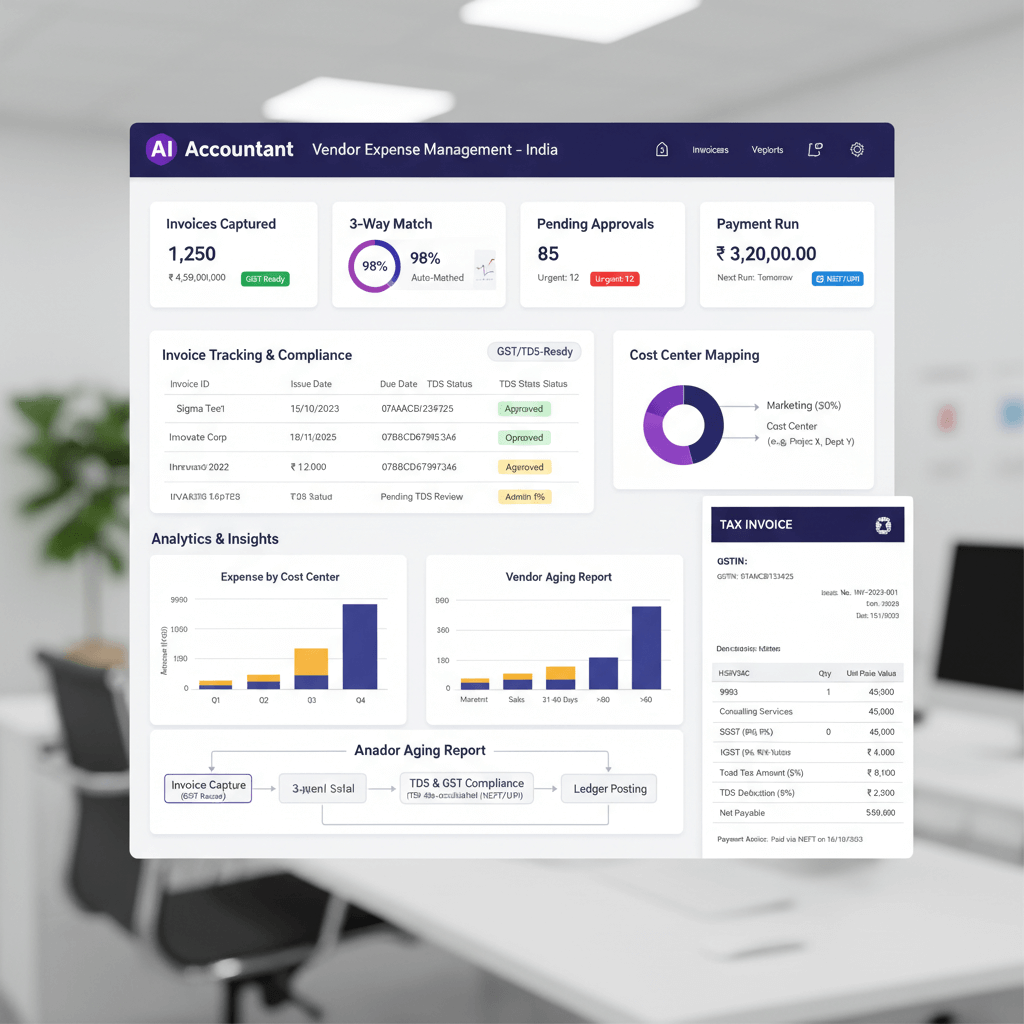
The core flow starts with OCR bill capture from emails or scans, auto GSTIN validation, duplicate detection, and policy checks. Approvals route to responsible managers. Ledger posting happens with the right categorization. Payments flow through UPI, NEFT, or RTGS. Reconciliation matches bank statements. Dashboards monitor DPO and vendor ageing.
India adds unique complexity, GST 2B matching for ITC eligibility, section wise TDS auto computation, e-invoicing with IRN validation, MSME interest for delays beyond 45 days, and careful tracking of advances and credit notes. Continuous AI monitoring helps catch issues early.
Key health metrics reveal your AP story, DPO efficiency, overdue bills, cash flow visibility, and cost center performance, all with real time spend tracking.
Sources, Volopay on vendor management systems, Open Money, vendor management trends 2025, ABBYY on expense automation
Key Capabilities to Evaluate
Supplier Invoice Tracking
Accurate capture and control is the backbone. Multi format OCR should read Indian invoices, extract line items, HSN, and tax splits, detect duplicates, link PO and GRN for three-way matching, validate GSTIN, and surface ageing and reminders with full audit trails.
The best systems flag anomalies like altered amounts or missing signatures, and they match invoice numbers across systems to prevent leakage.
Vendor Payment Automation
End to end payment runs need batch processing, maker checker approvals, TDS auto calculation and netting, bank file generation, and payment advice notifications. Smart automation uses terms driven vendor payment scheduling, enforces limits and protocols, and tracks status from initiation to settlement.
Expense Allocation to Vendors
Automated ledger categorization reduces manual work, learns from history, applies vendor specific terms, and handles fees, taxes, and recurring bills consistently. Accuracy here protects P and L integrity and makes variance analysis meaningful.
Cost Center Mapping
Map spend across departments, projects, and locations with split allocations and percentage based distributions. Real time budgets and variance reports reveal spending efficiency and help prevent overshoots.
Integration Depth
Reliable bi directional sync with Tally or Zoho keeps books aligned. Bank feeds cut manual entries. GSTN connectivity streamlines compliance. These links must work quietly, without babysitting.
Security and Controls
Role based approvals and maker checker protocols reduce risk. Vendor KYC ensures legitimacy. Change logs preserve history. Multi entity support and shared vendor masters allow scale with control.
Sources, Volopay on vendor management systems, Open Money, vendor management trends 2025
Typical AP Workflow
Bills arrive via email, messaging, or courier, the system ingests them automatically. OCR extracts details, duplicates are flagged, GSTIN is validated, and exceptions surface for review. Approvals route by amount and vendor type. Predicted ledgers propose expense allocation to vendors, users adjust if needed.
Approved bills sync to your accounting system, cost center mapping distributes amounts to departments or projects, budgets and variance reports update instantly. Payments are scheduled per terms, TDS is computed and deducted, bank files are generated, and payment advice is sent to vendors.
Next day, bank statements import, reconciliation matches transactions automatically, exceptions are flagged, and dashboards refresh DPO and ageing.
Sources, Volopay on vendor management systems, Open Money, vendor management trends 2025
Approaches to Vendor Expense Management
- Manual plus Tally only
Pros, familiar, low software cost, full control. Cons, heavy data entry, more errors, limited tracking, and no real time visibility. - ERP or AP add ons
Pros, structured workflows and enterprise features. Cons, complex implementation, limited India specific automation, and higher cost. - Fintech AP platforms
Pros, modern rails, real time visibility, and mobile access. Cons, ledger integration may be shallow, cost center mapping can be basic. - AI powered VMS
Pros, strong OCR, predictions, GST compliance, and automated spend analytics. Cons, requires proper setup and training during onboarding.
Sources, Volopay on vendor management systems, Open Money, vendor management trends 2025
Tools for Vendor Expense Management
- AI Accountant, Specialized for Indian bank statement processing and automated ledger mapping, bulk OCR for supplier invoice tracking, intelligent expense allocation to vendors with GST predictions, seamless Tally and Zoho sync, and security with ISO 27001 and SOC 2.
- Zoho Expense, Receipt scanning and multi currency, integrates tightly with Zoho Books, ideal if you use the Zoho ecosystem.
- SAP Concur, Enterprise grade invoice and expense with advanced approvals, powerful for large organizations, complex for SMBs.
- Volopay, Spend management with corporate cards, bill pay, and real time controls, strong on payment automation.
- Clear, GST focused platform with e invoicing, vendor management, and India first compliance features.
- Happay, Expense management with travel booking and robust T and E workflows.
Why AI Accountant, deep understanding of Indian banking formats, multi stage supplier invoice tracking, automated allocation with GST predictions, push pull Tally and Zoho sync, and dashboards for DPO, ageing, and cost center performance. Roadmap includes GSTN integration and Account Aggregator feeds.
Sources, Open Money, vendor management trends 2025, ABBYY on expense automation, Volopay on vendor management systems
ROI and Operational Impact
Automation typically cuts classification and reconciliation time by 70 to 75 percent, what took eight hours now takes two. Teams move from data entry to analysis, month end close compresses from weeks to days.
Errors fall sharply, duplicate payments trend to near zero, TDS mistakes vanish, vendor mapping stays consistent, and compliance penalties reduce.
Cash flow improves through optimized DPO, fewer late fees to MSME vendors, audit readiness, and the ability to use early payment discounts. Spend analytics enable negotiations and consolidation to unlock savings.
KPIs move in the right direction, invoice processing time down by about sixty percent, payment cycle time down by about forty percent, first time match rates up to about eighty five percent, and vendor query resolution faster by half.
Sources, Cashbook on expense management for growing businesses, ABBYY on expense automation, Volopay on vendor management systems, Open Money, vendor management trends 2025
Implementation Playbook, 30 Day Rollout
Week 1, Foundation Setup
Clean the vendor master, remove duplicates, update GSTIN and PAN, verify bank accounts, and complete KYC. Configure cost center mapping, define departments, projects, and locations, set allocation rules and budgets, design approval hierarchy based on amounts and vendor types.
Week 2, System Launch
Launch supplier invoice tracking with a pilot group, train users on uploads and exceptions, test TDS scenarios with real bills, run end to end tests, approvals, ledger allocations, and sync with Tally or Zoho.
Week 3, Payment Automation
Pilot vendor payment automation with low risk vendors, create batches, test TDS, generate bank files, and send advice. Run parallel reconciliation, refine matching rules, and document exception handling.
Week 4, Full Rollout
Expand to all vendors, monitor dashboards daily, track adoption and outcomes, collect feedback, refine rules, and run refresher training, share quick wins to build momentum.
Sources, Volopay on vendor management systems, Open Money, vendor management trends 2025
Pitfalls to Avoid
- GST 2B mismatches, vendor filings delayed or details not matching, systems must flag and block ITC until resolved.
- Missing IRN or e invoicing threshold breaches, keep thresholds updated to avoid penalties.
- Duplicate payments, same invoice with variants, advance adjustments not applied, and credit notes ignored, require strong duplicate detection and linking.
- Wrong expense allocation to vendors, misclassifications distort budgets and P and L, and misstate profitability.
- Inconsistent cost center mapping, different mappings for the same vendor, missing overhead allocations, and open projects not closed.
- Unreconciled bank entries, unmatched payments, unrecorded charges, and missed interest entries, do daily reconciliation.
- Missed TDS, thresholds or rates not updated, lower deduction certificates not applied, automate or risk interest and penalties.
- MSME interest obligations, payments delayed beyond forty five days, interest not accrued or disclosed, track MSME vendors separately.
Source, Open Money, vendor management trends 2025
Evaluation Checklist
Must Have Features
- Supplier invoice tracking with OCR for PDFs and images, accurate extraction for Indian formats, and dependable GSTIN validation.
- Vendor payment automation with section wise TDS, support for UPI, NEFT, RTGS, and clear payment advice.
- Expense allocation to vendors with learning, split allocations, and support for recurring patterns.
- Cost center mapping with multi dimensional allocations, budget integration, and variance reporting.
Integration Requirements
- Tally or Zoho Books bi directional sync, custom fields, and preserved audit trails.
- Bank integrations or flexible file uploads, configurable reconciliation rules.
Control Features
- Approval workflows aligned to your hierarchy, amount and vendor type routing, delegation during leave, and mobile approvals.
- Scalability for multi entity groups, shared vendor masters, and consolidated reporting.
Security Certification
- ISO 27001 and SOC 2 Type 2, India data residency as applicable, and regular third party audits.
Sources, Volopay on vendor management systems, Open Money, vendor management trends 2025
Conclusion and Next Steps
Vendor expense management India needs tools built for GST, TDS, and local workflows. Generic systems miss critical details. Manual processes do not scale. The right automation makes AP smooth, visible, and compliant.
Audit your pain points, duplicate payments, TDS anxiety, slow month end, or an out of control ageing. Pilot supplier invoice tracking and vendor payment automation with a small vendor set. Test cost center mapping with one department, measure time saved and errors reduced, then expand.
Start with high volume, low complexity vendors, build confidence, scale steadily. Choose a solution that grows with you. Use your own data to test complex scenarios and integrations. A capable vendor expense management system pays back in months through efficiency and control.
The future of AP in India is automated, intelligent, and compliant, move from paperwork to strategic vendor management.
FAQ
As a CA, how do I configure section wise TDS automation for 194C, 194J, and 194H, including lower deduction certificates, and ensure correct net payables every run
Set up TDS rule libraries by section, rate, threshold, and vendor type, capture PAN and residency, and attach lower deduction certificates with validity. In an AI tool like AI Accountant, map vendors to sections with overrides, enable auto threshold tracking per financial year, and validate section changes at invoice level. During payment runs, the engine nets TDS and produces challan ready summaries and vendor wise Form 16A support, ensuring net payable is correct and compliant.
How do I implement three way matching for PO, GRN, and invoice in an India context with tolerances and GST accuracy
Adopt a workflow that links invoice lines to PO lines and GRN receipts, set quantity and price tolerances, and make GST validation mandatory. Use three-way matching guidance to ensure HSN, tax rates, and taxable values reconcile. AI tools flag mismatches, propose resolutions like short receipt or price variance, and block posting until compliance issues are cleared.
What is the recommended process to reconcile GSTR 2B with vendor invoices and block ineligible ITC proactively
Automate import of GSTR 2B, map supplier GSTINs, and match invoice numbers, dates, and taxable values. Where 2B does not reflect an invoice, block ITC in your books, and schedule reminders to vendors. Tools like AI Accountant can maintain a reconciliation dashboard, tag exceptions by reason, and reverse ITC when 2B appears, preserving a clear audit trail.
How should I handle MSME 45 day payment rules, interest accruals, and Companies Act disclosures without manual tracking
Mark MSME vendors in the master and store registration evidence. Configure due dates by acceptance date, not invoice date, and set alerts at day thirty and day forty. If a delay occurs, auto accrue interest and post to finance costs, and generate disclosure ready reports. AI Accountant can track the clock and compute interest based on notified rates, easing compliance.
What is the most efficient way to validate e invoices, IRN, and QR codes during bill capture and store artifacts for audit
During OCR, extract IRN and QR payload, verify checksum and structure, and store the signed JSON and QR image with the invoice record. If IRN is missing where thresholds apply, route to exception. This creates a single source of truth for audits and prevents non compliant postings.
How do I split a single vendor invoice across multiple cost centers and projects while keeping GST and TDS intact
Use percentage or line level splits that allocate base value and tax proportionately to cost centers and projects. TDS applies on applicable base value before split, the system then posts distributed entries. In AI Accountant, define split templates by vendor or expense type, and apply them with one click at approval.
How can I prevent duplicate payments across group entities where invoices may be sent to multiple branches
Enable global duplicate checks on vendor GSTIN, invoice number, date, and amount across all entities. Implement maker checker for invoice intake, and consolidate vendor masters. AI dedup rules in AI Accountant also compare image hashes and OCR patterns, catching cleverly altered duplicates.
What is the best practice to optimize DPO without risking TDS deposit delays and MSME breaches
Segment vendors by terms, MSME status, and materiality. Use vendor payment scheduling that targets the last safe day, while auto scheduling TDS challans ahead of statutory due dates. Dashboards should display DPO by category and compliance countdowns, allowing finance to stretch payables with zero penalty risk.
How do I automate bank reconciliation for UPI, NEFT, and RTGS, including charges and reversals
Pull daily bank feeds, normalize narration patterns, and create matching rules for UPI VPA, NEFT UTR, and RTGS references. Auto post bank charges and reversals using rule based mapping. AI Accountant learns from confirmations and improves matching over time, shrinking the suspense ledger.
What minimum dataset do I need to migrate from a manual AP process into an AI driven system like AI Accountant
Prepare a clean vendor master with legal name, GSTIN, PAN, MSME status, bank details, and TDS section. Export opening payables and open POs. Collect last three months of invoices for training OCR, and sample bank statements for reconciliation rules. With these, AI Accountant can stand up a pilot in days, not months.
How do I enforce maker checker and role based approvals without slowing down operations
Design amount slabs and vendor type routes, add delegation rules for leave, and allow mobile approvals for speed. Maintain immutable audit logs with timestamps and user IDs. Good systems give approvers context, invoice image, PO, exceptions, and budget impact, enabling fast, informed decisions.
How should I account for advances, retainers, and security deposits so that net payables and TDS are accurate
Record advances to a separate ledger and link them to the vendor and intended PO, apply them during invoice posting with clear references. For retainers and deposits, define recognition rules and TDS applicability based on nature. Systems like AI Accountant net advances automatically, prevent overpayments, and present a clear settlement trail during audits.

Rohan Sinha is a fintech and growth leader building aiaccountant.com, focused on simplifying accounting and compliance for Indian businesses through automation. An IIT BHU alumnus, he brings hands-on experience across 0 to 1 product building, growth, and strategy in B2B SaaS and fintech.