-01%201.svg)
Key takeaways
- Daily idle, weekly idle, and monthly idle describe how often a financial product calculates or credits interest on your uninvested balance, daily idle earns on every calendar day, weekly idle on a seven day cycle, and monthly idle at month end.
- Idle cash at 3% savings costs an Indian SMB with Rs 50 lakh surplus roughly Rs 3.2 lakh per year versus liquid funds, compounding to around Rs 20 lakh over five years.
- A simple treasury policy with operating cash rules, investment tiers, and approval limits can add 200 to 300 basis points over savings rates without complex setups.
- Cash laddering across 7, 30, 60, and 90 day maturities improves both liquidity reliability and blended yield, even in a flatter rate environment.
- Automating bank reconciliation and cash positioning eliminates stale data that keeps surplus parked too long. AI Accountant's bookkeeping automation handles this for Tally based teams so finance leaders can focus on deployment decisions.
- Start this week: audit your idle balances, enable a sweep account, and move obvious surplus into a liquid fund. Small moves compound fast.
Idle Cash Terminology and Treasury Yields: What's New in 2026
Until mid 2025, sweep accounts for Indian SMBs typically offered 5 to 6% and liquid mutual funds returned 6 to 7%. By early 2026, the RBI repo rate sits at 6.25%, and yields have shifted. Sweep accounts now return 6.0 to 6.5%, liquid funds average 6.8 to 7.2%, and AAA corporate FDs offer 7.5 to 8.0%, roughly 50 to 100 basis points lower than 2024 peaks but still 200 to 300 basis points above savings rates of 3 to 3.5%.
The operational shift matters most for SMBs tracking daily idle, weekly idle, and monthly idle returns on their surplus. With a flatter yield curve, the gap between a 30 day FD and a 90 day FD has narrowed. This means laddering strategies need tighter rungs, favouring 30 to 90 day instruments at around 7.5% over ultra short funds that now yield only marginally more than sweeps.
Who feels this? Businesses with Rs 25 lakh or more in average surplus, especially manufacturing and trading SMBs with lumpy vendor cycles. If you are still parking funds in a savings account, the post tax drag at the 25% slab is real: a 7% liquid fund nets roughly 5.25%, while savings at 3.5% nets just 2.6%. Over five years on Rs 50 lakh, that gap compounds to nearly Rs 20 lakh lost.
- Audit your current blended yield against the latest RBI policy rate and adjust sweep thresholds accordingly.
- Review exposure caps: digital banks and small finance banks now offer sweeps at 7.8%, but cap exposure at 25% per institution (2026 update).
- RBI has strengthened cybersecurity mandates for treasury operations, making maker checker controls essential for all investments above Rs 5 lakh.
Real time MIS reporting dashboards help finance teams spot idle balances the same day they appear, rather than discovering them during month end reconciliation when the deployment window has already closed.
Understanding Treasury Management for Indian SMBs
Cash is the oxygen of business. Treasury management ensures every rupee works hard while bills get paid on time.
For Indian SMBs, this means balancing GST obligations, vendor cycles, seasonal sales, and growth investments. All while navigating multiple banking relationships and investment choices.
The core building blocks are cash flow forecasting, liquidity planning, surplus deployment, risk management, and banking optimization. Since SMB finance leaders often wear many hats, automation is essential. Tools like AI Accountant streamline cash tracking and reconciliation, freeing time for strategic decisions.
Treasury is not about sophistication for its own sake. It is about visibility, discipline, and consistent execution.
What Do the Terms Daily Idle, Weekly Idle, and Monthly Idle Mean for Financial Products?
These terms describe how a financial product treats your uninvested or idle balance when calculating returns. Understanding them helps you pick the right parking vehicle for your surplus cash.
- Daily idle means interest accrues on your idle balance every single calendar day. Liquid mutual funds, overnight funds, and most sweep accounts work this way. Your money earns from the day it lands to the day it leaves.
- Weekly idle means the product calculates or credits returns on a seven day cycle. Some corporate treasury accounts and certain fixed income products use weekly compounding. If you withdraw mid week, you may lose partial period interest.
- Monthly idle means returns are computed or credited at month end. Traditional savings accounts and some fixed deposits follow this pattern. Cash deposited on the 5th and withdrawn on the 25th earns for the full month in some products, but in others you earn nothing if the balance dips below a threshold before month close.
For SMB treasury purposes, daily idle products give you the most flexibility. You capture returns on every rupee for every day it sits, which matters when you are actively managing vendor payments, payroll, and GST outflows.
A practical rule: use daily idle instruments (sweeps, liquid funds) for your operating cushion, weekly or monthly idle products only when they offer meaningfully higher yields and you can commit the funds for the full period.
Why Indian SMBs Lose Money on Idle Cash
Parking lakhs in savings at 3 to 3.5% while borrowing at 12% destroys value. A business with Rs 50 lakh average idle balance loses roughly Rs 3.2 lakh per year compared with liquid funds yielding around 5.25% post tax at the 25% slab. Over five years, that compounds to nearly Rs 20 lakh.
- Complexity fears delay investment setup. Demat accounts and taxation feel daunting.
- Liquidity anxiety pushes conservative choices. Cash gets hoarded at negative real returns.
- Poor visibility from manual ledger entry reconciliation leaves outdated cash positions. Surplus goes undeployed.
The fix is simple. Improve visibility, set rules for operating cash, and automate surplus deployment. Even reducing your days sales outstanding (DSO) by 10 days can free 2 to 3% of revenue for treasury deployment. Small changes compound into meaningful gains.
Building Your Treasury Policy Framework
A practical treasury policy is your operating manual. It answers what to do with cash before the question arises. Keep it short, focused, and actionable.
- Operating cash: maintain 45 to 60 days of expenses plus a volatility buffer. Many SMBs start with 1.5 to 2 months of average monthly costs.
- Investment tiers: funds needed within 7 days stay in sweep or overnight vehicles (daily idle products). 7 to 30 days go into liquid funds. 30 to 90 days into ultra short duration or short term FDs.
- Risk limits: cap exposure by instrument and institution. For example, no more than 25 to 30% per bank and no more than 35 to 40% per mutual fund house. Spread across at least four institutions including small finance banks where yields are competitive.
- Approvals: up to Rs 10 lakh by CFO, Rs 10 to 50 lakh by CEO, above Rs 50 lakh by board. Clarity prevents delays.
- Procedures: define who initiates, approves, and monitors. Set a monthly review cadence. Quarterly deep dives refine policy.
- Tax: with post April 2023 rules, debt fund gains get taxed at slab rates. Incorporate this into post tax return comparisons. A 7% gross yield nets roughly 5.25% at the 25% bracket.
Start simple. Codify decision rules, then expand as complexity and scale grow.
Short Term Investment Options for Indian Businesses
India offers multiple instruments to park surplus cash. Each has distinct liquidity, idle interest calculation methods, and risk profiles. The table below reflects 2026 yields.
- Sweep accounts: automatic moves to linked FDs, 6.0 to 6.5% with instant access. Daily idle accrual in most configurations.
- Liquid mutual funds: high quality short securities, typical 6.8 to 7.2% returns, T+1 redemption. Daily NAV means daily idle earnings.
- Ultra short duration funds: 3 to 6 month horizons, 7.2 to 7.6% yields. Also daily idle.
- Treasury bills: sovereign backed 91, 182, 364 day maturities. Currently yielding around 6.0 to 6.5%, available through RBI's auction calendar.
- Corporate FDs: 7.5 to 8.0% in AAA or AA+ issuers. Limit exposure due to credit risk. Interest may accrue monthly idle or quarterly depending on the issuer.
- Commercial paper: higher yields for very short tenures, typically suited for larger tickets.
Diversify across instruments and institutions. Focus on liquidity ladders and risk limits. Avoid chasing headline yields blindly. Always compare on a post tax basis.
Cash Flow Forecasting and Liquidity Planning
Accurate forecasting shifts treasury from reactive to proactive. Begin with a rolling 13 week cash flow forecast. Keep Week 1 at day level precision, Weeks 2 to 4 daily, Weeks 5 to 13 weekly.
- Segment inflows and outflows into committed and variable. Model seasonal patterns and customer payment behavior.
- Build probability weighted scenarios. Avoid surprises by explicitly modeling uncertainty.
- Compare predicted versus actual weekly. If Week 1 misses by more than 5%, investigate quickly. Weeks 2 to 4 should stay within 10%.
Automated reconciliation is the backbone. AI Accountant categorizes transactions and matches them against forecasts. Variance alerts arrive immediately.
Use your forecast to capture float. That five day window before a vendor run can earn returns in overnight vehicles, products with daily idle accrual. Even small float windows add up over a year.
For real time visibility, monitor a central cash management dashboard. AI powered forecasting tools now integrate RBI rate alerts and real time DSO tracking, learning from your transaction patterns automatically.
Implementing Cash Laddering Strategies
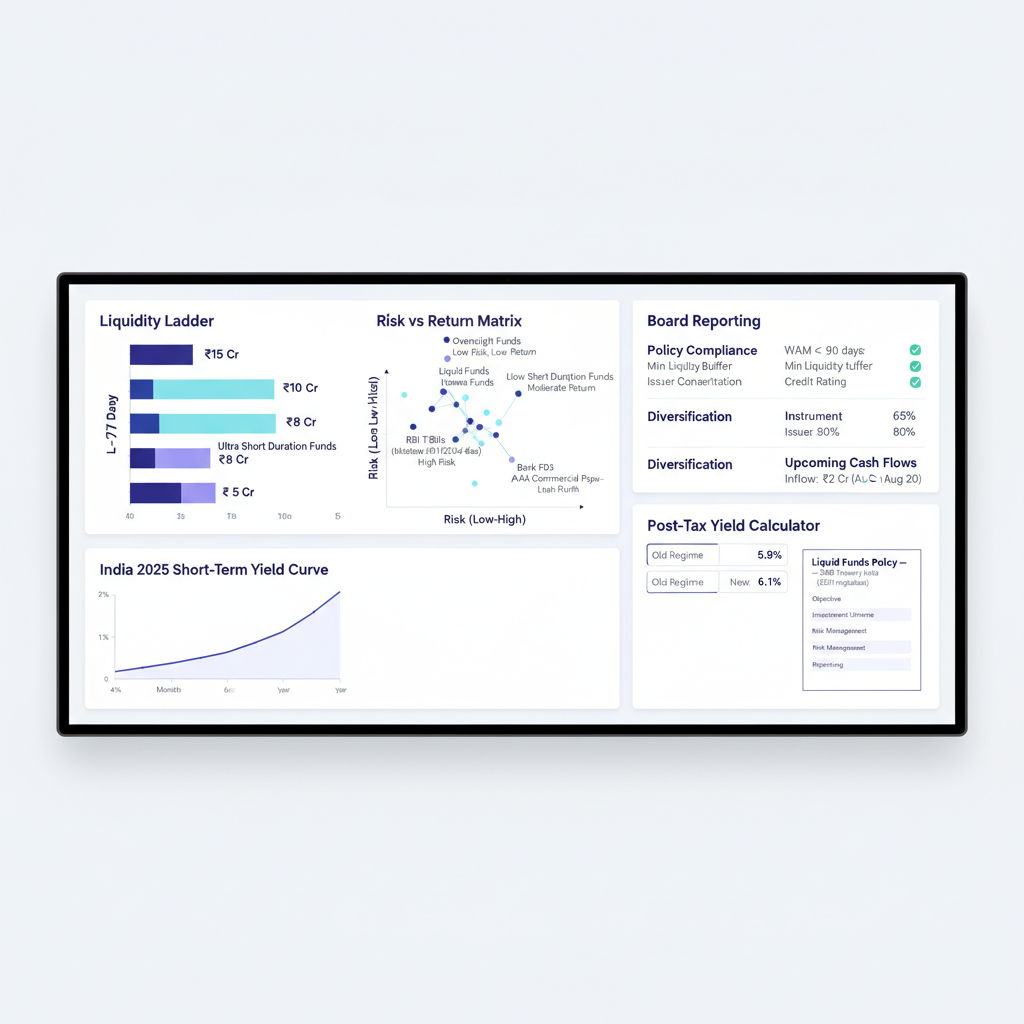
Cash laddering staggers maturities, creating a conveyor belt of liquidity. Instead of one large FD, split into multiple investments maturing at regular intervals.
- Map predictable needs. Salaries, GST, and vendor cycles become ladder rungs.
- Use an operational ladder for 7 to 30 day access, and a strategic ladder for 3 to 12 month commitments.
- Reassess at each maturity. Deploy to operations or reinvest. Let the ladder flex with your forecast.
With the yield curve flatter in 2026, the sweet spot for laddering has shifted. Emphasise 30 to 90 day FDs at around 7.5% over ultra short funds where the yield pickup is smaller than before. Lock longer only when you see clear rate rise signals.
Track the yield curve. Automate with standing instructions and systematic transfer plans where possible.
A disciplined ladder can add 150 to 200 basis points annually. Liquidity improves, and sleep quality improves too.
Risk Management in Treasury Operations
Your goal is capital protection with reasonable returns. Prioritize sleep at night over chasing yields.
- Credit risk: stick to high ratings. Review mutual fund portfolios for lower grade paper exposure.
- Liquidity risk: layer access. Keep 15 to 20 days of expenses instantly available in daily idle instruments. Use liquid funds for the next tier.
- Interest rate risk: balance fixed and floating exposures across short and medium tenures.
- Concentration risk: cap exposure per bank at 25% and per fund house at 35%. Spread across at least four institutions, including small finance banks offering competitive sweep rates.
- Operational risk: implement maker checker for all investments above Rs 5 lakh. RBI's enhanced cybersecurity framework now mandates stronger controls for treasury operations. Maintain registers and audit regularly.
Create a simple risk matrix. Score credit, liquidity, and complexity. Only consider options below a set threshold. Monitor monthly, document near misses, and adjust processes before issues become losses.
Banking Relationship Optimization
Banking relationships drive treasury outcomes. Audit your accounts, fees, and true costs including RTGS charges, forex markups, and minimum balance penalties.
- Negotiate better terms using your average balances. Request sweep facilities, preferential FD rates, and lower transaction charges.
- Establish a secondary (or third) bank for diversification and service variety. Digital first solutions and small finance banks can complement operations with higher sweep yields of up to 7.8%.
- Evaluate APIs and integrations. Direct connectivity to accounting software reduces manual reconciliation of ledger entries and vendor invoices.
- Track banking KPIs: collection periods, success rates, and resolution times. Use the data in quarterly reviews.
Virtual accounts enhance visibility for customer collections or business units while keeping a pooled balance. Build multiple RM relationships. Avoid single point bottlenecks.
Technology and Automation in Treasury
Automation converts treasury into a strategic lever. Start with bank reconciliation. AI Accountant is built for Indian SMBs, GST and TDS aware, and integrates with Tally and major banks.
Consolidate cash positions through a real time dashboard. Then configure automated sweeps based on thresholds. Maintain a minimum operating balance and sweep the rest into liquid and short duration vehicles with daily idle accrual.
Schedule payments through APIs. Reduce float and improve forecast accuracy. Corporate investment platforms allow bulk transactions. CSV uploads simplify fund deployment at scale.
Modern platforms now offer real time API consolidation across banks, auto sweeps triggered by balance thresholds, and DSO linked yield optimization. These eliminate idle cash drag by deploying surplus the same day it appears.
Document your stack and data flows. Run periodic automation audits. Identify manual pain points and automate the next bottleneck.
Regulatory Compliance and Tax Optimization
Compliance and tax shape net returns. Stay current and model post tax yields carefully.
- Debt fund gains get taxed at slab rates regardless of holding period (unchanged since April 2023). Factor this into comparisons with FDs and T bills.
- Account for TDS on FD interest. Provision for mutual fund tax liabilities even without TDS deductions.
- Include GST on banking and advisory fees in return calculations. Claim eligible input tax credits where applicable.
- Maintain board resolutions for investment limits. Keep registers and ensure disclosures comply with the Companies Act requirements.
- Forecast treasury income within advance tax computations quarterly. Avoid interest penalties due to underestimation.
- Document transfer pricing for related party treasury activities, especially cash pooling or inter company balances.
Subscribe to RBI, SEBI, and tax department updates. Policy shifts can materially alter treasury strategy.
Building Treasury Excellence Step by Step
Adopt a phased approach. Prove value, then scale.
- Month 1: audit cash positions, investments, and maturities. Quantify idle cash cost. Target a blended yield of 6.5% or higher on surplus.
- Month 2: enable sweep accounts, open liquid fund access. Move obvious surplus out of current and savings accounts.
- Month 3: document a policy. Set risk limits and approvals. Build a four week forecast. Track accuracy.
- Month 4 to 6: automate reconciliation and integrate banks. Explore digital banks for higher sweep rates. Track DSO, a 10 day reduction can free 2 to 3% of revenue for deployment.
- Month 7 to 9: add tiers by time horizon. Diversify to four or more institutions. Set monthly monitoring and reporting.
- Month 10 to 12: aim for largely automated operations. Target consistent outperformance over savings rates by 250 basis points. Board dashboards should show post tax returns versus benchmarks.
Measure success through idle cash percentage, incremental returns versus savings, forecast accuracy, and automation coverage. Train your team, create SOPs, and establish escalation protocols.
Creating Board Ready Treasury Reports
Board reporting elevates treasury to strategy. Build a dashboard around cash position, cash flow, returns, and risk.
- Answer what cash you have, where it sits, what you earn, what risks you manage, and what decisions need input.
- Use visual narratives. Waterfalls for cash changes, heat maps for risk concentration, trends versus benchmarks for returns.
- Include variance explanations and action plans. Build credibility through transparency.
- Present forward looking events: maturities and liquidity windows, and the market outlook for rates.
Keep jargon light. Emphasize decisions. Standardize format and cadence for consistency.
Conclusion
Treasury excellence is about clarity, discipline, and automation. Start with visibility. Move idle cash, whether measured on a daily idle, weekly idle, or monthly idle basis, into appropriate instruments. Manage risk through limits and ladders. Automate reconciliation and positioning.
The opportunity cost of inaction is large. A Rs 50 lakh idle balance costs you lakhs every year. Small changes today compound into meaningful gains tomorrow.
Platforms like AI Accountant remove manual overhead. Investment platforms make deployment simple. And this playbook gives you the framework. Perfect is not required, consistency is. Begin with one improvement this week. Your future self will thank you.
FAQ
What do the terms daily idle, weekly idle, and monthly idle mean for financial products?
Daily idle means your idle balance earns interest every calendar day, weekly idle means returns are calculated on a seven day cycle, and monthly idle means interest accrues or credits at month end. For SMB treasury, daily idle products like liquid funds and sweep accounts give the most flexibility since you earn on every rupee for every day it sits, which matters when cash moves frequently for vendor payments, payroll, and GST.
How do I quantify minimum operating cash for a manufacturing SMB with uneven vendor cycles?
Start with an average of the last three months of operating expenses, add a 20% volatility buffer, then provision for 45 to 60 days. If monthly operating costs average Rs 40 lakh, minimum operating cash usually sits near Rs 24 to 32 lakh. Validate with a 13 week forecast and refine monthly. AI tools can map patterns in payroll timing, raw material purchases, and statutory payments to fine tune the buffer, now also factoring GST e invoicing delays.
Liquid funds versus bank sweep accounts: which should a CFO prefer for seven day money?
For immediate access and zero friction, sweep accounts are convenient at 6.0 to 6.5% (2026 update). For seven day windows that tolerate T+1 redemption, liquid funds add roughly 100 basis points at 6.8 to 7.2%. Use sweep for daily operating cushions with daily idle accrual. Use liquid funds for predictable short windows identified through your 13 week forecast.
What is a practical ladder design for Rs 1 crore surplus expected to be stable for six months?
Allocate Rs 20 lakh to liquid funds for immediate needs, Rs 15 lakh each into 30, 60, and 90 day FDs at around 7.5%, and Rs 35 lakh into an ultra short duration fund (2026 update). Review at each maturity and redeploy based on updated forecasts. With a flatter yield curve, the 30 to 90 day FD range now offers the best risk adjusted pickup over shorter instruments.
How do April 2023 debt fund tax changes alter treasury choices for a company in the 25% bracket?
All gains are taxed at slab rates with no indexation benefit. A 7% liquid fund becomes roughly 5.25% post tax. Compare against FDs and T bills net of tax and costs. Model after tax returns, add GST on fees, and choose tiers based on both liquidity and post tax yield. Revisit redemption timing around quarter ends to align with advance tax planning. These rules remain unchanged heading into 2026.
What forecast accuracy targets are realistic for SMBs, and how are misses addressed?
Week 1 should be within 5%, Weeks 2 to 4 within 10%, Weeks 5 to 13 within 15%. Investigate misses by category: delayed receivables, unexpected expenses, or timing shifts in recurring payments. Automate bank reconciliation, then run variance analysis weekly, adjust scenario probabilities, and update buffers accordingly.
What is a practical automation roadmap for a lean finance team?
Phase 1: automate bank reconciliation and transaction matching. Phase 2: implement a real time cash management dashboard and scheduled payments. Phase 3: set sweep rules, ladder automation, and AI powered cash flow forecasting. Run quarterly audits to identify the next manual bottleneck to automate. In 2026, prioritise API based bank integrations and DSO tracking to spot deployable surplus faster.

A results-driven finance and sales professional with hands-on experience through finance internships and a fast-paced sales role. With a strong interest in accounting and business finance, Harsh focuses on turning complex topics into clear, practical takeaways for founders and finance teams.