-01%201.svg)
Key takeaways
- Rules based automation lets small businesses define clear if, then instructions that consistently categorize transactions, apply tax codes, and route approvals without manual work.
- Compared to machine learning, rules are predictable and audit friendly, you always know why a transaction went to a category or triggered a workflow.
- High impact use cases include Expense categorization, Bank reconciliation, and GST and tax calculations, which together can cut bookkeeping time by more than half.
- A structured rollout, start with data assessment, choose the right platform, build simple rules, test with history, then monitor and refine, delivers quick wins and sustained accuracy.
- Security and compliance must be foundational, encrypt data, enforce access controls, maintain immutable audit trails, and align to standards like ISO 27001 and SOC 2.
- Measure ROI through time saved, accuracy gains, faster month close, better GST compliance, scalability, and happier teams.
What is rules based automation in accounting?
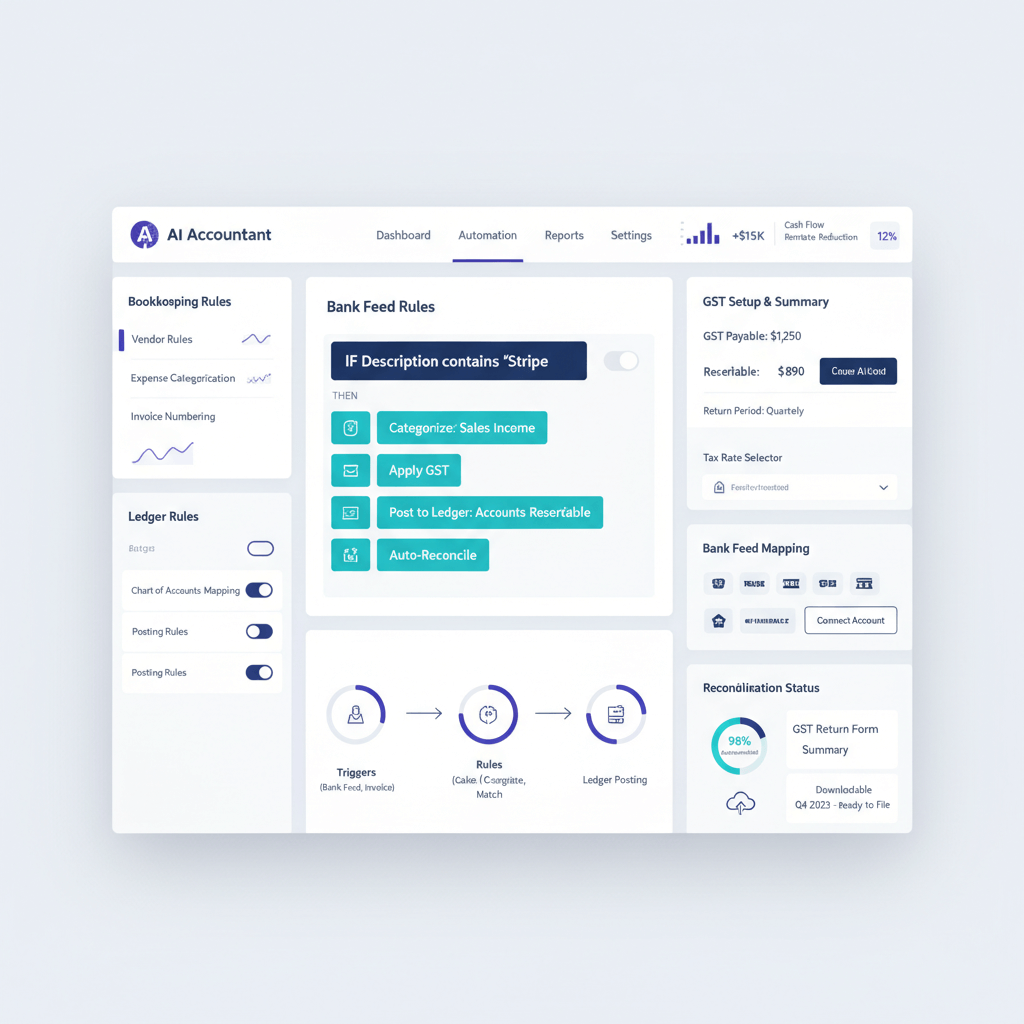
Rules based automation uses predefined conditions and actions to process accounting tasks automatically, for example, if the vendor contains Vodafone, then categorize as Telephone Expenses and apply 18 percent GST. The system executes your instructions consistently, delivering transparent outcomes you can explain to an auditor or a client.
Unlike AI models that infer patterns, rules are explicit, predictable, and easy to audit. You can start with simple triggers like merchant names, amounts, dates, and references, then extend to compound checks for greater precision.
Think of it as a dependable assistant that always follows your checklist, no surprises, complete traceability.
- Vendor or description contains a keyword, assign category, tax code, and vendor.
- Amount within a range, route for approval or flag for review.
- Day and date windows, perfect for rent, salaries, or subscription billing cycles.
Rules based vs machine learning automation
Rules deliver deterministic results, the same input produces the same output, which is ideal for compliance heavy workflows and audit trails. Machine learning suggests classifications from patterns in historical data, valuable for complex scenarios like anomaly detection or cash flow predictions, yet it evolves as data changes.
- Transparency, rules are explainable line by line, ML is probabilistic.
- Control, rules respect strict policy constraints, ML may need guardrails.
- Cost, rules run efficiently in standard accounting tools, ML often requires more compute and data engineering.
When to combine both
Use rules for routine categorization, tax application, approvals, and reconciliation, let ML propose new rules, surface exceptions, or score fraud risk. Many teams adopt a hybrid approach, using rules as the backbone and AI for suggestions and alerts.
Core benefits for small businesses
The gains are immediate, measurable, and compounding as your transaction volume grows.
- Time savings, reduce manual categorization and reconciliation by 60 to 80 percent, freeing owners and CAs to focus on analysis.
- Accuracy, consistent logic cuts human error, well configured rules often reach 95 percent accuracy or higher.
- Real time visibility, transactions hit reports correctly within minutes, improving decisions on spend, pricing, and collections.
- Cost reduction, cleaner books reduce rework and professional fees during closing and tax season.
- Compliance, correct GST codes and documentation by default, fewer notices and penalties.
- Scalability, process 100 or 10,000 transactions with the same effort, no proportional headcount growth.
Automation pays back quickly, time you save on clerical work becomes time you invest in advisory insights.
Common use cases and applications
Focus first on repetitive, rule friendly tasks where patterns are clear and exceptions are rare.
Invoice and bill processing captures vendor, amount, due date, and auto assigns expense categories and GST treatment, then queues for payment per terms.
Expense categorization removes tedious sorting, for example, fuel stations to vehicle expenses, software vendors to technology costs, internet providers to utilities.
Bank reconciliation matches bank feed transactions to ledger entries by amount, date, and reference, you only review exceptions.
Recurring transaction management standardizes subscriptions, rent, salaries, and retainers, ensuring consistent posting every period.
GST and tax calculations apply correct rates by category and location, making input credit and returns faster and cleaner.
Multi entity bookkeeping routes transactions to the right company or cost center based on account source or identifiers.
Approval workflows enforce thresholds and documentation, routing high value or unusual transactions for maker checker review.
Step by step implementation guide
Start with data assessment
Export three months of transactions, list frequent vendors, categories, and recurring patterns, then prioritize rules by volume and effort saved. Subscriptions, utilities, rent, and salaries are great first wins.
Choose your automation platform
- AI Accountant specializes in intelligent automation with deep integration for Zoho Books and Tally users
- QuickBooks Online offers bank rules and automated categorization features
- Xero provides bank rules and fixed asset automation
- FreshBooks includes automated expense tracking and recurring invoices
- Zoho Books features workflow automation and custom rules
- Wave offers basic transaction rules for small businesses
Evaluate fit on integration depth, rule flexibility, GST support, audit logs, and local compliance needs.
Design your rule structure
Create a simple catalog listing conditions and actions, for example, vendor contains Vodafone, category Telephone Expenses, GST 18 percent, with a short note on purpose and owner. Keep rules specific, avoid broad matches early on.
Set up initial rules
Implement one rule at a time, test thoroughly, then add the next. Prefer exact vendor matches and clear amount or date windows to avoid noise.
Test with historical data
Dry run rules on past transactions, confirm categories, taxes, and vendor mapping, then adjust priorities so specific rules execute before general ones.
Monitor and refine
Review performance weekly in the first month, track exceptions, and add or sharpen rules to capture new patterns. Establish a monthly review ritual.
Document exceptions
Not everything will fit a rule, define a catch all that flags items for manual review, and document how to handle common exceptions for consistency.
Start small, ship fast, learn from history, then expand confidently, your accuracy will climb with each targeted rule.
Best practices for rules configuration
Prioritize rule specificity
Execute exact vendor rules before partial matches or amount based rules. For example, target Amazon Web Services separately from Amazon marketplace to avoid misclassification.
Implement naming conventions
Name rules with purpose, scope, and date, for example, Utilities_Electricity_BSES_2024, and group by prefixes like EXP_ for expenses and REV_ for revenue.
Use compound conditions wisely
Combine vendor, amount, and date windows for precise triggers, for instance, landlord name, exact rent amount, first to fifth day window.
Build in safeguards
Flag large amounts for review, enforce maker checker on approvals, and when conflicts arise, prefer human review over automatic guessing.
Maintain audit trails
Log who created, edited, or executed each rule, with timestamps and before after comparisons, critical for reviews and audits.
Regular testing protocols
Quarterly audits with test transactions keep rules aligned to business changes, vendor naming shifts, and new categories.
Measuring success and ROI
Time savings
Track hours before and after automation across categorization, bill entry, and reconciliation, convert saved hours to currency to show quick payback.
Accuracy gains
Measure corrections per month, aim for 95 percent plus correct out of the gate, and calculate rework hours saved as errors drop.
Visibility improvements
Monitor time to close and report freshness, many teams move from week long closes to one or two days with well tuned rules.
Compliance improvements
Track GST filing accuracy and timeliness, tally notices and penalties avoided, and monitor input credit reconciliation speed.
Scalability
Watch cost per transaction processed fall as volumes grow, automation decouples headcount from transaction count.
Team satisfaction
Survey workload and overtime, automation shifts work from clerical to analytical, improving morale and retention.
Common challenges and solutions
Rule conflicts and overlaps arise when a transaction matches multiple rules, solve with strict precedence and more specific conditions, letting the narrowest rule fire first.
Handling exceptions is unavoidable, design a clear manual review queue for outliers, resist the urge to over automate rare cases.
Vendor name variations like Jio, Reliance Jio, or Jio Fiber can cause misses, use contains logic and maintain a vendor alias table.
System integration gaps can block data flow, choose platforms with robust APIs and tested connectors, AI Accountant deeply integrates with Zoho Books and Tally, and always keep a fallback manual import path.
Change management resistance is real, train early, show quick wins, and position automation as an enabler that elevates finance roles.
Rule maintenance burden grows over time, assign rule owners, review quarterly, deprecate outdated logic, and keep documentation current.
Integration with existing accounting systems
API connectivity
Confirm read write access, bi directional sync, and practical rate limits, batch processing may be required for high volume scenarios.
Data field mapping
Map vendors, accounts, taxes, and custom fields with a detailed matrix, test with realistic samples before go live.
Synchronization strategies
Pick real time for bank feeds and GST sensitive fields, batch less critical masters weekly, balance freshness with performance.
Master data management
Define a system of record for vendors, customers, chart of accounts, and tax codes, and enforce governance so updates flow consistently.
Error handling
Implement retries, dead letter queues, alerts, and detailed logs, so transient failures do not create data loss or duplication.
Popular accounting software integrations
- AI Accountant provides native integration with Zoho Books and Tally for Indian businesses
- QuickBooks offers an extensive marketplace of automation apps
- Sage exposes APIs for custom workflows
- NetSuite supports enterprise grade integrations
- Tally Prime continues to expand automation options
Security and compliance considerations
Data encryption
Use AES 256 at rest and TLS 1.2 or higher in transit, including temporary files, backups, and archives.
Access control
Adopt role based permissions, enable multi factor authentication, and audit access regularly.
Audit trails
Log every rule create, update, delete, and execution, with immutable, time stamped records stored separately from operational data.
Regulatory alignment
Prefer vendors with ISO 27001 and SOC 2 Type II, verify GST document retention and evidence trails meet local requirements.
Data residency
Know where data is stored and processed, enforce regional boundaries if regulations require it.
Backup and recovery
Define recovery time and recovery point objectives, test restores periodically, and include rule configurations in backup scope.
Future trends in accounting automation
Hybrid rules plus AI
Rules handle certainty, AI handles ambiguity, together they deliver speed, control, and insight.
Natural language rule creation
Describe a policy in plain English and the platform generates a working rule, increasing adoption across non technical teams.
Predictive compliance monitoring
Continuously scan transactions for GST mismatches and audit risks, fix issues proactively before filings.
Real time collaboration
Context aware chats and approvals within workflows reduce back and forth and speed resolutions.
Blockchain verification
Smart contracts and immutable records enhance trust for multi party transactions and inter company flows.
Voice activated accounting
Approve items, check cash, or draft a rule using voice, improving accessibility and speed for busy owners.
Conclusion
Rules based automation turns bookkeeping from a clerical burden into a fast, accurate, and compliant engine for growth. Start with a clear inventory of repetitive patterns, pick a platform that integrates with your systems, build simple rules, test on history, then refine continuously. With strong security and governance, you will close faster, see your numbers sooner, and make better decisions. Explore platforms like AI Accountant, build your first five rules, and let the compounding benefits begin.
FAQ
How should a CA structure rule precedence to avoid misclassification across similar vendors like Amazon, AWS, and marketplace sellers?
Order rules from most specific to least specific, for example, exact match Amazon Web Services first, then exact match Amazon Seller Services, then broad contains Amazon for general office purchases. Use compound conditions, vendor name plus invoice pattern or cost center, and add a final catch all that flags ambiguous items for review. Tools like AI Accountant make this precedence easy to manage and audit.
What is the recommended approach to configure GST rules for intra state versus inter state supplies in a rules engine?
Create category level tax profiles for CGST plus SGST versus IGST, then add conditions based on supplier and place of supply. The rule can check vendor GSTIN state code against your registration state, apply the correct rate, and attach evidence like invoice number and place of supply. AI Accountant can auto apply IGST when states differ, and default to CGST plus SGST when they match.
How can I handle vendor name variations without creating dozens of duplicate rules?
Use contains or regex like matching where supported, maintain a vendor alias table mapping Jio, Reliance Jio, Jio Fiber to one canonical vendor, and periodically merge aliases discovered from bank feeds. AI Accountant supports keyword based rules and vendor normalization, which keeps the rule catalog small while coverage remains high.
What controls should I set for maker checker approvals on high value transactions in an automated workflow?
Define thresholds by amount and category, for example, any expense above Rs. 100,000 or any capital purchase requires senior approval, then require documentation attachments before approval, and log approver identity and timestamp. AI Accountant can route flagged items to approvers, enforce document checks, and maintain an immutable approval trail for audits.
How do I reconcile bank feeds automatically while preventing false matches during month end close?
Use multi key matching, amount plus date tolerance plus reference, and add vendor or memo checks for common payees. Set stricter tolerances during close, for example, date within two days, and relax slightly mid month. Always send low confidence matches to an exceptions queue. AI Accountant scores matches and surfaces only the items that need human judgment.
Can rules handle multi entity, multi GST registration setups without cross posting transactions?
Yes, split rules by bank account, card source, or entity identifier in the description, then route to the correct company and GST registration. Lock each entity to its chart of accounts and tax profiles to prevent leakage. AI Accountant supports entity aware routing so one feed can be partitioned cleanly across businesses.
What documentation do auditors expect from an automated rules environment during statutory audit?
Auditors expect a rule register with name, purpose, owner, creation date, last change, conditions, and actions, immutable execution logs showing which rule processed each transaction, evidence attachments linked to entries, and change management records. AI Accountant provides downloadable rule and execution logs that map neatly to audit procedures.
How do I measure ROI from automation in a way that partners and clients accept?
Track baseline hours for categorization, bill entry, reconciliation, and corrections, then measure the same after go live, convert saved hours to cost using blended CA or staff rates, add error reduction savings from fewer corrections and notices, and quantify earlier month close benefits. AI Accountant includes dashboards for throughput, accuracy, and exception rates, which simplifies ROI reporting.
What is the best practice to test rules safely without impacting live ledgers?
Use a sandbox or copy of the ledger, replay the last three months of transactions, review classification accuracy, tax treatment, and approvals triggered, then adjust precedence and conditions. If a sandbox is not available, run rules in suggest only mode, then bulk apply after review. AI Accountant supports history replays and staged deployments.
How should a CA manage change control for rules to maintain compliance and reduce operational risk?
Adopt a lightweight governance model, proposed change with reason, peer review for accuracy and compliance, scheduled deployment with monitoring, and documented rollback. Maintain a versioned rule repository with before after diffs and timestamps. AI Accountant logs every change with user and time, making governance straightforward.
Can I combine machine learning suggestions with strict rules without compromising auditability?
Yes, keep ML in suggest mode, have it propose categories or tax codes with confidence scores, then convert high confidence suggestions into explicit rules that are fully auditable. For low confidence, route to human review. AI Accountant supports this pattern, giving you speed with control.
How do I ensure data security and client confidentiality when introducing an AI based automation tool?
Require AES 256 at rest, TLS 1.2 or higher in transit, role based access, MFA, ISO 27001 and SOC 2 Type II attestations, and clear data residency disclosures. Verify backup and recovery procedures and review vendor subprocessors. AI Accountant follows industry standard security practices and provides documentation for due diligence.
What is a practical starting set of five rules that delivers quick value for a typical Indian SME?
Utilities vendor contains Jio or Airtel, category Utilities, GST 18 percent, software subscriptions contains Google, Microsoft, or AWS, category SaaS, GST as applicable, fuel stations contains HPCL, BPCL, IOCL, category Vehicle Expenses, no input credit if company policy, rent vendor equals landlord, exact amount, first to fifth day window, category Rent, TDS as applicable, inter state purchases from registered suppliers, IGST applied based on place of supply. AI Accountant can template these rules so you can go live in a day.

Rohan Sinha is a fintech and growth leader building aiaccountant.com, focused on simplifying accounting and compliance for Indian businesses through automation. An IIT BHU alumnus, he brings hands-on experience across 0 to 1 product building, growth, and strategy in B2B SaaS and fintech.