-01%201.svg)
Key takeaways
- Treat vendor and contractor onboarding as your foundation, use a comprehensive onboarding checklist to prevent most downstream delays.
- Make Purchase Orders mandatory, insist on GRN or work completion certificates, and standardize invoice formats to reduce disputes.
- Adopt disciplined Payment runs, communicate schedules to vendors, and send remittance advice automatically.
- Implement robust matching, use three-way matching for goods and two-way for services, close exceptions quickly.
- Prioritize MSMEs and statutory dues, align cash outflows with inflows, and use early payment discounts where ROI beats borrowing cost.
- Enforce maker-checker controls, verify vendor bank changes via callback, and maintain thorough audit trails.
- Track performance with a simple weekly dashboard, monitor on-time approval and payment rates, and reduce exceptions below 5%.
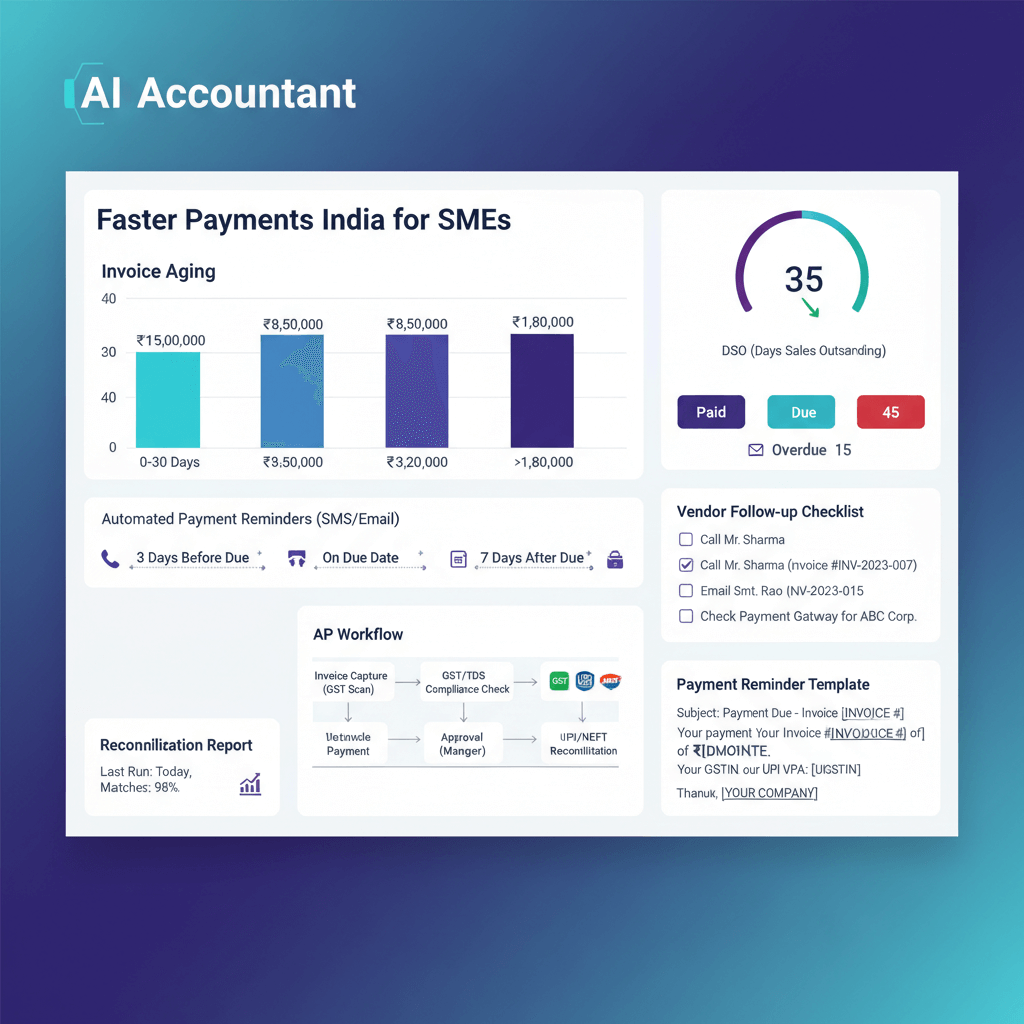
- Automate incrementally, start with OCR bill extraction, GSTIN validation, and mobile approvals, consider tools like AI Accountant for AP automation and GST reconciliation.
- Use structured vendor follow up and professional payment reminders India style, escalate communication thoughtfully, and log every interaction.
- Execute a 30 day roadmap, clean your vendor master, finalize SOPs, launch dashboards, and refine the process based on data.
Understanding why payments get delayed in India
Payment delays rarely begin with cash constraints, they start with broken processes, data errors, and approvals stuck in inboxes. When your vendor records are messy and documentation inconsistent, every step takes longer, then compliance and banking frictions pile on top.
- Process gaps: missing POs, unclear scopes, absent work completion certificates, disputes that drag for weeks.
- Data quality issues: wrong GSTIN, duplicate vendor masters, outdated bank accounts, one incorrect IFSC that stalls transfers.
- Document problems: invoices missing HSN, SAC, or PO references, e-invoicing ignored despite turnover thresholds.
- Approval bottlenecks: single approver unavailable, GRN arrives late, sign-offs stuck in email threads.
- Cash flow planning: no payment calendar, poor visibility of dues, last minute fund scrambling.
- Compliance friction: GSTR 2B mismatches that block ITC, confusion about TDS sections, foreign remittance forms overlooked.
- Banking logistics: maker and checker unavailable together, OTP delays, bank holidays that were not considered.
No PO, no payment. Simple rule, powerful impact.
When you eliminate these root causes systematically, your payment cycle becomes predictable, vendors trust your timelines, and escalations reduce sharply.
Critical India compliance requirements you cannot ignore
MSME payment rules
The MSME Samadhaan framework mandates payment within 45 days for registered MSMEs, delays invite interest at three times the bank rate. Capture MSME status during onboarding and prioritize these payments, one complaint can damage reputation permanently.
GST fundamentals
Ensure correct GSTIN, place of supply, and e-invoicing where applicable. Match purchases with GSTR 2B monthly, if your vendor does not file, your ITC stays blocked, which is cash you cannot use.
TDS accuracy
Apply Section 194C for contract work and Section 194J for professional services, mix ups lead to scrutiny. For foreign remittances, verify 15CA and 15CB requirements before initiating payments.
Pro tip: Keep a TDS matrix by vendor category, amount slab, and service type, review quarterly against regulatory changes.
Building a bulletproof vendor and contractor onboarding process
Strong onboarding prevents most issues. Convert onboarding from paperwork to a control tower that ensures clean data and clear expectations.
- Use a comprehensive onboarding checklist, capture PAN, validated GSTIN, and exact legal names.
- Collect MSME certificates and Udyam numbers, verify on the portal, tag for priority treatment.
- Store bank proof, match account holder name with vendor name, confirm NEFT, RTGS, IMPS, or UPI preference.
- Document payment terms clearly, net 30 or net 45, invoice date versus delivery date, early payment discounts, e-invoice applicability.
- Set expectations, submission cut off time, approval SLA, mandatory supporting documents, dispute window.
- Separate workflows for goods and services, contractors get Statement of Work templates, service providers get milestones and contacts.
- Maintain a single source of truth, even Excel can work if you deduplicate monthly using GSTIN as primary key, back up regularly.
Clean masters, clean payments. Invest once in data hygiene, reap predictability for months.
Designing your accounts payable workflow for zero surprises
Purchase Order discipline
Every PO must specify scope, rate card with tax breakup, milestones for contractors, and timelines. Make the PO reference mandatory on invoices.
Invoice ingestion
Process invoices in a daily slot, scan PDFs in bulk with tools like AI Accountant, QuickBooks, Xero, FreshBooks, or Tally document features. Verify GST fields immediately, flag mismatches early.
Matching rules
For goods, adopt three-way matching, PO, GRN, and invoice must align. For contractors, two-way matching against work order or completion certificate is sufficient.
Approval workflow
Assign primary and backup approvers by slab, under ₹25,000 to team leads, ₹25,000 to ₹1 lakh to department heads, above ₹1 lakh to CFO. Enforce SLA, auto escalate to backup on breach.
Predictable payment runs
Run scheduled Payment runs, weekly on Friday or bi weekly on the 15th and 30th, communicate the calendar to vendors and stick to it.
- Use NEFT for regular transfers, RTGS for urgent high value payments, IMPS for immediate small payments, and UPI for verified small vendors.
Exception handling
Create reason codes, GST mismatch hold, documentation pending, delivery dispute. Track exceptions in a central register, set resolution timelines, and update vendors proactively.
Always send remittance advice with invoice numbers, amount, UTR, and expected credit date, this alone kills most “payment not received” queries.
Mastering vendor follow up and payment reminders India style
Use thoughtful communication, not noise. A clear cadence turns pressure calls into predictable updates.
Follow up hierarchy
Email for routine updates, WhatsApp for urgent matters, phone for critical vendors or bounced emails, escalate to senior management only after exhausting channels.
Communication cadence
- T minus 7 days, pre due check, confirm documents, flag pending items.
- T minus 3 days, reminder, confirm inclusion in the next payment run, ask for missing details.
- On due date, share status and run date, set expectations explicitly.
- T plus 3 days, if delayed, apologize, give new ETA, cite reason code.
- T plus 10 days, escalation call by a senior team member, commit firmly.
Email templates
Pre due reminder: Hi Vendor, invoice number and amount are due on date, GSTIN validated, please confirm GRN or completion certificate status, if complete, we will process in the date payment run.
Due date status: Dear Vendor, invoice approved for payment, scheduled run on date, remittance advice will follow, ensure GSTR 2B filing for smooth reconciliation.
Delay note: Hi Vendor, sincere apology, payment held due to specific reason, new ETA date, delay reason code, share required documents to expedite, we value the partnership.
WhatsApp snippet
Payment update, INV number for amount processed today, UTR number, expected credit date, Finance Team.
Phone script
Hello Name, regarding invoice number due on date, approved and scheduled for date, any concerns we should note, thank you for patience.
Log every interaction, date, channel, contact, and outcome. History resolves disputes faster than memory.
Strategic cash flow planning to prevent payment delays
Visibility, prioritization, and timing deliver reliability.
- Run weekly forecasting on Monday, list dues, flag MSMEs, mark critical suppliers, and note statutory payments.
- Apply a prioritization matrix, statutory dues first, MSMEs second, critical suppliers third, service contractors next, flexible vendors last.
- Use early payment discounts where the annualized return beats working capital cost, track monthly capture rate.
- Schedule around inflows, if you collect on the 7th, pay on the 10th, align with GST filing to optimize ITC, keep contingency buffers.
- Consider vendor financing, collaborate with banks or NBFCs for supply chain finance, vendors get faster money, you get extended terms.
Example: A 2 percent discount within 10 days often annualizes above 36 percent, if your borrowing is 12 percent, take the discount.
Implementing controls and risk management
Build safeguards that prevent costly errors without slowing operations.
- Enforce maker-checker, creators cannot approve, approvers cannot execute, add a third reviewer above ₹5 lakhs.
- Scrutinize vendor master changes, verify bank edits via letterhead request and callback, retain old details for six months.
- Prevent duplicates, watch for repeated invoice numbers, round amounts, invoices just below limits, and date mismatches.
- Plan for bank holidays, track RBI calendar, note second and fourth Saturdays, move runs two days earlier in festival weeks.
- Maintain audit trails, log modifications, record reasons, and store supporting documents for eight years.
Red flags to investigate immediately:
- Same invoice number from different vendors
- Invoice amount exactly at an approval threshold
- Vendor name variations between invoices
- Rush payment requests without documentation
- New vendor seeking large advances
- Very old or future dated invoices
Measuring success with the right metrics
Use simple metrics that drive action rather than vanity dashboards.
- On time approval rate above 95 percent.
- On time payment rate at 90 percent overall and 100 percent for MSMEs.
- Exception rate below 5 percent.
- Average dispute resolution time under seven days.
- DPO aligned with policy, not too low, not too high.
- First time right rate above 85 percent for invoice processing.
- Vendor satisfaction score via quarterly survey, action on results below seven out of ten.
Track trends, month on month movement tells the story, not one snapshot.
Practical automation tools for SMEs
Start small, solve a pain point, then scale.
- Use Excel validation and shared Google Sheets, WhatsApp Business API for notifications, Google Forms for onboarding.
- Adopt OCR bill extraction, AI Accountant, QuickBooks, Zoho Books, Xero, and FreshBooks offer scanning features.
- Integrate GSTIN validation, catch mismatches before they hurt ITC.
- Automate matching rules, set tolerances, auto approve exact matches, route exceptions.
- Build simple dashboards, due queues, overdue by category, approval SLA breaches, cash versus obligations.
- Use mobile approvals to keep the flow moving outside office hours.
One automation at a time, master it, then add the next, complexity too early derails progress.
Your 30 day implementation roadmap
Week 1, foundation
- Clean vendor masters, remove duplicates, validate GSTINs, update bank details.
- Create standardized templates, onboarding checklist, approval matrix, payment calendar.
- Map the current process, identify bottlenecks, list pain points.
- Communicate changes, inform vendors, train the team, set clear expectations.
Week 2, process
- Launch the onboarding routine, capture MSME status, verify documents.
- Start invoice validation, check GST compliance, match with POs, flag exceptions early.
- Implement vendor follow ups, use templates, log all communication.
Week 3, compliance and controls
- Set up GSTR 2B reconciliation, download monthly returns, resolve mismatches quickly.
- Create exception codes, standardize hold reasons, train the team, inform vendors.
- Implement maker-checker without exceptions, document overrides, review weekly.
Week 4, optimization
- Launch dashboards, track core metrics, share with stakeholders.
- Review performance, capture what worked, adjust processes.
- Refine payment reminders India style, incorporate vendor feedback.
- Finalize SOPs, document processes, create training materials, plan quarterly reviews.
Moving forward with confidence
Reducing delays is not about expensive technology, it is about clean onboarding, disciplined workflows, and proactive communication. Fix onboarding, add structured vendor follow up and professional reminders, and your vendors turn into partners.
Build a simple dashboard, celebrate improvements, address degradations quickly. Perfect is the enemy of good, start with spreadsheets and graduate to automation. Vendors value predictability more than speed, consistent net 45 beats erratic payments every time.
For teams needing more automation, especially around GST reconciliation and bill processing, AI Accountant can handle heavy lifting while keeping humans in control. Tools amplify good processes, they do not fix broken ones.
Start today, clean one vendor record, send one proactive update, small actions compound into transformation.
FAQ
How should a CA prioritize vendor and contractor payments during a tight cash week?
Follow a strict matrix, statutory dues first to avoid penalties, MSMEs next due to the 45 day rule, critical suppliers third to protect operations, service contractors after milestone completion, and flexible vendors last. Where necessary, use partial payments to maintain goodwill, for example pay 70 percent now with a documented ETA and reason code for the balance, and communicate proactively.
What is the correct TDS section to apply for contractors versus professionals, and how do I prevent misclassification?
Apply Section 194C for contract work, typically 1 to 2 percent, and Section 194J for professional services, typically 10 percent. Build a vendor category matrix in your AP system, lock TDS sections by vendor category, and use an approval checklist to verify the service description against the section before payment. AI tools like AI Accountant can flag anomalies when invoice descriptions do not align with the registered vendor category.
How can I reconcile GSTR 2B with the purchase register quickly each month for multiple SME clients?
Download GSTR 2B early, standardize your purchase register fields, GSTIN, invoice number, date, taxable value, tax breakup, and PO reference, and run a match routine that flags unmatched invoices and ITC blocks. Prioritize vendors with frequent mismatches and push them to file timely returns. Tools such as AI Accountant can automate matching and generate exception reports by vendor, month, and tax head.
How do I implement maker-checker controls in a very small finance team?
Separate roles even if headcount is lean, creator logs the invoice, approver validates documents and authorizes payment, executor releases funds. For amounts above a threshold, add a third reviewer, often a partner or CFO. Use system logs to capture timestamps and user IDs, and audit overrides weekly. Mobile approvals help maintain flow when approvers are away.
Is e-invoicing mandatory for vendors above ₹5 crores, and what if the vendor is not compliant yet?
Yes, e-invoicing applies above the notified turnover threshold, verify the latest CBIC notifications for the exact limit. If a vendor is required but not compliant, request the IRN and QR code, short pay or hold until compliance is met, and share a timeline for release. For critical suppliers, assist with onboarding to e-invoicing via a consultant or an AI tool like AI Accountant that supports e-invoice validation.
How can a CA set up three-way matching for GST invoices when the client uses Tally or Excel?
In Tally, configure PO, GRN, and invoice modules, ensure item codes, quantities, and tax breakup match across documents. In Excel, design a template with PO, GRN, and invoice tabs, use lookup functions to align quantities and rates, and flag variances beyond tolerance. Consider adopting a workflow tool that integrates three-way matching natively for goods, and two-way for services.
What is the best cadence for vendor payment runs in Indian SMEs, weekly or bi-weekly?
Weekly runs provide faster cycles and better predictability for vendors, bi weekly runs on the 15th and 30th align well with typical inflows. Select a cadence that matches your collection patterns, then communicate and stick to it. Publish the calendar, remind vendors during onboarding, and send remittance advice after every run to reduce status queries.
How should I handle vendors who are not GST compliant but are business critical?
Short pay the tax component and hold separately, obtain a written undertaking with a timeline to comply, and escalate to senior management at the vendor if delays persist. Educate them on ITC impact with numbers, offer consultant contacts, and help register. Document decisions and reason codes for audit readiness.
How do I structure an approval matrix that balances speed and control?
Define slabs by amount, assign primary and backup approvers for each slab, and set SLAs, for example 24 hours below ₹50,000 and 48 hours above. Auto escalate on breach to backups. Keep documentation simple, capture PO, GRN or completion certificate, GST validation, and reason codes for exceptions. Use mobile approvals to prevent idle time.
What early payment discount strategy should I recommend to clients, and how do I measure ROI?
Compute the annualized return of offered discounts, 2 percent for 20 days early often annualizes above typical borrowing costs. Prioritize discounts from reliable vendors, integrate discount fields into the invoice register, and report monthly capture rates. If borrowing cost exceeds discount yield, defer, otherwise take the discount consistently.
How do I implement vendor financing or supply chain finance without overcomplicating operations?
Partner with a bank or NBFC that offers simple onboarding, vendors opt in, invoices are financed at a small fee, you pay later under extended terms. Start with a pilot group of vendors, measure cycle time improvement and dispute rates, then expand. Ensure your AP system marks financed invoices distinctly to avoid double processing.
What is a practical way to reduce payment status queries from vendors?
Provide self service, publish the payment calendar, share a simple status portal or periodic email listing invoices queued for the next run, and always send remittance advice with UTR and expected credit date. Maintain a communication register per vendor, and assign query champions for top vendors to resolve issues rapidly. Tools like AI Accountant can automate status notifications via email or WhatsApp Business API.
How can I design a disputes process that closes within seven days?
Use structured reason codes, documentation pending, GST mismatch, quantity variance, rate dispute, or scope change. Assign a clear owner per dispute, define a resolution SLA, and hold a daily stand up for open items. Offer partial pay where feasible to keep the relationship healthy, and record outcomes in the audit trail for future prevention.
What reports should I share with management to demonstrate AP discipline and vendor satisfaction?
Share a weekly dashboard, on time approval and payment rates, exceptions by category, dispute resolution time, DPO trend, and a quarterly vendor satisfaction score. Include action items for any metric below thresholds, for example exceptions above 5 percent or satisfaction below seven out of ten. Highlight wins, MSME on time rate at 100 percent, and early payment discount savings achieved.

Rohan Sinha is a fintech and growth leader building aiaccountant.com, focused on simplifying accounting and compliance for Indian businesses through automation. An IIT BHU alumnus, he brings hands-on experience across 0 to 1 product building, growth, and strategy in B2B SaaS and fintech.