-01%201.svg)
Key takeaways
- A 30 day sprint, done right, cuts 8 to 15 percent of operating expenses while protecting growth, and improves working capital by 10 to 20 DPO days
- Start with clean twelve month data, unify categories, then move fast on quick wins like unclaimed GST credits, unused SaaS seats, and renegotiated courier slabs
- Deep vendor analysis and zero based budgeting reveal hidden cost drivers, then Week 3 negotiations convert insight into signed savings
- Track booked versus realized savings, use a robust working capital dashboard and enforce monthly governance to prevent savings drift
- India specific levers matter, verify GST credit eligibility, TDS treatment, MDR rates on payment gateways, and slab pricing for logistics
- Cloud costs often drop 20 to 35 percent via rightsizing and commitments, see these cloud moves that paid off for repeatable tactics
- Use tools like AI Accountant to automate reconciliation, dashboards, and compliance so realized savings flow to cash
Introduction, What is a cost optimisation sprint and why Indian SMBs need it now
A cost optimisation sprint is a focused thirty day initiative where your team systematically identifies and eliminates unnecessary spending, without hurting growth. Unlike panic driven cuts that damage momentum, a sprint uses data and governance to make smart decisions about where every rupee goes.
For Indian SMBs, working capital pressures, GST complexities, and intense competition make even small inefficiencies costly. A well executed sprint typically delivers 8 to 15 percent reduction in operating expenses, and improves Days Payable Outstanding by 10 to 20 days. Recent data shows disciplined cost governance reduces cloud waste by double digits, and improves forecasting accuracy, but India specific realities like GST credit eligibility, TDS, payment gateway MDR, courier slab pricing, and vendor payment cycles demand a tailored playbook.
Move fast, but measure rigorously, every day of delay costs money, and disciplined execution converts analysis into cash.
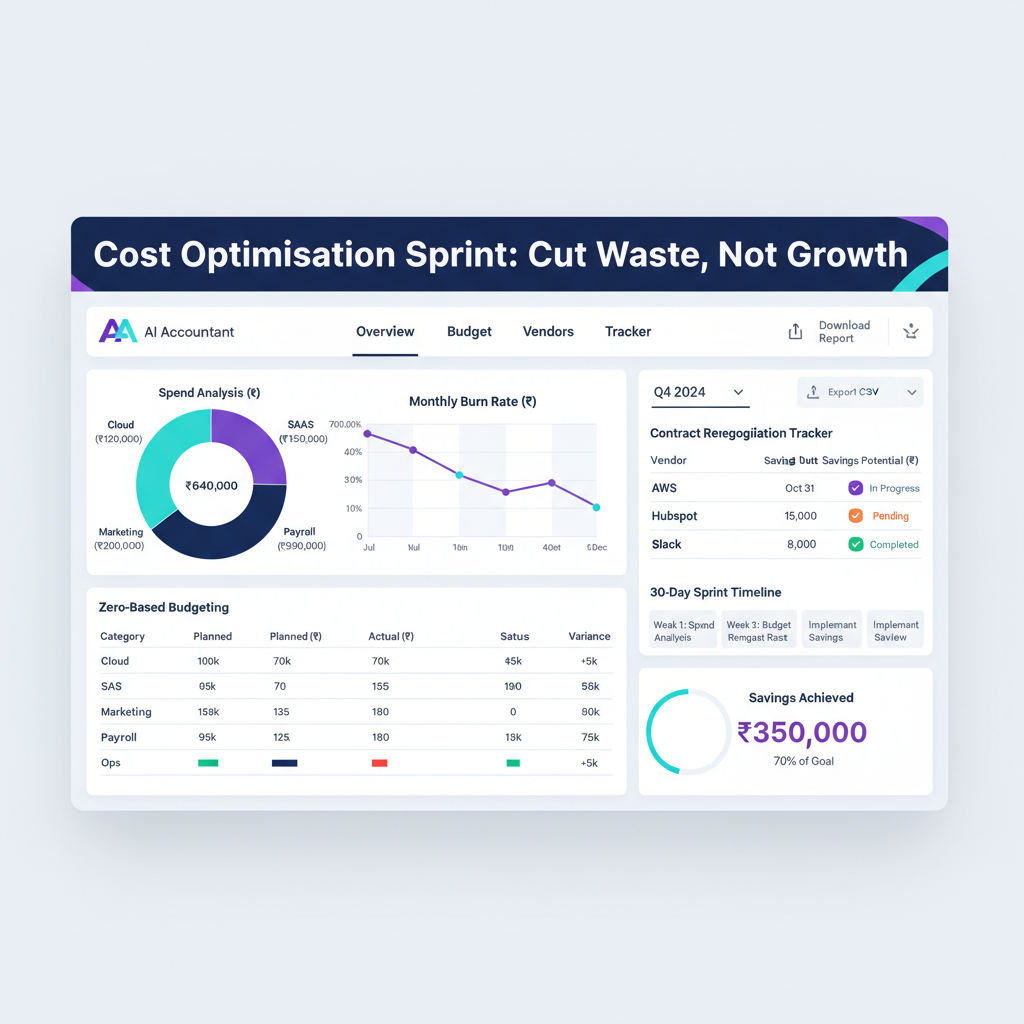
Your 30 day cost optimization timeline
Week 0, Data readiness
Gather twelve months of financial data, categorize spending, flag quick wins. The foundation determines your sprint’s success.
Week 1, Vendor spend analysis
Perform deep analysis on your top vendors, typically 70 to 80 percent of spending. Identify cost drivers and negotiation levers.
Week 2, Zero based budgeting
Rebuild budgets from scratch, justify every rupee, set spending caps that prevent future drift.
Week 3, Contract renegotiation
Execute negotiations with priority vendors, convert insights into signed savings.
Week 4, Savings tracking and governance
Ensure negotiated savings translate to realized cash, enforce monthly review rhythms.
Week 0, Setting up your data foundation for cost analysis
Spend three to five days building a single source of truth before analysis begins. Pull bank statements from all operating accounts, collect vendor invoices to confirm commercial terms and GST eligibility, export Tally or Zoho ledgers to validate categories, and include payment gateway statements from Razorpay or PayU for MDR and settlement fees.
Standardize categories that reflect India’s spend profile, Marketing and Customer Acquisition, Cloud and Infrastructure, SaaS and Tools, Logistics, Professional Services, Rent and Utilities, Finance and Banking. Build a baseline model in a simple spreadsheet, vendor name, category, twelve month total, monthly average, GST eligibility, recurring versus one time, and ownership.
Flag quick wins immediately, consolidate duplicate vendors, claim missed GST credits, review bank charges against benchmarks, cancel unused SaaS licenses with zero logins, and tighten auto renewals. These fixes deliver immediate savings while larger initiatives ramp.
- Reduce NEFT charges from ten rupees to two rupees per transaction
- Claim eligible GST input credits worth lakhs
- Consolidate courier accounts for volume discounts
- Eliminate dormant subscriptions and excess seats
Week 1, Deep vendor analysis to find hidden cost drivers
Run Pareto analysis, rank vendors by twelve month spend, focus on the top twenty who represent most addressable costs. For a company spending five crores annually, top vendors might include Blue Dart, AWS, Microsoft 365, outsourced call center, and office rent, see this India IT services versus domestic hiring cost analysis for context.
Cloud, analyze compute utilization, storage patterns, and data egress, rightsizing often saves 20 to 30 percent, lifecycle policies push cold data to cheaper tiers, CDNs reduce expensive transfer.
Logistics, examine weight slab utilization and zone pricing, shipments averaging 480 grams may pay the 500 gram slab unnecessarily, review returns which often exceed forward rates, and cash on delivery fees that accumulate quickly.
SaaS, audit usage versus paid licenses, trim seats to active users, downgrade tiers if premium features go unused, switch monthly to annual where justified to save 15 to 20 percent.
India specific checks, ensure invoices show correct GSTIN for input credit, confirm TDS deductions and certificates, benchmark MDR at scale, negotiate net banking and UPI rates, and assess foreign exchange spreads on international payments.
Build a target list, current spend, cost drivers, negotiation levers, realistic savings, owner, and timeline. This execution roadmap powers Week 3.
Week 2, Implementing zero based budgeting across functions
Zero based budgeting forces justification of every expense from scratch, preventing spending creep. Host half day workshops with Marketing, Sales, Operations, Technology, and Administration. Start with revenue forecasts, growth targets, and working capital constraints.
Classify each item as must spend or nice to have. Must spend, locked commitments, compliance requirements, revenue critical items like payment gateway fees. Nice to have, discretionary items that can be deferred, premium features, travel, non essential vendor add ons.
Define metrics that justify cost, Marketing linked to CAC and payback, Logistics aligned to delivery times and SLAs, Cloud mapped to users and latency targets. Create per function templates, AWS compute tied to concurrency, CRM costs tied to active accounts and interactions, Blue Dart linked to shipment volumes and delivery promises.
Lock monthly caps and enforce exceptions, any variance exceeding ten percent requires CFO approval, this adds accountability while preserving flexibility for genuine needs.
Week 3, Executing vendor negotiations for real savings
Prioritize using an impact matrix, focus on high spend vendors with high leverage. Logistics markets are competitive, cloud providers reward commitments, SaaS vendors discount to avoid churn.
Logistics levers, commit to minimum monthly volumes, negotiate slab boundaries, prepay quarterly for additional discounts, cap zone based variation, lock return shipment rates. Example script, “We ship 1.5 million units monthly at 30 rupees per unit, competitors offered 26 rupees, match that rate with a twelve month volume commitment and quarterly prepayment discounts, and we will continue our partnership.”
Cloud levers, reserved instances save 20 to 35 percent, savings plans add flexibility, spot instances for non critical workloads, storage lifecycle optimization, and enterprise support that unlocks optimization assistance, study these cloud moves that paid off to repeat winning patterns.
SaaS levers, annual prepayment for 15 to 20 percent discounts, multi year price protection, reduce seats to active users, downgrade tiers if premium features are unused, bundle products for package rates.
Payment gateway levers, for Razorpay or PayU, use volume to negotiate MDR down from 1.5 percent to around 1.1 percent, push for zero percent on UPI, reduce net banking, cap settlement fees and FX spreads.
Include India specific amendments, correct GST rates and tax invoice requirements for input credits, TDS terms and certificate timelines, extended payment terms to 45 or 60 days to improve DPO, SLA penalties for failures.
After signing, update Tally or Zoho vendor masters with new rates, revise purchase order thresholds, notify operations teams, and set renewal reminders to avoid auto renew surprises.
Week 4, Building systems for sustained cost control
Booked savings mean little unless realized. Create a savings tracker that distinguishes booked versus realized cash. Track monthly with owner accountability, and blockers preventing realization.
- Savings trend dashboard, booked versus realized over ninety days, target at least eighty percent realization
- Working capital dashboard, monitor DPO improvements and cash runway impact
- Category spend dashboard, compare actuals versus ZBB caps, auto alerts for more than ten percent variance
Establish governance, weekly fifteen minute operations syncs to clear blockers, monthly ninety minute savings reviews with CFO and function heads to approve exceptions and resolve escalations.
Reconcile monthly with your CA, sample invoices to verify new rates, adjust accruals to reflect baselines, validate GST and TDS treatments. To prevent savings drift, lock rate cards in accounting systems, mandate exception approvals, monitor vendor satisfaction, and schedule quarterly re baselines.
Common blockers, vendors invoicing at old rates, operations unaware of new terms, systems not updated, and purchase orders issued before negotiations. Address these systematically through weekly reviews.
Measuring success, key metrics and realistic targets
Primary metrics, operating expense reduction in addressable categories of 8 to 15 percent, realization rate above eighty percent in ninety days, Days Payable Outstanding improvement of 10 to 20 days, and ZBB variance held within 110 percent monthly and 100 percent on a rolling three month average.
Secondary metrics, GST credit recovery at 100 percent of eligible invoices, TDS compliance with zero mismatches, cloud costs aligned to 1.5 to 3 percent of revenue, and CAC payback under six months even with lower marketing spend. For perspective, use a web app development cost comparison mindset to benchmark external service rates against deliverables and total cost of ownership.
Typical Indian SMB targets, logistics cost reduction of 4 to 8 percent via slab optimization, cloud savings of 15 to 20 percent via commitments and rightsizing, SaaS reduction of 20 to 30 percent by eliminating unused licenses, and payment gateway savings of 25 to 30 percent via MDR renegotiation.
Essential tools and templates for your sprint
Recommended cost management software
- AI Accountant, automates bookkeeping, reconciliation, GST and TDS tracking, and generates real time dashboards for Indian SMBs, ideal for tracking cost initiatives and realized savings
- QuickBooks, comprehensive accounting with expense tracking and vendor management
- Xero, cloud based accounting with strong categorization
- FreshBooks, simple expense tracking for smaller teams
- Zoho Expense, integrated expense management with approvals
Templates that accelerate execution
- Vendor spend analysis spreadsheet, vendor name, category, twelve month total, monthly average, GST eligibility, recurring versus one time, quick wins, owner
- ZBB template per function, line items, business justification, driver metrics, current spend, approved budget, variance explanations
- Contract negotiation checklist, competitor research, market benchmarks, BATNA, business case, post signature operational updates
- Email templates for vendors, current spending, proposed terms, alternatives under evaluation, decision timeline
- Savings tracker, initiative ID, vendor, category, lever, baseline, new terms, booked savings, realized savings, realization percentage, owner, status, blockers
- Monthly governance agenda, savings performance, deep dives, pipeline reviews, working capital impacts, action items with owners and deadlines
Common pitfalls and how Indian SMBs can avoid them
- Cutting growth drivers without unit economics, ensure CAC and LTV remain viable, protect revenue critical channels
- Ignoring hidden costs when switching vendors, consider total cost of ownership, service quality, transition complexity
- Failing to update systems post negotiation, immediately change rate cards, vendor masters, and approvals
- Mishandling GST and TDS, verify GSTIN details, document TDS responsibilities, collect certificates promptly
- Over negotiating and damaging relationships, understand vendor margins, maintain communication, protect service levels
- Assuming linear savings, separate one time recoveries from run rate improvements, model scenarios for seasonality and inflation
- Losing discipline after the sprint, embed monthly governance, automate exception approvals, and re baseline quarterly
Getting started this week, your immediate action plan
Today, schedule a kickoff with CFO, finance controller, and function heads, define addressable cost scope, assign a data owner to begin collecting records.
Days 2 to 5, collect twelve months of bank statements, invoices, and ledger exports, run Pareto analysis to identify the top twenty vendors, flag quick wins such as GST credits and unused subscriptions.
Day 7, complete your baseline spend model and validate with finance, align scope and timeline, schedule Week 1 analysis sessions.
Week 2, conduct deep vendor analysis and build a prioritized target list with owners and levers.
Week 3, run zero based budgeting workshops, lock monthly caps and exception policies.
Week 4, launch priority negotiations, update systems and rate cards immediately upon signing.
Day 30, activate your savings tracker and governance rhythm, schedule the first monthly review.
You are shifting from reactive spending to proactive cost management, the discipline and systems you build in thirty days will generate savings for years.
Conclusion, making cost optimization part of your DNA
A well executed sprint delivers immediate financial benefits and lasting capabilities. Expect 8 to 15 percent expense reduction, 10 to 20 DPO days unlocked, clearer unit economics, and sustainable governance.
For Indian SMBs, the sprint addresses GST optimization, TDS compliance, payment gateway charges, and vendor payment cycles. With this playbook, you navigate local complexities while adopting international best practice cost management.
The financial impact is substantial, a company spending 1.25 crores monthly can save 15 to 20 lakhs per month, and improve working capital by 4 to 6 crores, extending runway and improving EBITDA margins.
More importantly, you build a culture where every rupee is consciously allocated, vendors are partners, and financial discipline enables growth. Start your sprint this week, move fast, measure everything, and sustain improvements over time.
FAQ
How should a CA structure a thirty day cost optimisation sprint for an SMB client without disrupting operations
Set a clear scope of addressable costs, usually 50 to 80 percent of opex. Week 0, build a twelve month baseline. Week 1, vendor analysis. Week 2, zero based budgeting. Week 3, negotiations. Week 4, governance and realization tracking. Use AI Accountant for ledger reconciliation and dashboarding so operations continue smoothly.
What datasets are mandatory to kick off vendor analysis, and how do I validate completeness
Bank statements for all operating accounts, vendor invoices and contracts, Tally or Zoho general ledger exports, payment gateway statements, and payroll or contractor registers. Validate by reconciling bank cash outflows to ledger totals, and sampling invoices for GST and TDS correctness. AI Accountant can auto flag gaps and mismatches.
How do I quantify booked versus realized savings for CFO reporting
Booked savings are contract rate reductions multiplied by projected volumes, realized savings are the actual delta in paid invoices against baseline. Maintain a tracker with initiative ID, vendor, baseline, new rate, booked, realized, and realization percentage. Automate monthly computation with AI Accountant, and include blockers and owner notes.
What levers deliver fastest savings in logistics for D2C clients, any India specific checks
Optimize slab boundaries, commit volumes for better rates, prepay quarterly, cap zone based pricing, and lock return shipment rates. India specific checks include GST compliant invoices for input credits, COD fee controls, and accurate addressability for metros versus tier 2. Track returns, first attempt delivery, and reweight disputes.
How should a CA present zero based budgeting outputs to business heads who resist cuts
Frame ZBB as growth enabling, not cost cutting. Tie each line item to business drivers, CAC payback, delivery SLAs, and user performance. Present must spend versus nice to have lists, show tradeoffs and opportunity costs, and set exception rules above ten percent variance. Demonstrate with AI Accountant dashboards how savings extend runway and improve EBITDA.
What is the best way to renegotiate MDR with Razorpay or PayU for a high volume merchant
Benchmark MDR by instrument and volume, present a twelve month volume commitment, request 1.1 percent for cards, zero percent for UPI, reduced net banking charges, capped settlement fees, and transparent FX spreads. Include SLA targets for uptime and settlement timing. Track realized MDR deltas in a savings dashboard.
How can I prevent savings drift after successful negotiations, teams tend to revert to old habits
Lock rate cards in accounting systems, require CFO approvals for changes, enforce ZBB caps with automated alerts, and run monthly governance reviews. Train operations on new terms, update POs, and reconcile invoices against contracted rates. AI Accountant can auto flag invoices at old rates and route exceptions.
What cloud optimisation steps are most defensible to auditors and investors
Rightsizing instances based on utilization metrics, reserved instances and savings plans with documented business cases, storage lifecycle policies for cold data, and CDN use to reduce egress. Reference vendor recommendations and internal performance baselines. Maintain before after evidence, and link decisions to these cloud moves that paid off.
How do I handle GST credits and TDS deductions during the sprint without creating compliance risks
Verify vendor GSTIN and tax invoice correctness, reconcile input credits monthly, and document TDS responsibilities in contracts with certificate timelines. Sample invoices post negotiation to validate updated tax treatments. Use AI Accountant to auto reconcile GST and TDS, and produce exception reports for quick resolution.
What targets should I set for an SMB spending 1.25 crores monthly, to keep expectations realistic
Operating expense reduction of 8 to 15 percent, realization above eighty percent in ninety days, DPO improvement of 10 to 20 days, GST credit recovery at 100 percent, and cloud costs within 1.5 to 3 percent of revenue. Logistics savings of 4 to 8 percent, SaaS savings of 20 to 30 percent, and MDR reductions to near 1.1 percent for cards.
How can an AI driven tool like AI Accountant reduce manual workload during the sprint
It automates bank reconciliation, invoice sampling, GST and TDS checks, variance alerts against ZBB caps, and real time dashboards for booked versus realized savings and working capital. This frees the finance team to focus on negotiations and governance while maintaining audit ready documentation.
What evidence pack should a CA prepare to demonstrate sustained savings to the board
Include baseline spend model, signed contracts with new terms, monthly savings tracker, realized savings proofs, governance meeting minutes, exception approvals, and compliance reconciliations for GST and TDS. Add before after operational KPIs, delivery SLAs, and cloud performance metrics, with AI Accountant dashboards as the single source of truth.