-01%201.svg)
Key takeaways
- Cloud based accounting gives startups real time numbers, shared access, and a single source of truth, replacing scattered spreadsheets and email threads.
- Early adoption improves investor readiness, reduces errors through automation, and supports scale across entities, locations, and currencies.
- Pick core features like live dashboards, bank and gateway reconciliations, compliance workflows for GST and TDS, a document repository, and AI insights.
- Compliance in India needs steady GST, TDS, Income Tax, and ROC tracking, with reconciliations that tie books to returns and audit support.
- A structured setup checklist, a monthly close, and a compliance calendar keep filings timely and audit trails clean.
- The right metrics include cash burn and runway, margins, MRR and ARR for SaaS, AR and AP aging, GST and TDS positions, and a repeatable board pack.
- CA led managed services like AI Accountant Virtual Accounting combine execution with a live dashboard, delivering speed to value and dependable closes.
What is cloud based accounting for startups
Cloud based accounting for startups means your books sit on secure remote servers, not on one desktop. The system connects to your bank and payment gateways, pulls in data, updates ledgers, and builds reports in real time. You can log in from any device, and your CA, founder, and finance hire can all work in the same place with role based access and audit trails.
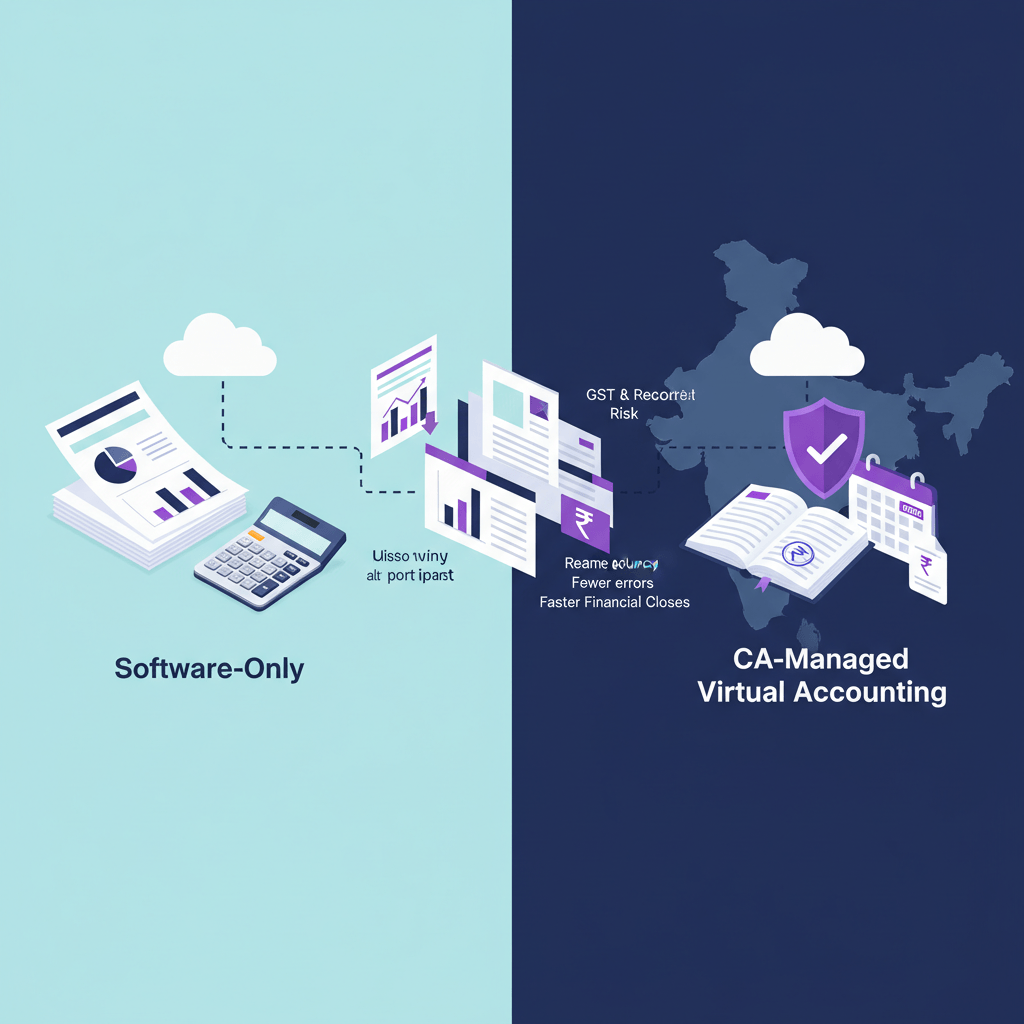
In a software only model, your team owns the updates and checks. In a managed virtual accounting model, a CA team runs entries, reconciliations, filings, and reviews while you keep the dashboard view at all times. This is different from desktop tools and Excel, which need installs, heavy manual entry, and awkward file sharing. With cloud, you avoid version control pain and lost attachments, and you gain one source of truth.
Strong security is non negotiable, so pick platforms with encryption at rest and in transit, role based access, and audit logs for safe collaboration.
Further reading: Cloud based financial solutions, Benefits of cloud accounting for startups.
Why startups should adopt cloud based accounting early
- Real time visibility: See revenue, expenses, profit or loss, cash flow, burn rate, and runway at a glance, with fewer surprises and better decisions.
- Automation for accuracy: Bank feeds and gateway rules reduce manual errors, saving hours each week.
- Investor readiness: Clean books, audit trails, MIS, and board packs build trust and speed diligence cycles.
- Collaboration: One shared system for founders, finance hires, and your CA cuts back on email and chat clutter.
- Scalability: Handle multi entity, multi location, and multi currency needs as you grow from freelancer to D2C to SaaS at seed or Series A.
Explore perspectives: Kosh on cloud accounting, Langdowns DFK overview, Infosys BPM take.
Core features to look for in cloud based accounting for startups
Live financial dashboard
See income and expense categories, trends, cash flow, burn, runway, and recent transactions in one glance view.
Bank and payment gateway reconciliation
Use auto matching, rules, alerts, and clear tie outs for gateways, essential for D2C and subscription sales. Deep dive: Payment gateway integration for accounting.
Compliance workflows
Track E invoice, GSTR 1, GSTR 3B, annual returns, and TDS challans and returns like 24Q and 26Q inside a structured workflow.
Document repository
Keep invoices, contracts, and working files in one labeled repository so audit support is ready on demand.
In platform collaboration
Maintain a chat channel with your CA team for questions, clarifications, and approvals to keep a clean record.
AI generated insights
Flag anomalies, late dues, cash shortfalls, and unusual spikes, so you can act before month end.
AR, AP, assets, and inventory
Manage aging, reminders, credit notes, payment plans, fixed asset registers, and inventory reconciliations when needed.
Compliance calendar
Track GST, Income Tax, TDS, and ROC dates, including payroll TDS, with owners and SLAs.
Security and controls
Use role based access, maker checker approvals, and audit logs to protect data and support internal controls.
Example service: AI Accountant Virtual Accounting blends these features with a CA team for execution plus a live dashboard for visibility. See more: Cloud based financial solutions.
Compliance essentials for Indian startups
GST
Register when turnover crosses 20 lakh, or 10 lakh in special states. Know place of supply, RCM, and HSN or SAC codes. If aggregate turnover is above 5 crore, enable E invoicing linked to GSTR 1. File GSTR 1 and 3B monthly or quarterly as per scheme, and annual returns GSTR 9 and 9C as applicable. Keep reconciliations between books and returns current.
TDS
Deduct under the right sections, such as 194C for contractors, 194J for professionals, and 192 for salaries. Pay challans monthly and file quarterly returns like 24Q and 26Q, and 27Q for non resident payments when applicable. Reference: TDS compliance services guide.
Income Tax
Plan advance tax in four parts. File ITR by July 31 for many cases. Prepare for tax audit if turnover exceeds the current threshold, and keep support files tidy.
ROC and MCA
For small companies, file MGT 7 annual return, AOC 4 financial statements, complete DIR 3 KYC, hold board meetings and an AGM, and maintain statutory registers and minutes.
Ongoing health checks
Match GST 2A or 2B with purchases, reconcile Form 26AS with TDS and income, and tie books to returns regularly. A CA led managed service like AI Accountant Virtual Accounting can keep these aligned while you focus on product and sales.
Setup checklist for cloud based accounting for startups
Choose your model
Decide between software only and a CA led managed service. With software only, your team runs daily work and filings. With managed service, a CA team executes with SLAs. Guide: Accounting solutions for startups.
Tailor the chart of accounts
Design a chart of accounts for your model, for example SaaS needs MRR, ARR, deferred revenue, and revenue recognition logic, while D2C needs channel splits, discounts, returns, and gateway fees.
Connect banks and gateways
Link bank accounts and payment gateways, pull feeds, set coding rules, and import past data for trend lines.
Define invoicing and GST logic
Set invoice formats, enable E invoice above 5 crore aggregate turnover, map place of supply, tax rates, and HSN or SAC codes.
Set a monthly close cadence
Fix cut off dates, reconcile bank and gateways, close ledgers by a set day, and lock the period after review.
Configure roles and approvals
Create user roles, approval flows for payments and journals, and maker checker to reduce risk.
Organize documents
Plan folders for invoices, contracts, bank proofs, GST and TDS support, and working sheets, and store them in the repository with simple naming rules.
Build MIS reports
Create P and L by function and channel, add cash flow, burn, runway, cohorts, and unit economics for SaaS or D2C, and save a standard board pack.
Create a compliance calendar
Map GST, TDS, Income Tax, and ROC dates with owners and backups, agree on SLAs with your CA team, and set reminders.
Learn more: Cloud based financial solutions.
Metrics and reports startups should track
- Cash, burn, and runway: Track monthly and monitor cash conversion cycle.
- Margins: Review gross and contribution margins. For D2C include discounts, returns, shipping, and gateway charges. For SaaS include hosting and support.
- Subscriptions: Track MRR, ARR, net revenue retention, churn, and expansion.
- Working capital: Monitor AR aging, AP aging, DSO, and DPO.
- Tax positions: Track GST payable, input tax credit, TDS liabilities, and advance tax.
- Board pack: Send a monthly pack with P and L, balance sheet, cash flow, key metrics, a short variance note, and open risks.
Reference: Cloud based financial solutions.
Cost and ROI of cloud based accounting for startups
Look at total cost of ownership, not only software licenses. Consider founder and staff time, delays, and penalties. Managed services add a fee, yet remove effort and risk, often onboarding faster and shipping MIS on time.
Speed to value: A CA led managed service can onboard in about 30 days, then deliver a steady monthly close. Oversight shifts from founder push to CA accountability for reconciliations and filings.
ROI comes from fewer errors, on time compliance, and faster fundraises, with many startups seeing payback in six to twelve months through saved penalties, tighter cash control, and sharper investor updates. See context: NAMA Ventures, Kosh.
Common pitfalls and how to avoid them
- Late filings: Use a compliance calendar with owners, backups, and reminders, and review status each week.
- Messy reconciliations: Reconcile banks and payment gateways weekly, not quarterly, and fix breaks fast.
- Mixed personal and business spend: Keep a separate business bank account and card, and record owner drawings and reimbursements clearly.
- No monthly close: Close books monthly, lock the period, and review variances with a simple checklist.
- Scattered chats and documents: Keep approvals in the system chat and store support in the repository, not in WhatsApp, so the audit trail stays clean.
Checklist support: Cloud based financial solutions.
Mini case vignette, D2C startup transformation
Before: A D2C brand ran on spreadsheets, gateway fees were not tied out, GSTR 3B was sometimes late, margins were unclear, and burn and runway were a guess.
After: With cloud based accounting and a CA led team, banks and gateways reconciled 100 percent each month, E invoices were automatic, category margins were clear, burn and runway were live on the dashboard, and GST and TDS were filed on time. The founder received a clean board pack monthly and answered investor questions in hours, not weeks. See approach: Cloud based financial solutions.
How AI Accountant Virtual Accounting fits
AI Accountant Virtual Accounting is a CA led managed accounting and compliance service with a central dashboard. A qualified CA team runs your books, reconciliations, GST, TDS, Income Tax, and ROC tasks. Payroll TDS and advisory are included. You get a single source of truth that you can see anytime.
On the dashboard you see revenue, expenses, profit or loss, balances, cash flow, burn, and runway, with drill downs to recent transactions. You also get AI generated insights that highlight due dates, unusual spend, and cash gaps.
The service covers monthly bookkeeping, ledger clean up, year end closing, fixed asset registers, inventory reconciliations, AR and AP management, payment gateway and bank reconciliations, and MIS reporting, plus support for statutory auditor coordination.
GST: Registration, monthly and quarterly filings such as GSTR 1 and 3B, annual filings like GSTR 9 and 9C, E invoice enablement, health checks, reconciliations, and advisory on place of supply, RCM, HSN, and rates.
Income Tax and TDS: ITR filing for individuals, partnerships, and companies, TDS advisory and compliance with challans and returns like 24Q, 26Q, 27Q, and property related forms like 26QB, 26QC, and 26QD, plus advance tax plans, tax audit prep, international tax advisory, expat tax, salary structuring, and 15CA preparation.
ROC for small companies: MGT 7, AOC 4, MSME filings, DIR 3 KYC, director changes, board meetings and minutes, AGM support, statutory registers, board report, and the annual report.
Onboarding is simple, with discovery, migration, and integrations, aiming to ship your first MIS within 30 days. Learn more: Cloud based financial solutions.
How to choose the right cloud based partner
- SLAs: Ask about close timelines, filing cut offs, and remedies if a date is missed.
- Reconciliation scope: Confirm all banks and gateways, frequency, and level of proof retained.
- Security and exit: Clarify data ownership, access controls, and how you receive your data if you leave.
- Audit readiness: Request a sample MIS and audit support pack, including trails, schedules, and labeled documents.
- Live demo and references: Meet the CA who will manage your account, and request case notes from similar stage startups.
Reference materials: Cloud based financial solutions.
Action plan for founders to go live
Weeks 1 to 2
Define needs, choose software only or a CA led managed service, draft your chart of accounts, and shortlist partners.
Weeks 3 to 4
Integrate bank feeds and payment gateways, migrate past data, configure invoicing and GST logic, set roles, and build the compliance calendar.
Month 2
Do your first monthly close, ship your first MIS, review burn and runway, and fix any gaps.
Month 3 and beyond
Start monthly KPI reviews, run GST 2A or 2B matching, review 26AS, improve controls and approvals, and keep documents neat. Guide: Cloud based financial solutions.
Closing thoughts
Cloud based accounting gives you real time visibility, compliance confidence, and scale. It cuts errors, speeds filings, and makes investor conversations smoother. Start with a tight setup, keep a monthly rhythm, and let your CA team plus dashboard do the heavy lifting while you grow.
If you want a simple path, book a demo with AI Accountant Virtual Accounting, see live P and L, cash flow, burn, and runway, and work with a CA led team that runs execution while you stay in control. Learn more: Cloud based financial solutions.
FAQ
What tangible outcomes should I expect in the first 90 days if I shift to a CA led virtual accounting model
In a well run engagement you should see a completed migration, connected bank and gateway feeds, a working chart of accounts with product and channel level reporting, the first monthly close on a fixed calendar, GSTR 1 and 3B filed on time, TDS challans and returns initiated, and a standard board pack. AI Accountant, as an AI enabled Virtual Accounting service, typically targets first MIS within 30 days, then moves to stable monthly closes with reconciliations at 100 percent for banks and gateways.
How do founders maintain control when a third party CA team runs the books
Control comes from role based access, maker checker approvals, and a real time dashboard. You approve payments and journals in workflow, you can drill into transactions and audit logs, and you lock periods after review. Services like AI Accountant provide in platform chat and a compliance calendar so you always see pending items, owners, and SLAs.
What is the simplest chart of accounts structure for a SaaS startup with monthly and annual plans
Keep revenue split by plan type and region, track discounts and refunds separately, use deferred revenue and revenue recognition schedules, and book hosting and support under cost of service for contribution margin clarity. Add MRR and ARR reporting views. An AI enabled model like AI Accountant can auto tag transactions and generate MRR bridges.
For D2C, how do I reconcile payment gateways and account for returns and COD variances without manual drudgery
Use automated gateway statements, rule based matching, and variance flags for fees, chargebacks, and COD settlements. Post returns to a separate contra sales account and net against discounts to keep category margins clean. AI Accountant typically sets rules per gateway and surfaces breaks on the dashboard for same week fixes.
What compliance controls should a finance head mandate to avoid GST and TDS penalties
Have a dated compliance calendar with owners and backups, weekly review of E invoice status, monthly 2A or 2B matching, maker checker for challans, and quarter end tie outs to Form 26AS. Keep a document repository with invoices and workings. Managed teams like AI Accountant embed these checks into the monthly close so filings ship on time.
How do I become investor ready from a finance and MIS standpoint before a seed or Series A raise
Stabilize monthly closes, reconcile banks and gateways fully, align books to GST and TDS returns, and publish a clean board pack with P and L, balance sheet, cash flow, unit economics, runway, and a short variance note. Maintain audit trails and labeled schedules. AI Accountant also prepares an audit support pack so diligence questions are answered in hours, not weeks.
Can cloud based accounting handle multi entity and multi currency structures common in cross border SaaS
Yes, with proper COA design, entity level books, intercompany transactions, and consolidation. For multi currency, use functional currency settings, revaluation rules, and realized or unrealized FX tracking. A CA managed service like AI Accountant sets this up and documents policies for audit readiness.
What KPIs should the CFO track monthly to manage cash and growth without surprises
Cash burn and runway, cash conversion cycle, AR aging and DSO, AP aging and DPO, contribution margin by product or channel, MRR, ARR, net revenue retention, churn, expansion, and tax positions for GST and TDS. These should appear in a standard board pack with trends and exception notes. AI Accountant auto compiles and publishes this pack each month.
How do we ensure data security and exit rights when working with a managed virtual accounting provider
Confirm encryption in transit and at rest, role based access, audit logs, and least privilege. Document data ownership in the contract, require periodic exports, and define an exit plan with a full data dump in open formats. AI Accountant follows these principles, with clear access policies and handover procedures.
What is the real ROI of moving from a founder managed spreadsheet workflow to a CA managed cloud stack
ROI shows up as reduced penalties, fewer errors, faster closes, and better cash control, which enables tighter working capital and shorter fundraise cycles. Many teams see payback within six to twelve months. With AI Accountant, time to first MIS is about 30 days, which accelerates value capture.
How does an AI enabled service actually use AI, beyond buzzwords, to improve accounting quality
Practical AI flags unusual spend, duplicate vendors, missing invoices for claimed ITC, late dues, and cash shortfalls. It can score reconciliation breaks and prioritize fixes. AI Accountant applies rules and machine learning to surface anomalies early, then routes them through a CA checklist for human review.
If we have no in house finance hire yet, can a managed service still keep us compliant and board ready
Yes. A CA led virtual accounting service runs bookkeeping, reconciliations, GST, TDS, Income Tax, ROC, and MIS end to end, with founders approving key items. AI Accountant does this with defined SLAs, maker checker controls, and a dashboard the founder can review anytime.