-01%201.svg)
Key Takeaways
Chartered Accountants (CAs) are no longer just the traditional number crunchers. Along with GST, TDS, audits, MIS reporting, and client coordination, the compliance burden has skyrocketed. Yet, a major portion of a CA firm's time is still devoted to tedious manual work — bank reconciliations, transaction tagging, data preparation in Excel, and error correction.
Clients demand quicker deliveries, live updates, and more transparent financial insights — not just year-end reports. AI-powered tools for CAs are the answer to this challenge. These instruments are not there to substitute CAs but to enhance productivity, i.e., they enable automation of routine tasks which is a great way to foster a firm's growth and retain the focus on advisory and other value-added works.
This article provides a curated list of the best AI tools for chartered accountants in India, evaluated based on relevance to Indian compliance, depth of automation, and suitability for CA firms managing multiple clients.
AI Tools for Chartered Accountants: What's New in 2026
The landscape for AI for chartered accountants has shifted meaningfully between 2025 and 2026, driven by both regulatory changes and maturing AI capabilities.
On the compliance front, the GST e-invoicing threshold dropped from ₹5 crore to ₹1 crore starting April 2025, pulling a significantly larger pool of SME clients into the e-invoicing net. For CA firms, this means more clients now require real-time invoice validation, structured data extraction, and automated GSTR matching. The GST portal has also expanded its API capabilities, enabling tighter integrations between AI tools and government systems. Firms that haven't automated GST reconciliation workflows are now spending disproportionate hours on manual matching for a larger client base.
ICAI has also taken a proactive stance. The ICAI AI portal now hosts tools like EasyRecon for offline GST reconciliation and SMART AI ITR Assistant for client document analysis, signalling institutional acceptance of AI in CA workflows. This is a shift from 2025, when most AI adoption was firm-led with limited institutional backing.
On the capability side, AI tools in 2026 increasingly handle end-to-end statement ingestion (bank, credit card, and vendor invoices) with higher accuracy in recognising Indian bank narration patterns, UPI references, and GST-specific fields. MindBridge-style audit analytics, which analyse 100% of transactions rather than relying on sampling, are becoming accessible to mid-sized Indian firms, not just global enterprises.
What to do now:
Firms that treat AI adoption as a gradual, workflow-first exercise rather than a big-bang software purchase are seeing the most consistent gains in turnaround time and client capacity. Platforms designed for real-time MIS and reporting are particularly well-suited for this phased approach.
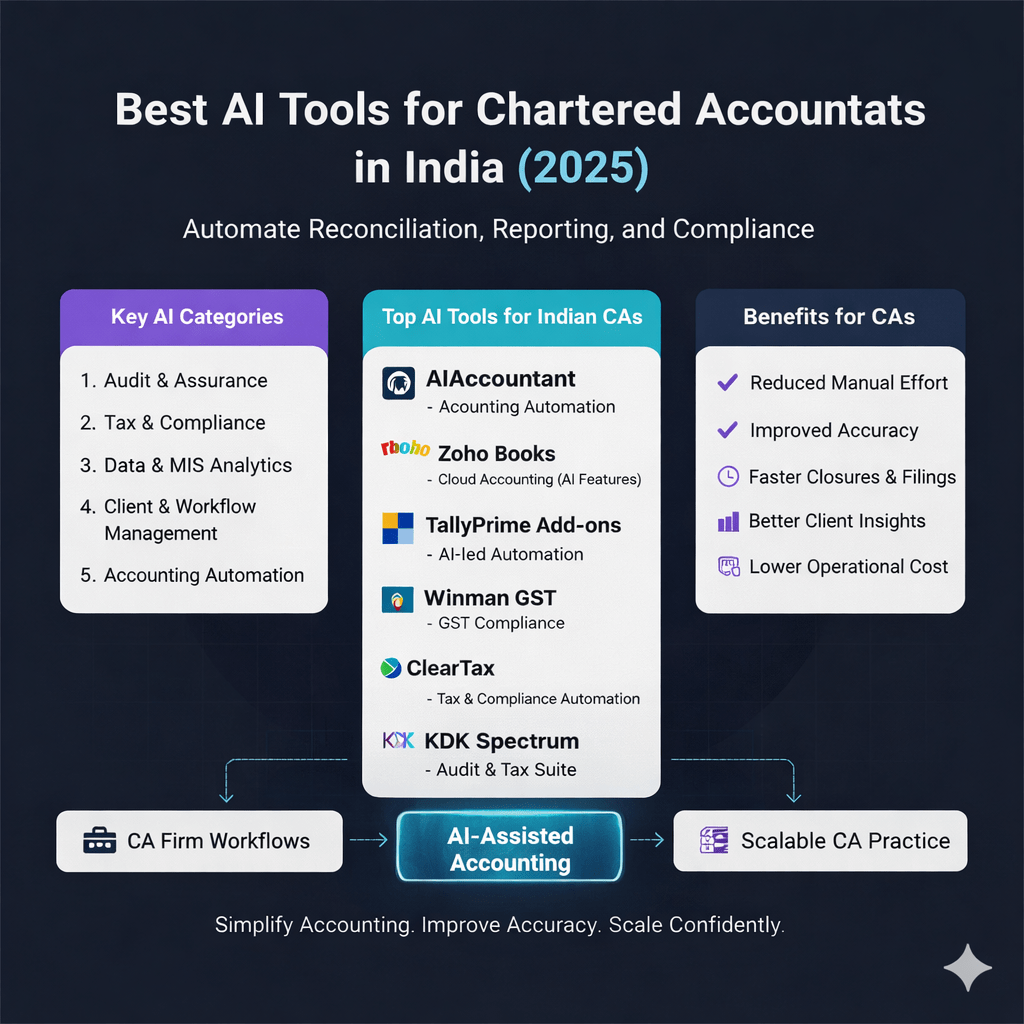
| Tool | Best For | Works with Tally | Primary Focus | Suitable for CA Firms |
|---|---|---|---|---|
| AI Accountant | Multi-client CA firms | Yes | Accounting automation, reconciliation, MIS | High |
| Suvit | Compliance-heavy workflows | Yes | Data entry & compliance automation | Medium |
| Vyapar TaxOne | GST-focused SMB clients | Limited | GST compliance & invoicing | Low–Medium |
| Ankpal | Firms open to new accounting systems | No | All-in-one accounting & compliance | Medium |
| Zoho Books | Zoho-based client setups | No | Cloud accounting with AI features | Medium |
| Global AI Tools | Advanced automation & audit analytics | No | Anomaly detection & audit insights | Low |
What to Look for in the Best AI Tools for CAs
AI is a much talked-about technology in the accounting domain. However, it is necessary to note that the technology has not achieved an equal level of maturity across all areas. A study covered by the Journal of Accountancy found that accountants using generative AI closed month-end books 7½ days sooner.
Nonetheless, a significant number of AI assistants are being presented as essential for the accounting profession. These include intelligent writing assistants, natural language query tools, chatbots, intelligent document processing (IDP), and intelligent process automation (IPA).
Not all AI tools for CA professionals are built for Chartered Accountants. Many are generic accounting platforms with limited relevance to Indian compliance or CA workflows. While selecting the best AI tools for CAs, it is necessary to see through the hype and consider the real capabilities that contribute to accuracy and that save time and effort.
India-Specific Compliance Support
Compliance is a must for CAs in India. Any AI tool you decide to work with must be designed in accordance with Indian rules and regulations, inclusive of GST, TDS, bank statement formats, and audit workflows. Those missing India-specific logic may end up creating manual work instead of eliminating it.
Leading AI tools for chartered accountants understand GST frameworks, typical bank narration patterns, and compliance deadlines. They not only make it easier to perform routine compliance tasks but also lessen the chances of overlooked entries, mismatches, or last-minute corrections during audits and filings.
For GST specifically, the CBIC continues to issue circulars that affect reconciliation logic. Your AI tool should keep pace with these updates rather than requiring manual rule adjustments each quarter.
Integration With Existing Systems
The majority of CA firms are deeply dependent on Tally, Excel, and bank statements. The AI tool should be compatible with these structures and not request an entire change of the work process.
It is advisable to find out if the tools in question can perfectly cooperate with your current accounting environment, smoothly synchronise the data, and provide the areas where exports or direct connections are necessary. The integration can be performed at the pace of your team, without them being disrupted or clients needing retraining.
Level of Automation
Automation is the core of AI, not just a few superficial tricks. The best AI for CA workflows ought to be capable of automating the logically most tedious and lengthy tasks: bank statement data extraction, transaction categorisation, reconciliation, and ledger mapping.
As a result, manual tagging is minimised, the error margin is lowered, and the month-end as well as year-end processes are expedited. If we look at a longer time span, then powerful automation paves the way for CA firms to raise the number of clients they take on without the need for higher staffing levels.
Reporting & Dashboards
The new-age clients are not satisfied with just compliance. They require transparency and updates as well. AI tools that provide MIS reports, cash flow views, and profitability dashboards are instrumental in helping CAs transition from mere bookkeeping to advisory roles.
The present-day reporting instruments put the financial data across in a lucid, real-time manner. This makes it the least time-consuming way to respond to the client's queries, spot trends sooner, and get ready for forthcoming decisions.
Data Security & Access Control
CAs are in charge of very sensitive financial data, so data protection should not be an afterthought. The AI tool of your choice should maintain strict security practices such as ISO certifications, the use of encrypted data, and setting access controls that are unambiguous.
Check for role-based permission, audit trails, and members' controlled data access features. These are a guarantee of compliance, accountability, and peace of mind, particularly when one has to manage numerous clients or work with distributed teams.
Best AI Tools for CA in India (2025)
With dozens of accounting and automation tools claiming to be "AI-powered," it can be difficult for Chartered Accountants to identify which ones actually deliver value in real-world CA workflows. Below is a curated list of the best AI tools for CAs in India:
1. AI Accountant
AI Accountant is built specifically for Indian CA firms and finance teams, with a strong focus on automating the most time-consuming parts of accounting rather than replacing existing systems.
What it does:
AI Accountant automates bank and card statement processing, transaction categorisation, ledger mapping, and reconciliation. It converts raw financial data into clean, accounting-ready entries and presents insights through real-time dashboards.
Key AI capabilities:
Works alongside Tally / Zoho:
Instead of forcing CA firms to switch accounting software, AI Accountant works with tools like Tally and Zoho Books, making adoption easier and less disruptive.
Best for:
CA firms handling multiple clients who want to scale operations, reduce manual work, and deliver faster reporting without increasing headcount.
Security: ISO 27001 and SOC-2 Type II certified, with role-based access controls and encrypted data storage.
While AI Accountant focuses on end-to-end automation and visibility, other tools in the market take a more compliance- or use-case-specific approach.
2. Suvit
Suvit positions itself as an AI-powered assistant for CA firms, with a strong emphasis on compliance-related workflows.
Focus:
Suvit primarily targets data entry automation and compliance processes, aiming to reduce manual bookkeeping effort for CA teams.
Strengths:
Limitations:
Suvit works well for firms looking to optimise specific compliance-heavy tasks, but may require additional tools for broader reporting needs.
3. Vyapar TaxOne
Vyapar TaxOne is a GST-focused solution aimed largely at small businesses and professionals working with SMB clients.
GST and SMB-focused automation:
The tool emphasises GST-related workflows such as invoicing, returns filing, and compliance support, making it useful in GST-heavy environments.
Where it fits best:
Vyapar TaxOne is better suited for CAs working closely with small businesses that need basic GST automation, rather than firms handling complex, multi-client accounting operations.
4. Ankpal
Ankpal combines accounting and compliance features into a single platform, positioning itself as an alternative to traditional accounting software.
Accounting + compliance platform:
It offers bookkeeping, compliance, and some automation capabilities within its own ecosystem.
Pros for CA firms:
Cons for CA firms:
5. Zoho Books (AI Features)
Zoho Books is widely used across India and includes embedded AI-driven features within its accounting platform.
Embedded AI capabilities:
Zoho Books offers automation rules, smart insights, and basic AI assistance for accounting tasks.
When it makes sense for CAs:
For CA firms already managing multiple clients on Zoho Books, its AI features can add incremental efficiency. However, firms using mixed systems or Tally-heavy setups may find its AI capabilities limited without additional tools.
6. Provi AI
Provi AI is an AI platform designed specifically for Indian Chartered Accountants, tax professionals, and accounting firms. It helps streamline audit, taxation, compliance, and accounting workflows through AI-powered document analysis, tax research, and contextual AI assistance.
Strengths:
- AI assistant trained on Indian GST, Income Tax, auditing, and accounting concepts
- Analyse PDFs, Excel files, financial statements, and audit working papers using AI
- Support audit procedures, ledger scrutiny, variance analysis, and financial reviews
- Generate summaries, audit checklists, client communications, reports, and working papers in seconds
- Built specifically for Indian CA workflows, with features tailored for tax, compliance, and accounting professionals
Best for:
Chartered Accountants, tax consultants, and accounting firms that want to automate repetitive audit and documentation tasks, accelerate tax research, and improve productivity with an AI assistant designed for Indian accounting and compliance requirements while ensuring professional judgement remains with the practitioner.
7. Global AI Tools Used by CA Firms
Some larger or specialised CA firms also explore global AI tools, particularly for advanced automation or audit analytics.
Common examples include:
While these tools are powerful, they often require customisation to fit Indian compliance requirements and may not integrate seamlessly with Tally or GST workflows. They also tend to carry higher price points that may not suit mid-sized Indian CA firms.
Choosing the right AI tool depends on the size of your firm, the number of clients you manage, and how deeply you want to automate your accounting processes. In the next section, we'll look at how these AI tools actually improve day-to-day CA workflows and where they create the biggest impact.
How AI Tools Improve Day-to-Day CA Workflows
Beyond feature lists, the main benefit of AI for CA workflows is the daily execution of routine work. What these tools essentially do is that they don't change the output of a CA firm. The firm is still delivering the same service, only with less manual effort and more predictable results: error-free entries, fewer mismatches, faster reporting.
Automating Bookkeeping & Reconciliation
In most cases, CA teams are trapped in the same monthly cycle of activities. They download statements, tag transactions, map ledgers, and later fix mismatches and suspense entries. AI tools do away with this manual grind by executing the "first pass" work automatically and leaving humans with the task of exception review only.
The productive time savings typically come from:
Faster Month-End and Year-End Closes
A close turns into a disaster when too much dirty work is piled up at the tail end. AI tools offer solutions by enabling closings to be kept close to "close-ready" all through the month.
It implies that during the final stage, there is less catching-up and work to be redone because of fewer surprises. The team is therefore able to devote more hours to review and quality checks than to data preparation.
Smarter MIS & Client Reporting
Most of the MIS work in CA firms is still done in Excel. By making dashboards and summaries update directly from the underlying accounting data, AI tools simplify reporting. Typical reporting enhancements include:
Reducing Dependency on Junior Staff
Typically, junior staff handle repetitive tasks such as tagging, entry checks, and reconciliation prep. This leads to an increased dependency on manpower and creates rework risk due to accuracy variation.
AI tools mitigate this by automating the repetitive work. Juniors can then dedicate more time to review and learn higher-value tasks, while senior staff spend less time checking basics.
Serving More Clients Without Increasing Headcount
The biggest operational win is the breaking of the "more clients = more people" equation. Once manual workload is reduced, firms are in a position to onboard more clients while still maintaining turnaround times and consistency.
This is the point where chartered accountant AI ceases to be a productivity hack and turns into a scaling advantage.
AI Tools vs Traditional Accounting Software
Traditional accounting software has been the backbone of CA firms for years. It is reliable, familiar, and widely accepted. However, most traditional tools are still input-driven. They depend heavily on manual effort to produce accurate outputs.
AI tools change this by assisting before the data reaches final books. The difference is not about replacing accounting software, but about how much manual work sits around it.
Manual vs AI-Assisted Workflows
In a traditional setup, most of the effort goes into preparing data before it is even ready for review. Statements are downloaded, entries are tagged, ledgers are mapped, and reconciliations are checked line by line.
AI-assisted workflows reduce this preparation layer. The system handles the first level of processing, while the CA team focuses on validation and judgement.
Key shift in workflow:
Time Saved Per Client
With manual workflows, time spent per client increases linearly with transaction volume. More entries simply mean more effort.
AI tools compress this effort by automating repetitive steps. While review time still exists, the hours spent on groundwork drop significantly, especially for clients with high transaction counts.
Over time, this time saving compounds across months and across clients.
Error Reduction
Manual processes are prone to:
AI tools reduce these errors by applying consistent logic and pattern recognition across data sets. Humans still review the output, but they review fewer exceptions, not every line item.
This improves overall accuracy without increasing review burden.
Better Advisory Bandwidth
When most of the team's time is consumed by data preparation, advisory work becomes reactive or gets deprioritised.
AI tools free up capacity by removing repetitive work. This gives CA firms more room to:
The result is not just faster accounting, but more meaningful client conversations.
In short, traditional accounting software remains essential, but AI tools act as a layer that reduces manual effort around it. In the next section, we'll look at how CA firms can start adopting AI tools gradually, without disrupting existing workflows.
How CA Firms Should Actually Think About AI Adoption
Firstly, AI adoption for CA firms should not start with tools but rather constraints. Most firms are not limited by the lack of expertise or demand. They are limited by time and consistency. AI tools are most efficient when they are employed to eliminate these limitations, rather than when they are considered as separate software purchases.
Start by identifying the single workflow that produces the most friction every month. It may be reconciliation delays, MIS preparation, or repeated data corrections. Then pick the AI tool that is designed to solve this friction point. Those firms which decide to automate everything at once often suffer from the issue of adoption and learning, rather than capability.
Finally, AI should not merely be judged based on feature lists but rather on operational outcomes: quicker closes, fewer reconciliation issues, improved turnaround times, and more engaging client conversations. The tools that silently keep these outcomes improving from one month to another are likely to deliver a lot more value than the tools that promise radical transformation but interrupt daily work.
The ICAI has also begun publishing guidance on AI use in professional practice, signalling that the profession views these tools as complements to, not replacements for, professional judgement.
If you are still curious about how to get most out of AI accounting tools, why not book a quick 10-min demo with aiaccountant.com. No pressure.
FAQs
What are the best AI tools for chartered accountants in India?
The best AI tools for chartered accountants in India include AI Accountant, Suvit, Vyapar TaxOne, Ankpal, and global options like Vic.ai and MindBridge. The right fit depends on your firm's size, client count, and whether you need Tally integration, GST reconciliation, or end-to-end bookkeeping automation.
Are AI tools approved or usable by CA firms in India?
Yes, AI tools are usable by CA firms in India as productivity and automation software. They do not replace statutory responsibilities or professional judgement. ICAI has also begun hosting AI-powered tools on its own portal for tasks like GST reconciliation and ITR document analysis. (2026 update) Most firms use AI tools as internal systems to automate bookkeeping, reconciliation, and reporting while continuing to comply with ICAI standards.
Can AI tools work with Tally?
Yes, several AI tools are designed to work alongside Tally rather than replace it. They typically process bank or transaction data, perform categorisation and reconciliation, and then sync or export clean entries into Tally for final accounting and compliance work. This "layer on top" approach avoids disrupting existing client workflows.
How much time can a CA save using AI tools?
Many CA firms report saving several hours per client every month. Research indicates that accountants using generative AI closed month-end books 7½ days sooner than those using traditional workflows. The biggest gains usually come from automating reconciliation, transaction categorisation, and MIS preparation.
Do AI tools replace accountants or reduce the need for CAs?
AI tools do not replace Chartered Accountants. They automate repetitive groundwork (statement processing, tagging, reconciliation) so CAs can focus on review, judgement, compliance, and advisory work. Professional expertise remains essential for interpretation and decision-making.
How should a CA firm start adopting AI tools?
Start small by testing an AI tool on one client or one workflow, such as bank reconciliation or statement processing. Once the team is comfortable and accuracy is validated, roll out across more clients. Firms that try to automate everything at once often face adoption friction rather than capability issues.
Are AI accounting tools secure for client financial data?
Most established AI accounting tools follow strong security practices including encrypted data storage, role-based access controls, audit logs, and recognised certifications like ISO 27001 and SOC-2 Type II. CA firms should still review data handling policies, permission structures, and compliance certifications before onboarding any tool for client data.

Rohan Sinha is a fintech and growth leader building aiaccountant.com, focused on simplifying accounting and compliance for Indian businesses through automation. An IIT BHU alumnus, he brings hands-on experience across 0 to 1 product building, growth, and strategy in B2B SaaS and fintech.