-01%201.svg)
Key takeaways
- AI bookkeeping software automates transaction classification, reconciliation, and reporting, delivering 95%+ accuracy from day one and improving as it learns your firm's patterns.
- CA firms using automated bookkeeping handle 2.5× more clients without additional hires, shifting staff from data entry to advisory services that command higher fees.
- Real-time dashboards replace stale monthly reports, giving business owners daily visibility into cash flow, receivables, and GST liabilities.
- Firms adopting hybrid pricing (fixed fees for AI-handled tasks plus hourly for advisory) report 23% higher margins and 28% better client satisfaction.
- The cost of inaction is real: manual processes introduce errors that cascade into ITC reversals, compliance penalties, and audit flags.
- Platforms like AI Accountant's bookkeeping automation reduce month-end closes from days to hours while maintaining ISO 27001 and SOC-2 Type II security standards.
AI Bookkeeping Automation: What's New in 2026
In 2025, most CA firms still relied on a mix of spreadsheets and semi-manual processes to handle bank statement ingestion and transaction categorization. By early 2026, the shift to fully automated pipelines has accelerated sharply, driven by both regulatory changes and economics.
The biggest operational shift: India's GST e-invoicing threshold dropped further, pulling more SMEs into mandatory digital compliance. This means CA firms managing 50+ clients now deal with significantly more structured invoice data flowing in daily. Manual matching is no longer viable at this volume. Firms that haven't automated their GST reconciliation workflows face a growing backlog that compounds each filing period.
On pricing, the industry is moving away from hourly billing for routine work. A 2023 study found hybrid models (fixed fees for automated tasks, hourly for advisory) boosted margins by 23%. By 2026, this has become the default for forward-looking firms. AI platforms now cost a fraction of the $40,000 to $100,000 enterprise setups of previous years, with subscription tiers starting well below that for small practices.
The cost of inaction is concrete: missed ITC claims due to unreconciled invoices, late filing penalties of ₹50 per day per return (₹20 for nil returns), and compliance flags that trigger GST audits. Firms still running manual reconciliation report error rates 5 to 10× higher than those using automated vendor bill matching.
What to do now:
- Audit your current month-end close time. If it exceeds one day per client, automation will show immediate ROI.
- Map your top 10 clients' bank statement formats and verify your tools can ingest them without manual conversion.
- Review your pricing model. If you're still billing hourly for data entry, you're leaving margin on the table.
The Current State of Manual Accounting Processes
Traditional accounting workflows are breaking under the weight of modern business complexity. Every month, accountants across India face the same exhausting routine: downloading bank statements in various formats, manually categorizing hundreds of transactions, and reconciling invoices against payments.
A single mistake can cascade through the entire financial reporting chain. It requires hours of detective work to identify and fix. One misclassified vendor invoice can throw off your GST return, trigger an ITC mismatch, and invite scrutiny from tax authorities.
The human cost is significant. CA firms regularly work 12-hour days during busy periods. Not because the work is intellectually challenging, but because of the sheer volume of data entry and verification required. Meanwhile, business owners wait weeks for reports that are outdated by the time they arrive.
This delay between financial events and actionable insights creates a fundamental disconnect between accounting and business strategy. According to ICAI's guidance on accounting standards, timely financial reporting is essential for stakeholder decision-making, yet most SME finance teams struggle to deliver it with manual processes.
Understanding AI Bookkeeper Capabilities
Modern AI bookkeeper technology goes far beyond simple automation. These systems use machine learning algorithms trained on millions of transactions to understand patterns, context, and relationships in your financial data.
Whether you upload a PDF bank statement, a scanned invoice, or an Excel export, the system uses advanced OCR and natural language processing to extract every detail. Think of it as robotic process automation (RPA) with intelligence layered on top.
- Intelligent classification: Predicts the correct ledger account, GST code, and expense category for each transaction.
- Anomaly detection: Flags unusual transactions for review, such as a one-time high vendor charge or a duplicate payment.
- Contextual matching: Matches payments to outstanding invoices and tracks partial payments across multiple bank accounts.
- Continuous learning: Improves accuracy over time based on your business patterns and manual corrections.
- Multi-format ingestion: Handles statements from SBI, HDFC, ICICI, Axis, and dozens of other banks without manual template setup.
"AI Accountant has cut our month end close from three days to just a few hours, with zero reconciliation surprises."
Key Benefits of Automated Bookkeeping Technology
Enhanced Accuracy and Error Reduction
Automated bookkeeping delivers accuracy rates above 95% for transaction classification. It doesn't tire out after hundreds of ledger entries. When errors do occur, they are systematic and easy to correct in bulk.
Consider GST compliance: an AI bookkeeper trained on Indian regulations can assign correct HSN/SAC codes, calculate tax amounts, and flag exceptions. It cross-references data across sources and alerts you if an invoice amount doesn't match the corresponding payment. According to GST portal guidelines on return filing, accurate input data is the foundation of correct GSTR-2B reconciliation.
The difference is stark. Manual processes typically produce error rates of 3 to 5%. AI-powered classification brings this below 0.5% within the first few months of use. For a firm handling 10,000 transactions monthly, that's the difference between 300 to 500 errors and fewer than 50.
Significant Time and Cost Savings
Tasks that once took hours now finish in minutes. A typical month-end that required three days of manual work can be completed in half a day. CA firms can redeploy staff to advisory services, handling 2.5× the client volume without extra hires.
Faster processing gives clients real-time reports, enabling better decisions on payment terms and collections. Reduced errors mean fewer billable hours spent on corrections, driving profitability higher.
The economics are straightforward. According to a Bloomberg Tax report on AI efficiency in accounting, firms adopting automation save between $600 and $2,800 per month in operational costs while cutting report preparation time from 20 hours to roughly 10. For Indian CA firms, this translates to freeing up 40 to 60 hours per staff member per month.
Real Time Financial Reporting and Insights
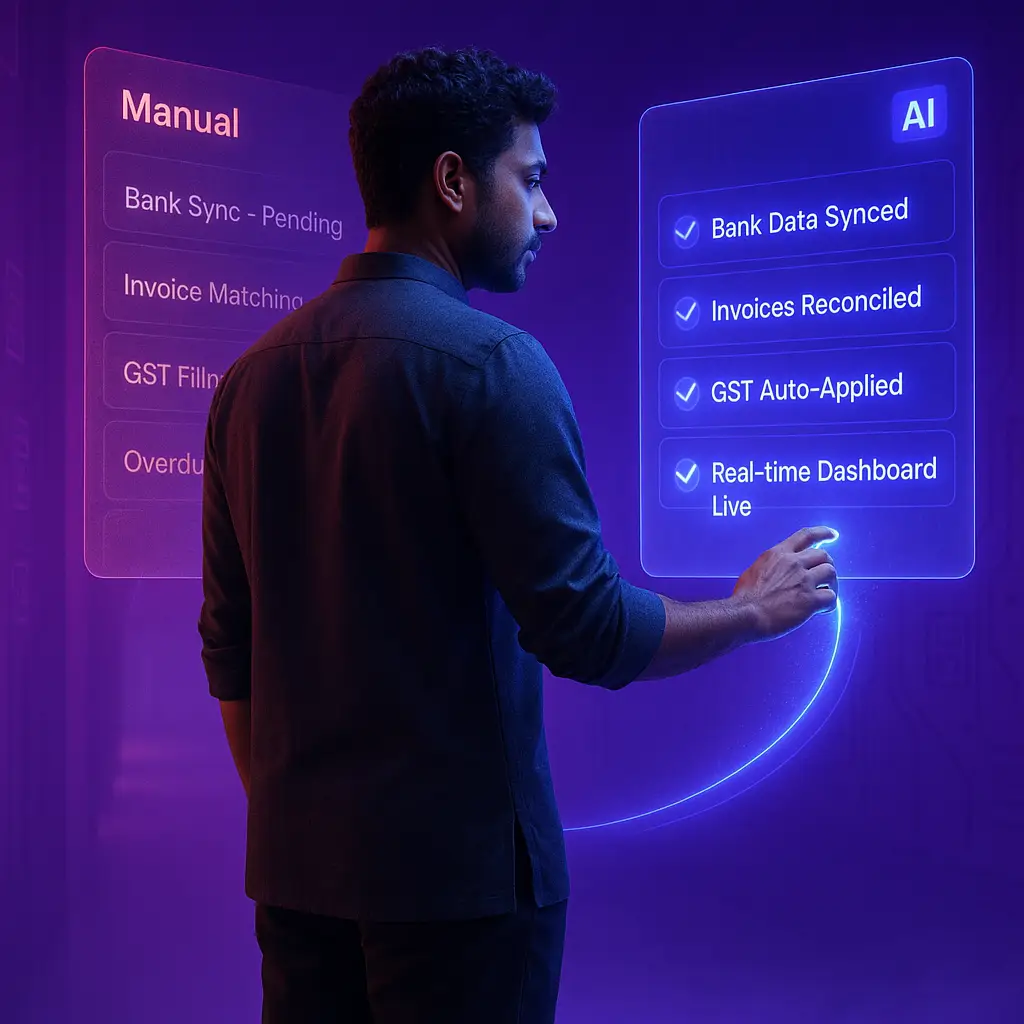
AI accounting software updates dashboards as soon as new data arrives. This transforms periodic snapshots into live views. Revenue tracking happens daily, so you can course-correct before month end.
Investors and boards gain confidence from up-to-the-minute performance metrics rather than stale historical reports. Cash flow forecasting that reacts to business events in real time becomes possible, not aspirational.
For SME founders on Tally, this means connecting bank feeds and seeing categorized, reconciled data within hours rather than waiting for their CA to manually process everything at month end.
Pricing Models for AI Accounting Tools
The shift from hourly billing to value-based pricing is reshaping how CA firms charge for their services. When AI handles the volume work, billing by the hour penalizes efficiency.
Three models are emerging in 2026:
- Subscription or tiered pricing: Charged per user or transaction volume. Predictable costs for firms, scalable with client growth. Plans typically range from basic (sole practitioners) to enterprise (large CA firms with 50+ clients).
- Hybrid pricing: Fixed monthly fees for AI-automated tasks like data entry, classification, and reconciliation, combined with hourly rates for strategic advisory. This model has shown 23% higher margins and 28% better client satisfaction in industry surveys.
- Value-based pricing: Fees tied to outcomes such as error reduction, compliance accuracy, and real-time reporting access. Premium advisory packages in India range from ₹40,000 to ₹4,00,000+ annually depending on complexity.
As noted by Sage's research on practice pricing in the AI era, firms that restructure pricing around client outcomes rather than time spent consistently outperform those clinging to hourly models.
FAQ
How can AI Accountant streamline GST reconciliation for my clients?
AI Accountant automatically matches your purchase register with GSTR-2B data, flagging mismatches in real time. It uses machine learning trained on Indian tax rules to assign correct HSN/SAC codes, calculate liabilities, and identify ITC discrepancies before filing deadlines. This reduces manual checks from hours to minutes per client.
What accuracy rate can I expect from automated transaction classification?
Most AI bookkeeping platforms deliver above 95% accuracy from day one, improving to 99%+ as the system learns your historical patterns. AI Accountant achieves this by training on your specific vendor names, narration styles, and ledger preferences, bringing error rates below 0.5% within months.
Can AI accounting software handle multiple bank formats and languages?
Yes. Advanced OCR engines parse PDFs, images, and exports from Indian banks including SBI, HDFC, ICICI, and Axis without manual template setup. AI Accountant recognizes terms like "NEFT Dr", "UPI/Cr", and "Online Transfer" across formats and narration styles automatically.
How does AI bookkeeping detect anomalies in financial data?
It analyzes transaction amounts, vendor histories, and timing patterns to establish baselines. If a familiar vendor suddenly shows a charge 3× the average, or if a duplicate payment appears, the system flags it for human review before it hits your books.
How does the pricing model for AI Accountant work?
AI Accountant uses subscription-based tiered pricing, charged per user or transaction volume, with plans ranging from sole practitioners to large CA firms. This model enables predictable costs that scale with your client base. (2026 update) Many firms now pair this with hybrid client billing: fixed fees for automated deliverables and hourly rates for advisory, boosting margins by 23% on average.
Will AI replace chartered accountants?
No. AI handles volume-driven execution tasks like data entry, classification, and reconciliation. CAs remain essential for judgment calls: tax planning, audit opinions, business advisory, and client relationships. The firms growing fastest in 2026 are those using AI to free up 40 to 60 hours per staff member monthly, redeploying that time into higher-value services.
How quickly can a CA firm implement AI Accountant?
Most implementations take 1 to 2 weeks, including data mapping and staff training. AI Accountant provides guided onboarding with dedicated support to minimize downtime. Firms typically see measurable ROI within the first month-end close after go-live.

Rohan Sinha is a fintech and growth leader building aiaccountant.com, focused on simplifying accounting and compliance for Indian businesses through automation. An IIT BHU alumnus, he brings hands-on experience across 0 to 1 product building, growth, and strategy in B2B SaaS and fintech.