-01%201.svg)
Key Takeaways
- AI accounting software replaces manual spreadsheet work by automating data entry, reconciliation, reporting, and compliance, cutting error rates to below 0.1% in hybrid workflows.
- OCR platforms now achieve up to 98% extraction accuracy across invoices, receipts, and bank statements, making re-entry of financial data practically obsolete.
- Real-time bank reconciliation and dynamic dashboards give CA firms and finance teams continuous visibility into cash flow, expense anomalies, and revenue trends.
- Built-in fraud detection flags duplicate invoices, threshold breaches, and vendor mismatches in real time, reducing financial risk without adding manual review steps.
- Predictive cash flow forecasting and scenario modeling help businesses spot shortages weeks in advance and plan around seasonal swings.
- For firms looking to eliminate repetitive bookkeeping tasks, AI Accountant's bookkeeping automation handles extraction, categorization, and matching so your team can focus on advisory work.
AI Accounting Software in 2026: What's Changed and Why It Matters
The biggest shift between 2025 and 2026 is accuracy at scale. In 2025, most OCR-based document processing tools hovered around 90 to 93% extraction accuracy on Indian invoices and bills. By mid-2026, leading platforms are consistently hitting 98%, thanks to multi-language and multi-line item support trained on larger datasets. For a CA firm processing 5,000 invoices a month, that jump means roughly 250 fewer manual corrections every cycle.
On the compliance front, India's GST e-invoicing threshold changes continue to pull more SMEs into automated workflows. Firms that still rely on spreadsheet-based reconciliation face growing penalty risk from missed matches and delayed filings. The CBIC's latest GST circulars reinforce that accuracy and audit trails in digital records are no longer optional for businesses above the threshold.
The operational reality in 2026 looks like this:
- AP and AR automation now handles partial payments, splits, and multi-currency matching with near-zero manual intervention.
- Hybrid human-AI review models have become the standard. AI processes the volume; a CA or reviewer handles only flagged exceptions.
- SOC 2 Type II and ISO 27001 certifications are table stakes. Clients and auditors expect them before onboarding any automation tool.
Who does this hit hardest? Mid-size CA firms managing 10 or more clients on Tally, and SME finance teams processing over 1,000 transactions a month. If your team is still copy-pasting bank statements into Excel, you are likely losing 15 to 20 hours per week that could go toward advisory or client relationships.
The cost of inaction is tangible: missed ITC claims, delayed GST filings attracting interest at 18% per annum, and audit flags from inconsistent ledger entries. If you haven't already, now is the time to map your highest-volume workflows and evaluate where automated GST reconciliation can close the gap.
What is AI Accounting Software?
AI accounting software combines artificial intelligence, machine learning, and optical character recognition to automate financial processes that traditionally required hours of manual work. It actively learns from your transactions, recognizes patterns, predicts categorizations, and spots anomalies that human eyes might miss.
Using natural language processing, it interprets invoices and receipts in any format. Machine learning algorithms adapt to your business patterns, improving accuracy over time.
This technology doesn't replace accountants. It frees them from repetitive tasks so they can focus on strategic planning and client relationships. Think of it as a digital colleague that handles the grunt work while you handle the judgment calls.
Automated Data Entry and Categorization
Smart Document Processing
Advanced OCR technology reads and extracts data from PDFs, scanned invoices, or Excel files with remarkable accuracy. In 2026, top platforms achieve up to 98% extraction accuracy across multi-line items and multi-language documents, according to industry benchmarks from Intuit.
The AI understands context. "Professional Services – Website Design" is correctly categorized under marketing expenses, not office supplies. It maps vendor invoices to the right ledger entries without manual re-entry.
Intelligent Transaction Categorization
The AI learns unique spending patterns. It categorizes supplier payments as inventory costs and SaaS subscriptions as operating expenses.
It considers amounts, vendor names, dates, and seasonal trends. As your business evolves, the categorization adapts. AI also suggests tax codes and ledger entries based on historical feedback, reducing the need for manual corrections.
Error Reduction That Actually Matters
Manual data entry error rates run 1 to 3%, which adds up at scale. A firm processing 10,000 transactions a month could see 100 to 300 errors each cycle.
AI driven entry cuts errors to below 0.1% and flags uncertain categorizations for human review. This catches issues early rather than at year-end audit, saving hours of rework and reducing compliance risk.
Real Time Reconciliation and Financial Reporting
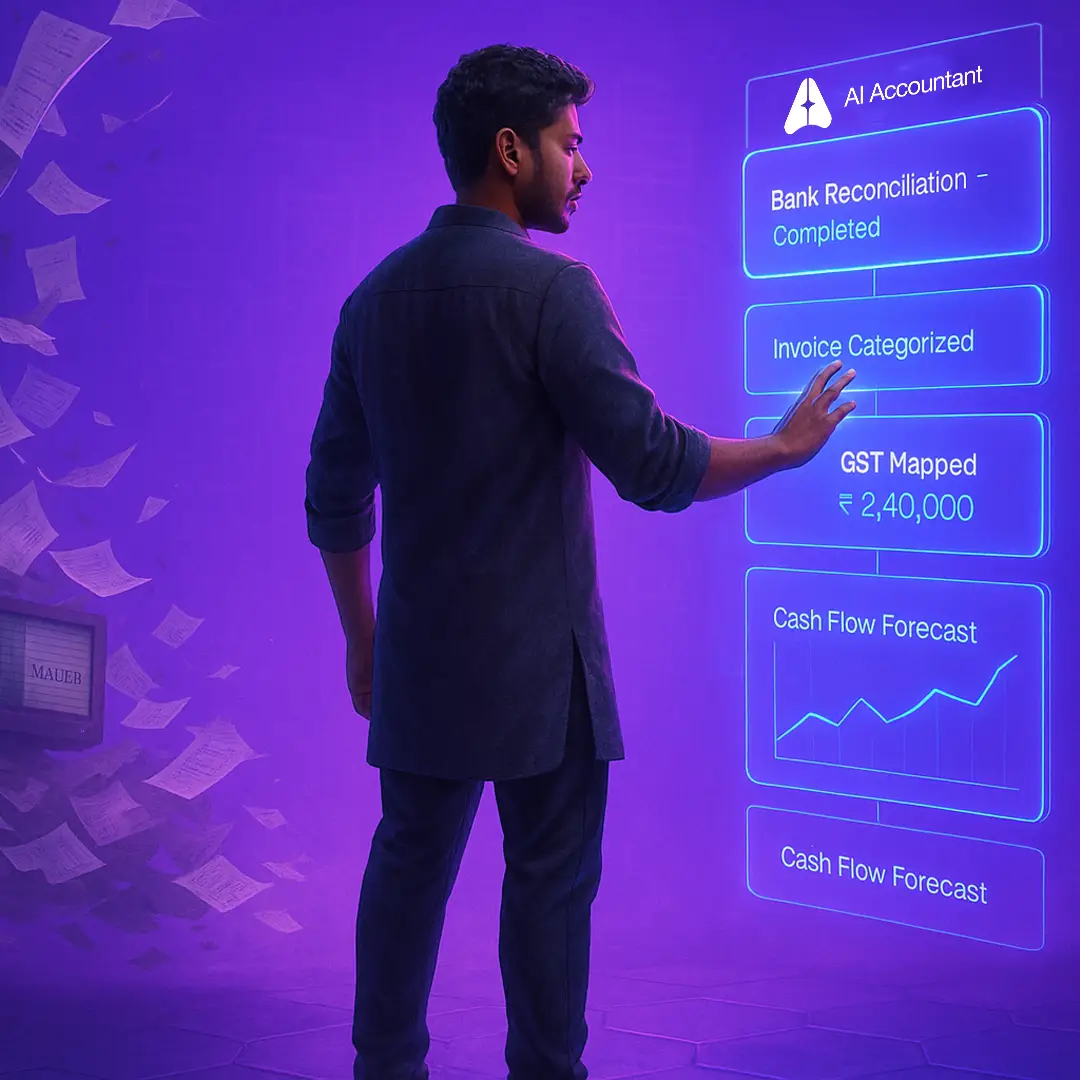
Instant Bank Feed Reconciliation
The software matches bank transactions with accounting entries automatically. It handles partial payments, splits, and currency conversions without manual intervention.
Discrepancies are flagged with suggested explanations based on historical patterns. For CA firms managing multiple clients on Tally, this means reconciliation that used to take a full day now wraps up in minutes.
Dynamic Financial Dashboard Creation
Static reports become obsolete the moment you print them. AI generates dashboards that update with each transaction.
These dashboards highlight cash flow projections, expense anomalies, and revenue trends in real time. Teams can drill into specific periods, clients, or cost centers without waiting for month-end reports.
Collaborative Client Portals
AI powered client portals give stakeholders secure, role-based access to financial data. Clients upload documents directly, AI processes them instantly, and accountants review remotely.
This creates seamless collaboration without the back-and-forth of email attachments and manual uploads.
Fraud Detection and Risk Management
Pattern Recognition for Anomaly Detection
AI learns your normal spending behavior and flags deviations. It analyzes context, timing, and transaction relationships.
For example, it can identify vendor discrepancies or unusual employee reimbursement claims that fall just below approval thresholds.
Suspicious Transaction Monitoring
Advanced algorithms detect duplicate invoices, payment amounts designed to avoid authorization thresholds, and mismatched vendor details. Authorization anomalies also trigger alerts, even within approved limits.
In 2026, these systems incorporate learning from user responses, as noted in analysis from Articsledge's AI accounting overview. This means fewer false positives over time and sharper detection of genuine risks.
Real Time Risk Alerts
Immediate alerts surface suspicious activities with contextual history. The system shows you why a transaction was flagged, not just that it was flagged.
It learns from your responses, tuning sensitivity to balance false positives and genuine protection. This makes fraud monitoring practical for smaller teams that cannot afford dedicated risk analysts.
Predictive Financial Insights and Cash Flow Forecasting
Scenario Modeling for Strategic Planning
Scenario modeling evaluates multiple variables like seasonality, market trends, and growth cycles to create realistic forecasts in seconds. You can run "what-if" analyses, for example, testing the impact of a raw material cost spike or a delayed receivable.
Intelligent Cash Flow Predictions
Cash flow forecasting analyzes receivables aging, payment terms, seasonal revenue patterns, and external factors. It warns of potential cash shortages weeks in advance, giving you time to arrange working capital or adjust payment schedules.
For Indian SMEs managing tight cycles around GST payment dates, this visibility is critical.
Automated Budget Variance Analysis
AI continuously compares actual performance to budgets. It explains variance causes based on historical patterns and suggests corrective actions.
This replaces the tedious process of manually comparing spreadsheet columns and hunting for explanations at quarter-end.
Tax Compliance and Preparation Automation
AI accounting tools handle tax line mapping, form generation, and deadline tracking. They auto-map GST and VAT codes based on transaction type and vendor profile.
They update with changing regulations and flag missing documentation, reducing the risk of penalties and manual errors. For Indian businesses, this means staying aligned with GST portal requirements without constant manual monitoring of notification changes.
AI Powered Audit Support and Compliance
During audits, AI provides traceable transaction trails, automated sampling, and risk-based testing. It accelerates evidence gathering and ensures compliance with accounting standards.
Auditors increasingly expect digital audit trails. AI tools create these automatically, mapping every transaction to its source document, approval, and ledger entry. This aligns with ICAI's evolving guidance on technology-enabled audit practices.
Top AI Accounting Software Solutions
- AI Accountant: End-to-end automation including OCR, ML categorization, Tally integration, GST reconciliation, and multi-org support. 450+ customers, 300M+ transactions processed, ISO 27001 and SOC 2 Type II certified.
- QuickBooks AI: Workflow automation, tax maximization, cash flow forecasting, and BI dashboards for small businesses.
- Xero: Machine learning categorization, project profitability tracking, and bank feed matching for growing firms.
- Sage Intacct: AI powered insights, streamlined operations, and SMB forecasting for high-performance finance teams.
- Botkeeper: Hybrid AI-human bookkeeping with 24/7 processing, audit trails, and accounting platform integrations.
- FreshBooks: Invoice automation, expense tracking, and time management with built-in AI categorization for freelancers and small teams.
How AI Accountant Delivers Superior Results
AI Accountant leverages advanced ML models to adapt rapidly to your chart of accounts and vendor list. Its human-in-the-loop review ensures high accuracy, while continuous learning refines performance with each transaction.
With Tally integration, multi-org support, and SOC 2 Type II certification, it fits directly into the workflows CA firms and SME finance teams already use.
The Future of AI in Accounting
Emerging capabilities include natural language query interfaces, voice-activated data retrieval, and deeper integration with enterprise ERPs. Platforms are expanding to connect with 30 or more systems out of the box.
The next wave will focus on predictive advisory and AI copilots that answer financial questions in plain language, as highlighted in Sage's 2025 AI roadmap. The goal is not fully autonomous financial operations, but AI that acts as a strategic partner alongside human judgment.
Making the Transition to AI Accounting Software
- Assess current workflows and identify high-impact automation areas. Start with AP, AR, and bank reconciliation where volume is highest.
- Deduplicate records and standardize your chart of accounts. Map legacy data to hierarchical structures before migration.
- Choose a vendor offering seamless integration with your ERP (such as Tally) via APIs or prebuilt connectors. Most integrations complete in 5 to 7 days.
- Plan a phased rollout. Begin with data entry and reconciliation, then expand to compliance and reporting.
- Train accounting staff on review workflows and exception handling. The hybrid model works best when humans know exactly when to step in.
- Monitor performance metrics and refine AI rules over time. Track error rates, processing time, and flag volumes monthly.
Conclusion: Transform Your Financial Operations Today
AI accounting software is no longer optional. It is essential for firms aiming to boost efficiency, accuracy, and strategic value.
Embrace intelligent automation to reduce manual workloads, enhance financial insights, and position your practice for future growth. The firms that adopt now will spend less time on data entry and more time on the advisory work that actually drives revenue.
FAQ
1. AI Accountant कितने समय में ट्रांजैक्शंस का ऑटोमैटिक कैटेगराइजेशन सेटअप कर सकता है?
AI Accountant पहले 200 to 300 ट्रांजैक्शंस पर मॉडल ट्रेनिंग करता है, जिससे 24 to 48 घंटों में 80% तक सटीक कैटेगराइजेशन मिल जाता है। 2026 के updated models historical learning से तेज़ी से refine होते हैं, और accuracy 95% से ऊपर पहुंच जाती है (2026 update)। जैसे-जैसे वह आपके पैटर्न समझता है, manual corrections लगभग खत्म हो जाती हैं।
2. OCR आधारित डॉक्यूमेंट प्रोसेसिंग में एरर आ रहे हैं, AI Accountant कैसे सुधार करेगा?
AI Accountant uncertainty scoring का उपयोग करता है ताकि low-confidence डेटा human reviewer को फ्लैग हो जाए। यह hybrid human-AI workflow एरर रेट 0.1% से नीचे ले आता है। 2026 में OCR accuracy 98% तक पहुंच गई है, जिससे flagged items की संख्या भी काफी कम हो गई है (2026 update)।
3. क्या AI Accountant रीयल टाइम बैंक रिकंसिलीएशन कर सकता है?
हां, AI Accountant बैंक फीड को सीधे लिंक करता है और partial payments, splits और multi-currency ट्रांजैक्शंस को automatically match करता है। Discrepancies को audit trail के साथ auto-flag किया जाता है, जिससे CA firms को month-end reconciliation में घंटों की बचत होती है।
4. Seasonal cash flow forecast कैसे काम करता है?
AI Accountant historical trends, receivables aging, supplier terms और external market data को मिलाकर scenario modeling करता है। आप "what-if" analyses सेकंडों में चला सकते हैं, जैसे कि raw material cost spike या GST payment date के आसपास cash squeeze का impact।
5. AI Accountant में फ्रॉड डिटेक्शन कैसे कार्य करता है?
यह pattern recognition, anomaly detection और authorization monitoring का संयोजन है। Duplicate invoices, threshold breaches, और vendor profile mismatches को real time में flag किया जाता है। System आपके responses से सीखता है, जिससे false positives समय के साथ कम होते जाते हैं।
6. क्या AI Accountant टैक्स कंप्लायंस और GST ऑटोमेशन हैंडल करता है?
हां, यह GST/VAT लाइन mapping, form generation और deadline alerts integrate करता है। Missing documents को फ्लैग किया जाता है और बदलते regulations के अनुसार rules automatically update होते रहते हैं। यह GST portal requirements के साथ alignment बनाए रखने में मदद करता है।
7. AI Accountant मेरे ERP/Tally सिस्टम से कैसे जुड़ता है?
AI Accountant REST APIs, secure webhooks और prebuilt connectors (including Tally) के माध्यम से सीधे आपकी systems से डेटा fetch करता है। Integration आम तौर पर 5 to 7 दिन में complete हो जाती है, vendor support के साथ।

Rohan Sinha is a fintech and growth leader building aiaccountant.com, focused on simplifying accounting and compliance for Indian businesses through automation. An IIT BHU alumnus, he brings hands-on experience across 0 to 1 product building, growth, and strategy in B2B SaaS and fintech.