-01%201.svg)
Key takeaways
- Secure financial reporting blends controls, compliance, and visibility so your numbers are accurate, timely, and supportable.
- Focus on seven pillars, governance, access control, data integrity, reconciliations, compliance, documentation, monitoring, to stay audit ready.
- A simple month end and year end blueprint with maker checker reviews and period locks reduces surprises and speeds close.
- Track a short list of KPIs, close time, reconciliation completion, on time filings, exceptions within SLA, access reviews, backdated entries, and audit adjustments.
- A CA led virtual accounting model with a live dashboard, like AI Accountant, delivers execution discipline and real time visibility without heavy software.
- Startups, SMBs, and freelancers can implement this in weeks, not months, and gain faster filings, smoother audits, and investor ready reporting.
Secure Financial Reporting Made Simple for Startups, SMBs, and Freelancers
Secure financial reporting is about keeping your numbers safe, clean, and ready when you need them. It protects your data from leaks, keeps entries accurate, supports timely access, and makes audits and filings smoother. If you are a founder, a finance lead, or a freelancer, secure financial reporting matters now. It helps you avoid penalties, build trust with investors and clients, and make better decisions with confidence. You do not need a big team to get this right, you need clear controls, steady processes, and a system that gives you visibility. That is where a CA led model with a live dashboard like AI Accountant can help without overselling or locking you into heavy software.
For context on financial data security and reporting fundamentals, see notes from ShareFile, Ramp, and Intuit.
What is secure financial reporting and why it matters now
Secure financial reporting is bigger than basic cybersecurity. It is a full system of internal controls over financial reporting, simple policies, and clear visibility that protects the integrity of your accounting data end to end. Think of five pillars of protection.
- Confidentiality, keep sensitive numbers safe from the wrong eyes.
- Integrity, make sure entries are accurate and consistent.
- Availability, get to your data on time when decisions cannot wait.
- Compliance, follow laws and standards for GST, TDS, income tax, and ROC.
- Auditability, maintain clean trails so anyone can retrace how a number came to be. See a primer on audit trails here, Automated audit trails for businesses.
As your business grows, mistakes and gaps grow with it. Weak controls lead to bad decisions, missed filings, and penalties. Investors and lenders care about reporting quality and discipline, and control weaknesses can slow funding and scaling.
Secure financial reporting gives you peace of mind. Your team spends less time fixing errors and more time on planning and cash flow. Your CA partner can do reviews and filings faster because your ledgers and schedules are already tidy and supportable. Useful background, transparency and ethics in financial reporting, financial reporting guide, and enterprise reporting insights.
Common risks and failure points in secure financial reporting
If secure reporting slips, it often slips in the same places. Knowing the traps helps you fix them early.
- Spreadsheet sprawl, many versions of the same sheet, broken formulas, and manual pastes cause silent errors. Version control is missing and no one knows which file is final.
- Delayed reconciliations, bank accounts, payment gateways, accounts receivable, and accounts payable are not reconciled on time. This lets small mismatches become big variances.
- Weak access controls, too many people can edit ledgers, there is no maker checker review, backdated entries slip in without approval.
- Compliance lapses, GST and TDS deadlines get missed, place of supply is wrong, HSN or rates are off, income tax advance payments are forgotten.
- Missing audit trails, documents are stored in email threads and chats, there is no central repository, it becomes hard to prove what was approved and when.
The good news, each risk has a clear control that can reduce it. A shared dashboard, defined roles, bank feeds, reconciliations by date, and a close checklist all make a big difference. For security fundamentals see this finance data security guide.
Pillars of secure financial reporting for audit ready and compliant reporting
- Governance
Set a standard chart of accounts that everyone uses. Write simple accounting policies for revenue, expenses, capitalization, and provisioning. Keep a close calendar so everyone knows cut off dates. Agree on naming rules for files. Small rules save large time. - Access control
Use role based access. Give each user the least privilege needed. Set maker checker steps for sensitive actions like journal entries and backdating. Review access monthly. - Data integrity
Post entries promptly. Attach documents to transactions. Lock prior periods after close. Run ledger scrutiny to catch duplicates, odd balances, and misclassifications. - Reconciliations
Reconcile banks every week or at least every month. Reconcile payment gateways to sales, fees, and settlements. Reconcile accounts receivable and payable to statements. Reconcile inventory and fixed assets to registers. See automated reconciliation services for a simple approach. - Compliance assurance
File GST returns on time. This includes GSTR 1 and GSTR 3B monthly or quarterly as needed, and GSTR 9 and GSTR 9C annually. Manage TDS advisory and returns like Form 26Q, 24Q, 27Q, and property related forms 26QB, 26QC, and 26QD. Keep your income tax and advance tax on track. For small companies handle ROC forms like MGT 7 and AOC 4 as required. - Documentation
Maintain a central document repository with folders by period and type, use versioning so you can roll back. Keep invoices, bank statements, agreements, and reconciliations in one place. See document management for accounting for a checklist. - Monitoring
Set alerts for anomalies. Watch for large variances month over month. Track negative balances where they should not exist. Keep audit trails on who changed what and when.
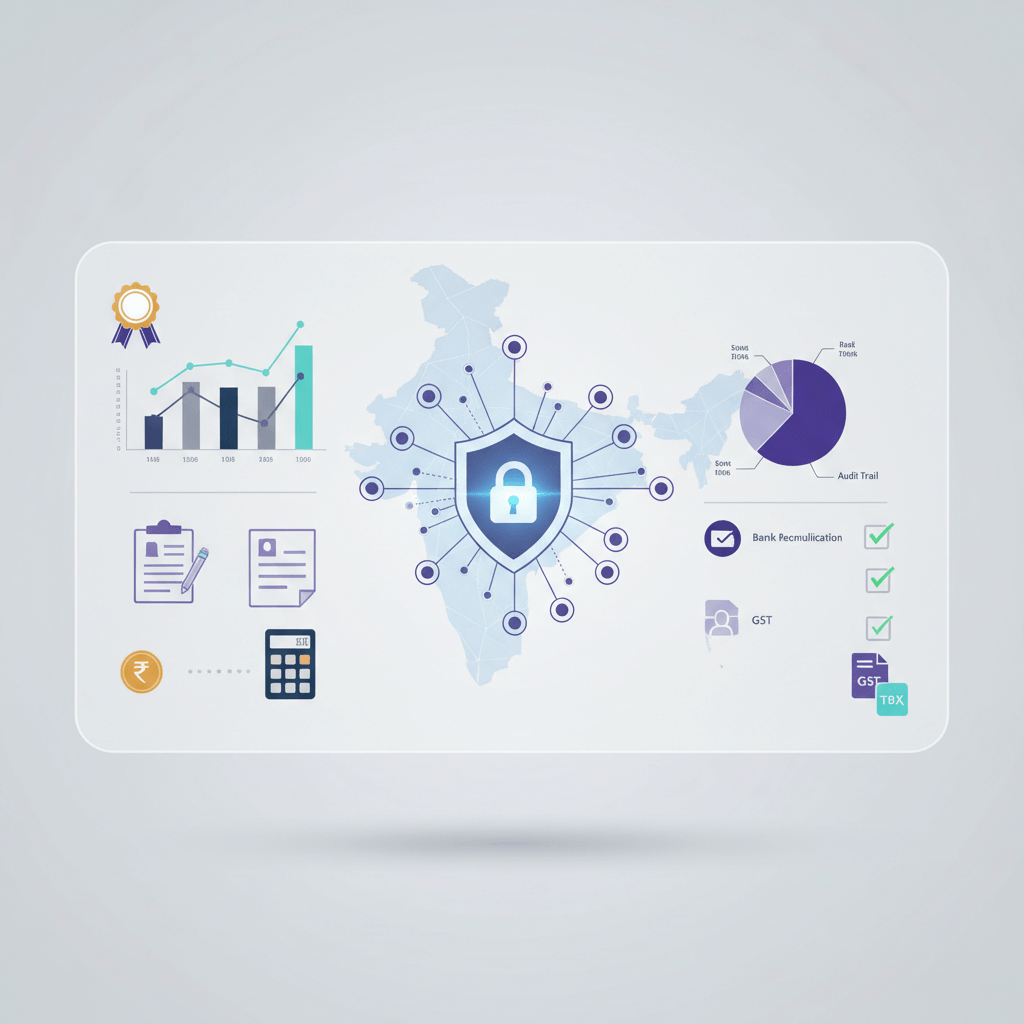
Visual, diagram of pillars showing governance, access, integrity, reconciliations, compliance, documentation, monitoring. Alt text, pillars of secure financial reporting for startups. For broader reporting context, see what is financial reporting and data security guide.
Month end and year end blueprint for internal controls over financial reporting
Daily and weekly
- Capture all sales, purchase, and expense transactions.
- Attach bills, receipts, and contracts to entries.
- Tag entries with correct categories and GST details.
- Match bank feeds and record payments against invoices.
- Review exception alerts for odd or duplicate entries.
Month end
- Post accruals, prepayments, depreciation, and provisions.
- Reconcile bank accounts and payment gateways fully.
- Reconcile accounts receivable and accounts payable to statements.
- Review revenue recognition and credit notes.
- Close inventory movements and reconcile to stock records.
- Review fixed asset register and capitalization.
- Run variance analysis for revenue, gross margin, and expenses.
- Prepare MIS and management reporting pack with P and L, balance sheet, and cash flow.
- Lock the period after approvals.
Quarterly
- Review TDS and GST reconciliations.
- Compute and plan advance tax.
- Review working capital trends and cash runway.
- Do a mini health check on compliance statuses.
Year end
- Prepare closing schedules for all balance sheet lines.
- Complete asset and inventory counts and reconciliations.
- Prepare audit support papers and ledgers for your statutory auditor.
- Prepare tax audit support if applicable. This is preparation only and not a certification.
- Finalize annual GST reconciliations and file GSTR 9 and 9C as required.
- Align ROC forms and secretarial documents for small companies as needed.
Tip, turn this checklist into a standard operating procedure. Assign owners and due dates. Use a dashboard to track status. Your close will become faster and more predictable in a few cycles.
Visual, checklist graphic for month end close. Alt text, secure financial reporting month end checklist. For helpful primers, see financial reporting guide and security guide.
KPIs to measure data integrity in accounting
- Close time, how many days to finalize books after month end. Aim to reduce this over time without cutting controls.
- Reconciliation completion rate, of all accounts that need a reconciliation this period, what percent are fully reconciled and reviewed by the due date.
- On time filing rate, of all required GST, TDS, income tax, and ROC filings, what percent were filed on or before the deadline.
- Exceptions within service level, track how many exceptions or variances were cleared within your set window, for example, resolve bank breaks within three business days.
- Access reviews complete, did you complete monthly access reviews and remove inactive users.
- Count of backdated entries, how many backdated journal entries were posted after period close. Fewer is better. Each one should have clear approval.
- Audit adjustments, how many audit adjustments were required later. Fewer adjustments show stronger integrity in your base process.
Show these KPIs in your dashboard and review them monthly with your CA partner. Useful context, financial reporting KPIs and reporting best practices.
How a CA led virtual accounting model enables secure financial reporting
Many teams try to build everything in house and end up with fragmented email threads and scattered spreadsheets. A CA led virtual accounting model gives you execution clarity and live visibility together. This is exactly how AI Accountant operates. It blends managed CA services with a centralized dashboard so you get both discipline and transparency.
What the CA team executes
- Accounting and bookkeeping, monthly bookkeeping across sales, purchases, and expenses, ledger scrutiny and clean up, year end closing entries and schedules, fixed asset register maintenance, inventory records and reconciliation, accounts receivable and payable management, bank and payment gateway reconciliations, cash flow preparation that is non certified, MIS and management reporting, support with coordination with your statutory auditor.
- Taxation and compliance, GST registration when needed, regular filings like GSTR 1 and GSTR 3B, annual returns like GSTR 9 and 9C, end to end GST advisory such as place of supply, RCM applicability, HSN codes, and tax rates, e invoice enablement, GST health checks and reconciliations.
- Income tax, income tax return filing for individuals, partnerships, and companies, TDS advisory and compliance including monthly challan payments and Forms 26Q, 24Q, 27Q, 26QB, 26QC, and 26QD, TDS and income tax health checks, advance tax calculations and payments, tax audit preparation that is non certification, international tax advisory, expat tax and salary structuring, 15CA preparation.
- Payroll services that are fully non attest, monthly TDS calculation for payroll, advisory on salary structuring to help employees save taxes within the law.
- Annual ROC compliance and secretarial support for small companies, MCA and ROC compliance filings such as MSME vendor filings, MGT 7 annual return, AOC 4 financial statements, DIN application and director appointment or resignation, DIR 3 KYC, increase in authorised share capital and share allotment, board meetings and minutes, AGM support, statutory registers, board report and annual report, for entities that meet the small company criteria.
What the dashboard provides
- A live financial overview including revenue, expenses, profit or loss, and balances.
- Income and expense breakdowns.
- Cash flow trends, burn rate, and runway.
- AI generated insights and alerts.
- Recent transactions and bank statement analysis.
- A central document repository with version control.
- A compliance calendar with dates and filing status.
- Central communication with your CA team inside the system.
How this maps to secure reporting
- Governance lives in your chart, policies, and close calendar set by the CA.
- Access control is managed through roles and maker checker workflows.
- Data integrity comes from disciplined bookkeeping and period locks.
- Reconciliations are run and reviewed monthly.
- Compliance assurance is tracked in the dashboard with status and alerts.
- Documentation is centralized and searchable.
- Monitoring happens through variance alerts and an audit trail.
Together this model reduces spreadsheet sprawl, speeds your close, and makes filings boring in the best way. You still own decisions and oversight, the CA team does the heavy lifting with non attest execution and advisory. Visual, dashboard screenshot with overview tiles, compliance dates, and a documents pane. Alt text, secure financial reporting dashboard view. Background reading, data security practices and reporting benchmarks.
Use cases for secure financial reporting across SaaS, D2C, and freelancers
SaaS startup
- Revenue recognition needs clear rules for subscriptions, upgrades, credits, and refunds.
- Contractor payments may need TDS handled on time with correct sections.
- GST place of supply can vary by customer location and service type.
- You want monthly runway and burn rate to be accurate and explainable to investors.
D2C and ecommerce brand
- Marketplaces have complex settlements. You need reconciliations between orders, fees, returns, and payouts.
- E invoice enablement may be needed once you cross limits.
- Inventory reconciliation must tie to COGS and closing stock.
- GST rates and HSN codes must be applied correctly across product lines.
Freelancer or solo consultant
- Simple invoicing and collection tracking keeps cash steady.
- RCM for GST can apply depending on services and clients.
- Advance tax planning avoids surprises.
- Clean books help with quick ITR filing and proofs for loans or visas.
In each case, the same secure reporting pillars apply. Clear policies, tight reconciliations, accurate tax treatment, and a single source of truth for documents keep you safe and ready. References, data security and reporting playbooks.
Implementation roadmap for internal controls over financial reporting
- Discovery and setup
- Onboard your entity details and users.
- Create or refine your chart of accounts.
- Draft light policies for revenue, expenses, capitalization, discounts, and credit notes.
- Define your close calendar and cut off rules.
- Integrations and workflows
- Connect bank accounts and payment gateways where possible.
- Map invoice and expense capture to categories and GST fields.
- Set maker checker workflows for journals and backdating.
- Configure document repository with naming rules.
- Compliance calendar and MIS
- Set up your GST, TDS, income tax, and ROC timelines with reminders.
- Define your MIS pack with P and L, balance sheet, cash flow, AR aging, AP aging, and unit economics where needed.
- Add variance and anomaly alerts for faster reviews.
- Pilot close and training
- Run a pilot month close following the checklist.
- Review breaks and fixes with your CA partner.
- Iterate on policies and workflows.
- Train your team to use the dashboard and keep commentary inside one system.
By the second or third cycle your close should feel smooth, exceptions will shrink and filings will go out on time. More context on financial reporting rollouts, overview and best practices.
Putting it all together with AI Accountant
AI Accountant is built for secure financial reporting. It delivers a managed CA service and a live dashboard in one simple model. You get end to end bookkeeping, reconciliations, and compliance with clear visibility into your numbers, documents, and due dates. The service covers accounting, GST, TDS, income tax, payroll advisory, and small company ROC support. The dashboard gives you a real time view of cash flow, burn, and trends, along with alerts and a central repository. Execution is non attest and led by qualified CAs.
If you want a steady month end and year end close, fewer surprises, and faster filings, this model keeps your team lean while your controls stay strong. Book a quick demo and speak with a CA about your setup and goals.
Final note
Secure financial reporting is achievable with steady habits and a CA led system that emphasizes internal controls over financial reporting. Start with the checklist in this guide, bring your team and your CA partner into one source of truth. Your numbers will tell a clear story, your filings will be on time, and your stakeholders will trust what they see.
FAQ
What is the difference between data security and secure financial reporting
Data security is about tools like encryption and network protection, secure financial reporting adds the process side. It includes internal controls over financial reporting, reconciliations, compliance checks, and audit trails that protect integrity and accountability. See a useful primer on data security from ShareFile, and an audit trail overview here, automated audit trails for businesses.
Can spreadsheets be part of a secure month end close
Yes, if you enforce version control, restricted access, and documented reconciliations. However, a centralized dashboard and a CA led workflow, as provided by AI Accountant, reduce copy paste risk, ensure maker checker reviews, and keep one source of truth as you scale.
How does maker checker control work in practice for journals and backdating
Creator and approver are separated, sensitive actions like manual journals, backdated postings, or vendor master edits require review by a designated approver. AI Accountant configures these roles, logs who did what and when, and locks prior periods after close, reducing unauthorized changes.
What documents should we retain, and for how long, to stay audit ready
Keep GST and TDS invoices and returns for at least six years or more as required, preserve income tax proofs, contracts, board approvals, bank statements, and reconciliation files. Maintain auditable trails showing approvals. A central repository with versioning, like the one in AI Accountant, makes retrieval simple.
Will secure financial reporting reduce statutory and tax audit adjustments
Yes, disciplined reconciliations, timely accruals, and documented policies reduce post audit adjustments. Firms that adopt monthly controls typically see fewer reclassifications and shorter audit cycles. See benchmarks and guidance on financial reporting quality.
How do we manage GST complexity across states, RCM, and e invoice thresholds
Define master data rules for HSN, place of supply, GST registration mapping, and RCM logic. AI Accountant embeds these rules in bookkeeping and compliance checks, flags mismatches during GSTR 1 and 3B prep, and alerts you when e invoice thresholds are approached.
What KPIs should a founder track monthly to gauge reporting health
Start with close time, reconciliation completion rate, on time filing rate, exceptions cleared within SLA, access reviews complete, count of backdated entries, and audit adjustments. AI Accountant visualizes these on the dashboard and highlights hotspots automatically.
How quickly can we achieve a five day close after onboarding
Most teams reach a predictable five to seven day close in two to three cycles, provided bank feeds are connected, document capture is enforced, and maker checker is active. AI Accountant runs a pilot month close, fixes breaks, and then locks a repeatable cadence.
What integrations matter most for secure reporting and how are they governed
Bank feeds, payment gateways, invoicing, and expense tools are the priority. Governance means read only bank access where possible, role based permissions, and reconciliation checkpoints. AI Accountant establishes these controls, then ties each data flow to a reconciliation and review step.
How do we control access for founders, finance staff, and external auditors without over exposing data
Use least privilege roles. Founders see dashboards and reports, finance staff have scoped edit rights, auditors get time bound read access to evidence folders. AI Accountant applies role templates, monthly access reviews, and automatic user deactivation for inactivity.
What is the cost and benefit trade off versus hiring in house accountants
A CA led virtual model combines expert oversight with process automation, so you avoid overstaffing while achieving a stronger control environment. Benefits include faster close, fewer penalties, cleaner audits, and better investor communication. AI Accountant typically replaces scattered tools and reduces spreadsheet sprawl.
How are anomalies detected, for example duplicate payments or revenue spikes
Rules based and AI driven checks scan ledgers and bank lines for duplicates, backdated entries, unusual variances, and broken mappings. AI Accountant flags these as exceptions, routes them for review, and tracks resolution time against SLA.
Can we generate audit ready schedules and tie outs directly from the system
Yes, a proper setup produces balance sheet schedules for every line, AR and AP agings that tie to ledgers, bank and gateway reconciliations, and fixed asset registers with depreciation working. AI Accountant packages these with document links so auditors can self serve.
How do we ensure compliance filings are on time, every time, across GST, TDS, income tax, and ROC
Use a compliance calendar with owners and due dates, automated reminders, and status tracking. AI Accountant maintains this calendar, reconciles data before filings, and provides a final review checklist so submissions are timely and complete.
What happens if we need to post a backdated correction after period lock
Backdated entries should be rare and explicitly approved. In AI Accountant, the prior period is locked, a correcting entry is created with documentation, and an audit note captures rationale and approver details, preserving integrity while keeping the trail intact.