-01%201.svg)
Key takeaways
- A profitability analysis dashboard gives you a real time visual command center to track margins by product, geography, or customer segment, answering "where are we making money?" in seconds instead of hours.
- Segment wise profit reporting and cost centre analytics reveal hidden expense leaks (TDS mismatches, accumulated bank charges, FX losses) before they erode your bottom line.
- Heatmaps and automated variance alerts surface anomalies early, shifting your financial management from reactive firefighting to proactive margin control.
- Indian SMBs processing ₹1 crore+ monthly transactions save 15 to 20 hours per month by replacing manual spreadsheet tracking with automated dashboard tools.
- If your CA team still reconciles margins manually at quarter end, you are spotting profit leaks 90 days too late. Weekly visual reviews change that.
- AI Accountant's MIS reporting integrates with Tally to auto generate profitability dashboards, eliminating double entry and giving finance teams instant margin visibility across entities.
Profitability Dashboards for Indian SMBs: What's New in 2026
Until March 2025, most Indian SMBs tracked profitability through monthly or quarterly Excel reports built manually from Tally exports. From April 2025, two regulatory shifts changed the game. The GST e-invoicing threshold dropped to ₹5 crore turnover (per CBIC's notification framework), pulling lakhs of additional businesses into real time digital compliance. Simultaneously, the Income Tax Department's updated TDS reporting requirements under Section 194R and 194S now demand more granular transaction tracking.
The operational shift is significant. Finance teams now need dashboards that reconcile GST input tax credit in near real time, not at quarter end. Businesses above ₹5 crore turnover must validate e-invoice data against their profitability reports daily. Those below the threshold still benefit because suppliers above it generate structured data that feeds directly into automated dashboards.
CA firms managing 20+ clients feel this most acutely. Manual margin tracking across multiple entities now risks missed ITC reversals (18% interest under Section 50 of the CGST Act), late TDS deposit penalties (1.5% per month), and blocked GST filings. For businesses ignoring these changes, the cost compounds quickly: a single quarter of unreconciled ITC mismatches on ₹50 lakh input can mean ₹2.25 lakh in interest alone.
What to do now:
- Audit your current margin tracking workflow. If it depends on month end Tally exports, you are already behind.
- Set up automated GST reconciliation that feeds into your profitability dashboard weekly.
- Review TDS variance reports monthly instead of quarterly to catch mismatches before filing deadlines.
Platforms like AI Accountant now auto map e-invoice data to segment wise profit reports, reducing the reconciliation gap from weeks to hours.
The Growing Need for Visual Margin Tracking in Indian SMBs
Indian SMBs juggle GST compliance, TDS calculations, multiple accounts, and diverse revenue streams. Traditional spreadsheets deliver accuracy but often hide the story behind the numbers.
Founders ask, "Which product line is most profitable?" or "Why did our margins drop last quarter?" without a clear answer. According to ICAI's guidance on financial reporting standards, timely and granular financial information is essential for sound business decisions.
Running a business blindfolded is possible. But the journey will be bumpy, stressful, and full of detours.
Modern visual tools bridge the gap between data and insight. They highlight profit leaks before they become major issues. For SMBs processing hundreds of ledger entries and vendor invoices monthly, a visual margin tracker replaces guesswork with clarity.
What Is a Profitability Analysis Dashboard?
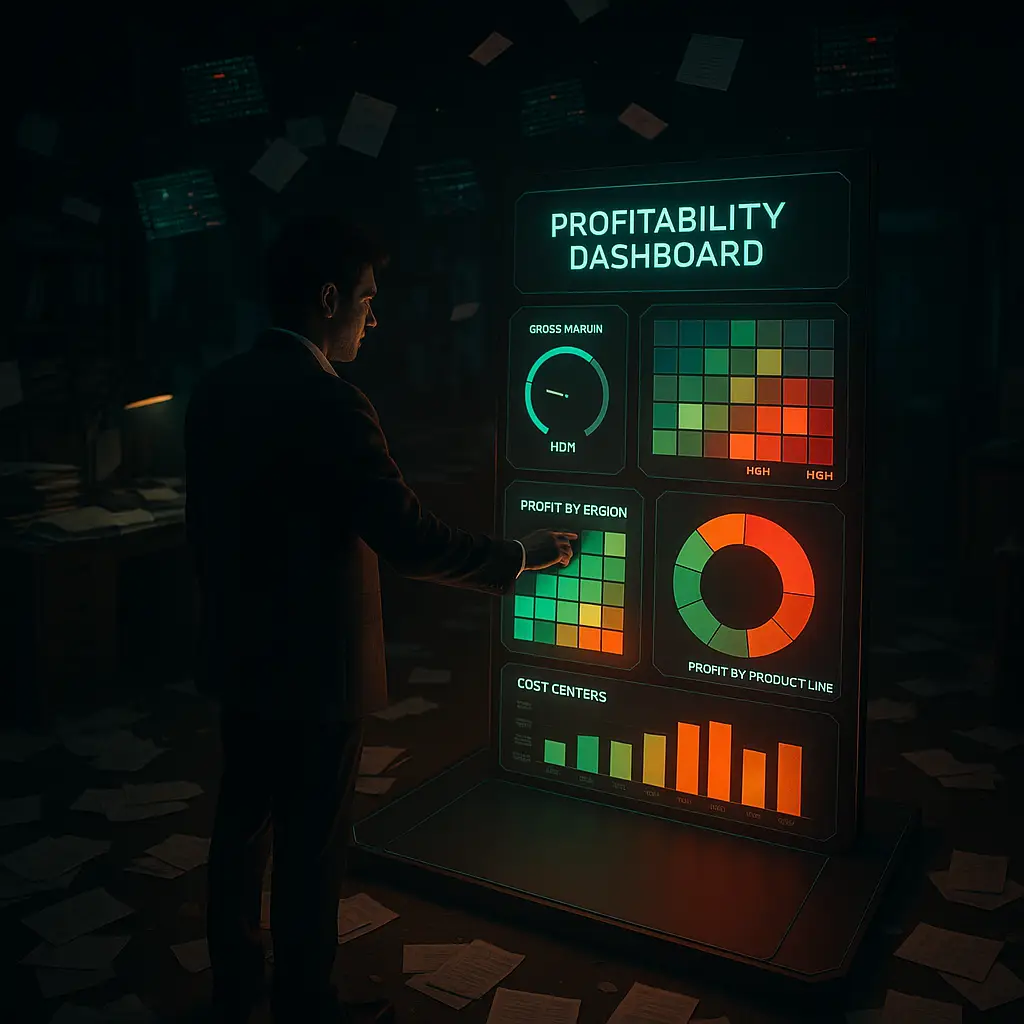
Think of this dashboard as your financial cockpit. It centralizes real time KPIs, profit drivers, and segment performance in one interface. Instead of hunting through files, you see an organized, visual story of your business health.
Top dashboards share these traits:
- Clarity and reliability in metrics that reflect reality.
- Segmentation by product, geography, or customer for granular insights.
- Real time data integration to keep decisions current.
- Accessible design for CAs, CFOs, and non-finance founders.
A well built profit margin dashboard answers three questions instantly: where is money coming in, where is it leaking out, and what changed since last week?
Key Visual Tools for Profitability Tracking
Gross Margin Tracker
Your fundamental efficiency metric, visualized across offerings. A gross margin tracker highlights best and worst performers at a glance.
This aids pricing negotiations and product launch decisions. For example, an FMCG distributor in Pune can instantly see that Product A earns 32% gross margin while Product B sits at 11%, triggering a review of supplier costs or minimum order quantities.
Segment Wise Profit Reporting
Break down profits by line, geography, or customer. Discover that your Bangalore operations earn high margins versus lower margin Delhi branches. Then allocate resources wisely.
Segment wise reporting also helps during audit preparation. When your CA asks for division level P&L data, the dashboard delivers it in one click instead of a week of manual compilation.
Cost Centre Analytics
Track expenses by department or project to spot overlap and underutilization. Visual comparisons make budget variances obvious.
For instance, a SaaS company might discover three departments paying for overlapping software subscriptions. Consolidating those saves ₹2 to 3 lakh annually, a leak invisible in traditional account statements.
Net Profit Heatmap
A color coded overview of profitability across dimensions. Red, yellow, and green visuals surface anomalies and successes instantly.
Heatmaps work especially well for multi location businesses. A retail chain with 15 stores can spot the two underperforming outlets in seconds, then drill into transaction level details to understand why.
Benefits of Visual Profitability Tools for Indian SMBs
Visual profit analysis tools support compliance and strategy without complexity:
- Integrated with Tally for audit readiness, reducing last minute scrambles during statutory audits.
- Enterprise level analytics at SMB friendly cost, often under ₹5,000 per month.
- Real time visibility for proactive margin control instead of quarter end surprises.
- Reduced dependency on a single CA or accountant who "knows where everything is" in the spreadsheet.
As per RBI guidelines on financial reporting for MSMEs, businesses benefit from maintaining transparent and timely financial records. Visual dashboards make that practical, not just aspirational.
How AI Accountant Automates Profitability Analysis
AI Accountant generates dashboards from bank and ledger data, using auto segmentation and ledger classification. It integrates with Tally, eliminating double entry.
The platform auto categorizes transactions from bank statements and credit card feeds. It then maps them to the right ledger heads, populating your gross margin tracker and net profit heatmap without manual intervention.
Indian Specific Examples of Profitability Leaks
- TDS mismatches flagged by variance trend reports. Even a 1% TDS short deduction on ₹1 crore turnover means ₹1 lakh in potential penalties and interest (per Income Tax Department provisions under Section 201).
- Refund charges and return processing costs eroding margins over time, especially in e-commerce where return rates exceed 25% in some categories.
- FX losses separated from operational efficiency, critical for export oriented SMBs dealing in USD or EUR invoicing.
- Accumulated bank and processing fees revealed in aggregated visuals. A typical SMB paying 2% on card transactions across ₹50 lakh monthly sales loses ₹12 lakh annually, often unnoticed.
- GST input tax credit reversals due to supplier non compliance, identified only when reconciliation happens quarterly instead of monthly (per GST portal Rule 36(4) provisions).
Setting Up Your Profitability Analysis Dashboard
Start by defining core metrics: gross margin, segment profitability, and cost centres. These three cover 80% of what founders and CAs need.
Choose a tool that integrates with your existing workflow. Use clear filters and color schemes so anyone on the team can read the dashboard without training.
Establish a review rhythm. Monthly works for stable businesses. Weekly is better for fast growing SMBs or those with seasonal revenue swings. Share dashboard access widely rather than restricting it to finance teams alone. When sales managers see margin data, pricing discipline improves naturally.
Advanced Features for Growing Businesses
- Predictive analytics for cash flow forecasting, helping you anticipate tight months before they arrive.
- Multi entity consolidation for group structures, essential for holding companies or franchise models.
- Automated alerts when metrics deviate beyond set thresholds (e.g., gross margin drops below 20%).
- Drill down capability from summary to individual transaction details for investigation.
- Integration with sales pipelines for context, connecting revenue forecasts to margin projections.
Common Implementation Mistakes to Avoid
- Tracking too many metrics at once. Start with 5 to 7 KPIs, not 30.
- Ignoring data quality. Fix ledger classification and transaction mapping first. A dashboard built on dirty data gives confident wrong answers.
- Over customizing dashboards without a clear purpose for each view.
- Using dashboards only during crises rather than as a regular management tool.
- Skipping user training on interpretation and action. A dashboard nobody reads is just expensive decoration.
Conclusion: Better Margins Start with Better Visibility
Profitability dashboards shift SMBs from reactive to proactive financial management. Automated solutions remove technical barriers, delivering insights that support strategic growth.
Clear margins drive confident decisions. Whether you are a CA firm managing 50 clients or a founder scaling from ₹2 crore to ₹20 crore, visual margin tracking is no longer optional. It is the difference between knowing your numbers and actually understanding them.
FAQ
How can I automate GST calculations and integrate them into a profitability dashboard?
Connect your Tally data to an automation platform that classifies GST transactions in real time. This reflects tax positions alongside margins automatically, ensuring compliance and insight without manual effort. With the e-invoicing threshold now at ₹5 crore, automated GST feeds into dashboards have become essential for a larger pool of businesses (2026 update).
What steps should a CA follow to set up bank statement imports for margin analysis?
Upload or schedule bank feeds in your dashboard tool, map account codes once, and let auto classification handle the rest. The system then populates gross margin trackers and heatmaps instantly, saving 3 to 5 hours per client per month on manual data entry.
Can a profitability dashboard generate segment wise profit reports for a trading firm?
Yes. Define product categories in your segment setup, and the dashboard breaks down profits by line, geography, or customer group with color coded visuals. Trading firms with 10+ product lines benefit most because manual segment tracking at that scale is error prone and slow.
How does a dashboard handle TDS mismatches and flag them automatically?
The dashboard compares actual TDS deductions against ledger entries and flags variances in a dedicated widget. Alerts trigger when thresholds are breached, helping CAs correct mismatches before filing deadlines. Under current rules, late TDS deposits attract 1.5% monthly interest, making early detection critical (2026 update).
Is multi entity consolidation available for group companies in India?
Yes, multi entity consolidation is a standard feature in modern profitability dashboards. You define separate legal entities, map inter company transactions, and view combined profitability or drill down by entity. This is especially useful for holding structures managing 3 or more subsidiaries under a single CA firm.
How secure is financial data in cloud based profitability dashboards?
Reputable platforms use bank grade encryption, role based permissions, and audit trails. CAs can set read only or edit rights for team members. Look for ISO 27001 and SOC 2 Type II certifications as minimum security benchmarks when evaluating any dashboard tool.

A results-driven finance and sales professional with hands-on experience through finance internships and a fast-paced sales role. With a strong interest in accounting and business finance, Harsh focuses on turning complex topics into clear, practical takeaways for founders and finance teams.