-01%201.svg)

If you run a manufacturing business in India, choosing the right manufacturing accounting software is harder than it looks.
You're dealing with hundreds of purchase invoices, GST variations, vendor formats, and constant stock movement, all at the same time.
One wrong entry can throw off your margins completely.
On top of that, you still need to figure out:
- What your actual product cost is
- Whether you're making or losing money per batch
- How much stock is stuck in production
This is where manufacturing accounting becomes very different from regular accounting.
It's not just about bookkeeping. It's about connecting inventory, production, and finance in one place.
What Makes Manufacturing Accounting Software Different
A regular accounting tool helps you track sales, expenses, and GST.
But manufacturing businesses need more than that.
They require software that can:
- Handle high-volume billing (multiple vendors, formats, and entries)
- Track raw materials and finished goods together
- Support bill of materials (BOM) and production costing
- Manage inventory across stages (raw to WIP to finished goods)
- Calculate actual margins, not just revenue
Without this, most manufacturers end up relying on Excel, which quickly becomes messy and error-prone.
Top 6 Manufacturing Accounting Software Options for Indian Businesses
1. Tally Prime: Best All-Round Manufacturing Accounting Platform
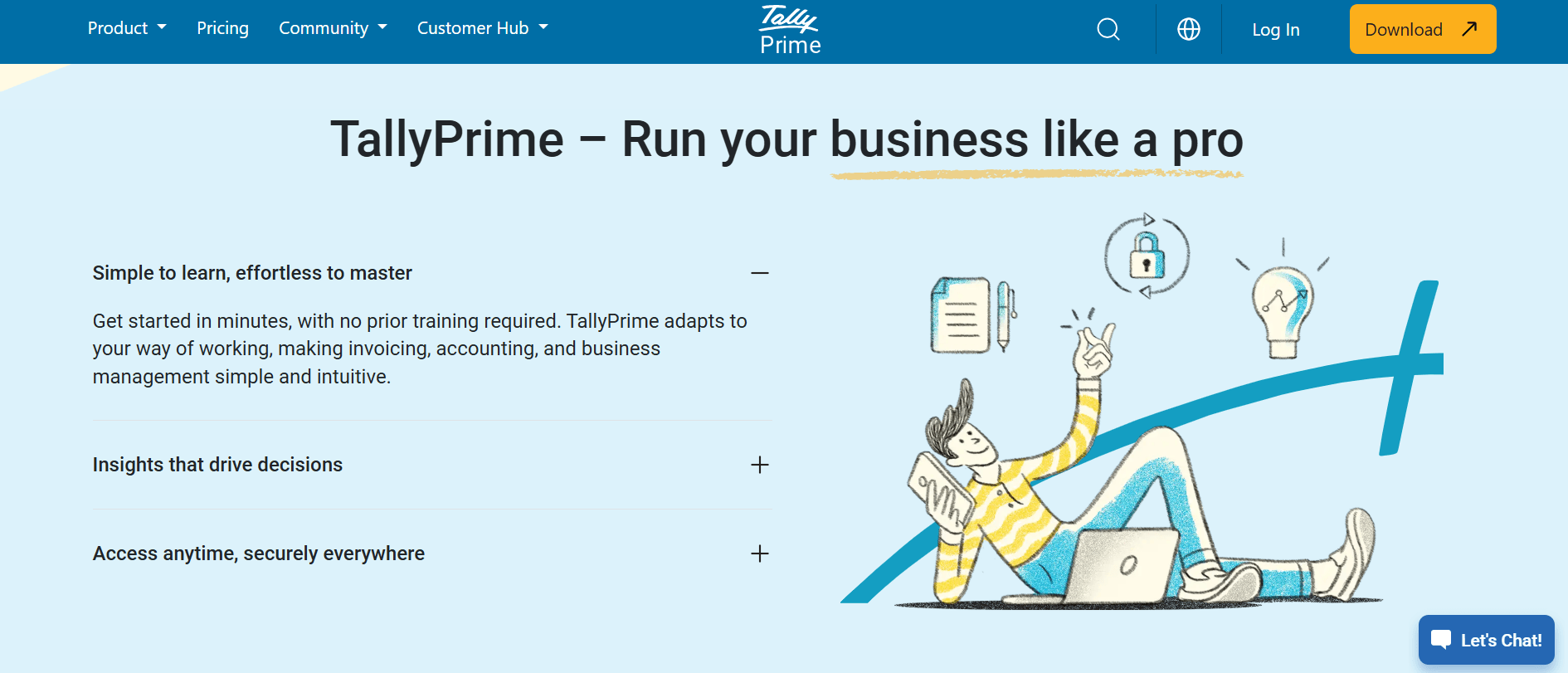
Tally Prime is the legacy accounting and ERP system for Indian manufacturing SMBs, and for good reason. It handles the full-stack accounting needs most manufacturers deal with daily. From inventory to compliance, it's the system most accountants are already comfortable with.
It covers:
- Inventory management
- Bill of Materials (BOM)
- Multi-godown tracking
- Job work and cost centres
- GST compliance
If you've hired accountants for your business, chances are they already know how to operate Tally.
Why manufacturers use it: Tally's inventory module lets you track raw materials, WIP, and finished goods with strong control. You can set reorder levels, manage stock movement, and generate detailed reports at an item level. For businesses doing ₹50 to 100 crore with multiple warehouses, this depth is difficult to replace.
The real limitation: The issue isn't capability. It's the manual workload and dependency on people.
Every purchase bill, bank entry, and GST reconciliation has to be manually entered or verified. For manufacturers handling 300 to 600 purchase bills a month with up to 100 line items each, this becomes a constant bottleneck.
This leads to:
- Heavy reliance on accountants: Founders or CEOs can't realistically operate Tally themselves. Even basic visibility depends on the accounting team.
- Operational risk: If one accountant is on leave, work piles up immediately. There's no buffer or automation layer.
- Data entry fatigue: Teams spend hours entering repetitive data instead of reviewing or analysing it.
- Higher error rates: Manual entry across hundreds of line items increases the chances of mistakes in ledgers, GST amounts, or vendor mapping.
- Delayed visibility: Since everything is entered after the fact, real-time financial visibility is limited.
This is exactly the gap modern AI-led tools are solving, not by replacing Tally, but by reducing the manual effort required to run it.
Pricing: Tally Prime Silver (single user) is approximately ₹18,000/year. Gold (multi-user) is approximately ₹54,000/year. It's typically deployed locally with a one-time license, though cloud setups are also available.
Verdict: Tally Prime is still the foundation for most manufacturing businesses in India. If you need deep inventory control, job work tracking, and cost centre analysis, it remains one of the strongest options at this price point. The real problem isn't Tally. It's the manual workload that comes with it.
2. AI Accountant: Best for Manufacturing Companies With High Volume Bills
.png)
AI Accountant is not a replacement for Tally. It's an automation layer that sits on top of it, and that distinction matters.
If your business already runs on Tally Prime and your biggest issue is the manual workload, AI Accountant directly addresses that. It focuses on reducing effort in bill entry, bank reconciliation, and GST matching: the exact areas where accounting teams spend most of their time.
What it actually does well:
High-volume bill processing with real AI:
The platform handles up to 1,000 purchase bills per month depending on the plan. It uses AI-based extraction instead of template-based OCR, which is critical for manufacturers dealing with multiple vendor formats.
Over time, the system learns your ledger mappings. This means repeat vendors and product codes get auto-mapped with increasing accuracy, reducing manual intervention significantly.
Multi-line item support:
It supports bills with up to 100 line items per document. This is especially useful for manufacturers receiving bulk material invoices with detailed breakdowns.
GST 2A/2B reconciliation with better categorisation:
Instead of a basic matched/unmatched view, it breaks reconciliation into four categories:
- Matched
- Mismatched (amount differences)
- Missing entries
- AI probable matches
This reduces the time spent manually reviewing mismatches, especially at scale.
Bank statement automation:
The platform processes bank statements and maps payments to open invoices automatically. It can handle most standard payment scenarios. Complex partial payments across multiple bills from a single vendor may still need manual review.
Two-way sync with Tally:
Entries created in AI Accountant sync back into Tally while preventing duplicates. Tally continues to remain your source of truth.
Compliance and trust:
AI Accountant is ISO and SOC Type 2 certified. The parent company, Karbon Business (YC S21), has been operating for over 7 years with 500+ active users.
Where it's honest about its limits
AI Accountant is a bookkeeping automation tool, not an ERP.
It does not currently offer:
- Inventory management (no stock tracking or reorder levels)
- BOM or production workflows
- Sales order automation
- Forecasting or analytics
- Eligible vs ineligible GST classification
If your problem is inventory or production control, you still rely on Tally for that. If your problem is manual bookkeeping workload, this is where AI Accountant fits.
Best Feature: Real-time financial dashboard that gives complete visibility into your business finances—without waiting for month-end reports.
Unlike traditional accounting tools where you see numbers after everything is entered and closed, AI Accountant gives you live visibility into your financial position as transactions happen.
Pricing
Plans are available based on monthly bill volume and bank statement count. We offer a 30-day money-back guarantee applies on all monthly plans. Annual plans with additional savings are also available.
Verdict: If you're a manufacturer using Tally and dealing with high bill volumes, AI Accountant gives you a focused solution. It reduces dependency on manual data entry without forcing a system change. It's not meant to replace Tally. It makes Tally actually manageable at scale.
3. Marg ERP: Best for Pharma, FMCG, and Distribution Manufacturing
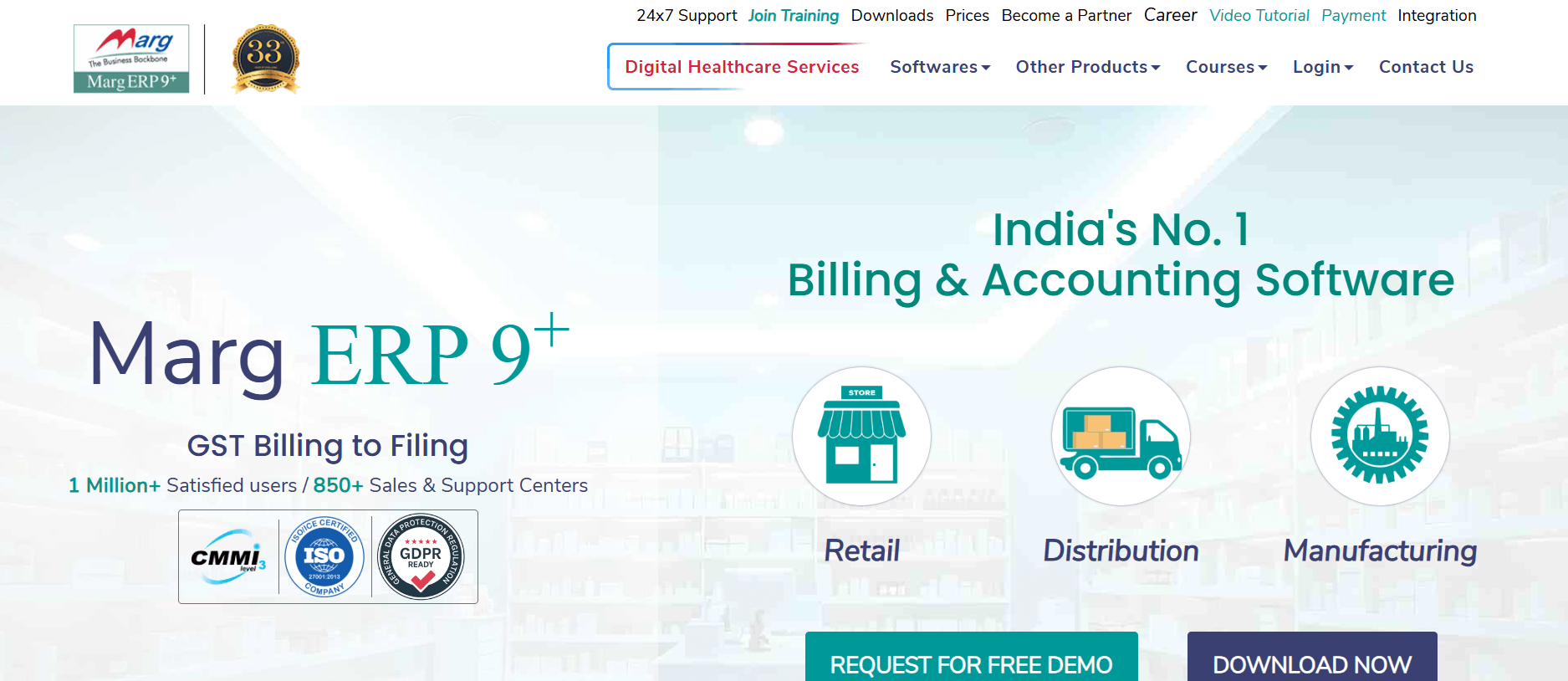
Marg ERP is purpose-built for product-based businesses, particularly pharma, FMCG, and distribution-heavy manufacturing. It includes inventory management, batch tracking, expiry date management, barcode integration, and GST compliance in a single system.
Where it wins: For manufacturers in regulated industries (pharma, food processing, chemicals) where batch-level traceability is non-negotiable, Marg's specialised modules are difficult to replicate with generic tools. It also handles multi-location inventory and integrates with point-of-sale for businesses that distribute directly.
Where it falls short: Marg is not as widely known or supported as Tally among CAs, which can create friction during audits or when working with external accounting firms. The interface is functional but dated, and the learning curve is steeper than modern cloud tools. Automation is limited, meaning data entry remains largely manual.
Pricing: Typically ₹15,000 to ₹40,000 as a one-time license depending on modules, plus annual maintenance (AMC). Confirm current pricing with the vendor.
Verdict: Strong choice for pharma and FMCG manufacturers where industry-specific compliance (batch tracking, expiry, barcode) is a hard requirement. Less suitable for general manufacturing that doesn't need those features.
4. Busy Accounting: Best Budget Option with Manufacturing Module
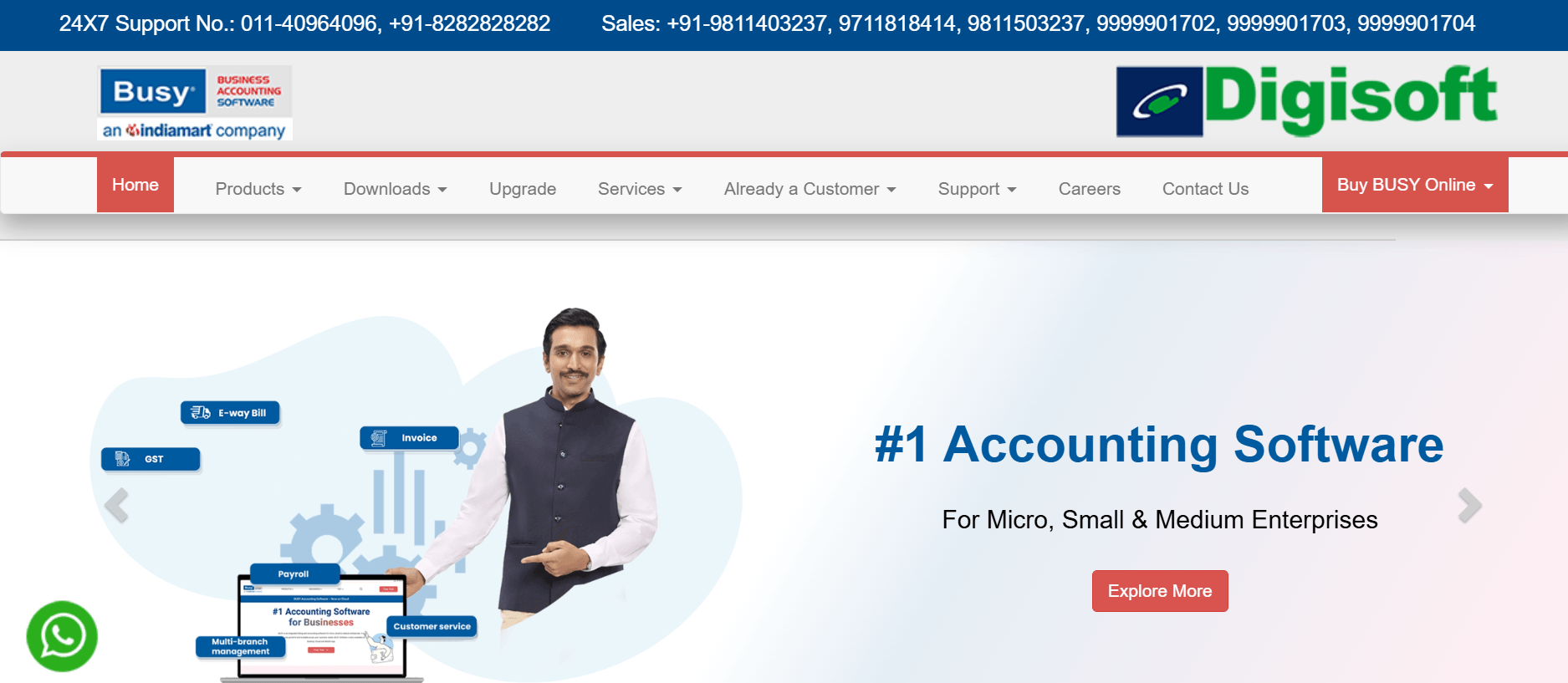
Busy is a popular accounting solution among Indian SMBs, particularly businesses that straddle trading and manufacturing. It includes a manufacturing module covering BOM, production orders, and material consumption at a lower price point than Tally Prime.
Where it wins: Busy supports multi-location inventory, job work, and production orders at a lower total cost of ownership than Tally Prime's Gold license. For small manufacturers (under ₹10 crore revenue) who find Tally's pricing steep, Busy is a credible alternative.
Where it falls short: Busy has a significantly smaller ecosystem than Tally. Fewer CAs are trained on it, fewer add-ons exist, and switching to Busy can create friction when working with external accounting professionals. There is no meaningful automation layer for bill entry or GST reconciliation.
Pricing: Approximately ₹9,000 to ₹18,000/year depending on the edition. Check the vendor site for current rates.
Verdict: A solid budget pick for smaller manufacturers who need a manufacturing module but can't justify Tally's per-user licensing. Accept the ecosystem tradeoff going in.
5. Zoho Books: Best Cloud-Native Option for Smaller Manufacturers
Zoho Books is the strongest cloud-native accounting platform available in India for SMBs. GST-compliant, well-designed, and deeply integrated with the Zoho ecosystem (Zoho Inventory, Zoho CRM, Zoho Projects), it suits manufacturers who want cloud-first operations and a modern interface.
Where it wins: Zoho Books' UI is significantly cleaner than Tally or Busy. When combined with Zoho Inventory, it can handle purchase orders, sales orders, item tracking, and fulfilment workflows. The API ecosystem is strong, making it easier to connect with other tools. It works well for manufacturers under ₹25 to ₹30 crore revenue who are starting fresh or migrating away from Tally.
Where it falls short: Zoho Books is not Tally. If your CA, auditor, or supply chain partners work in Tally format, you will face friction. For heavy manufacturing with complex job work or cost centre analysis, Zoho Books reaches its limits. Bill volume automation is partial, with no AI-based extraction at the level that dedicated tools offer.
Pricing: ₹2,499 to ₹7,499/month depending on the plan. Check current Zoho pricing, as it changes.
Verdict: Strong choice for tech-forward smaller manufacturers who are Tally-agnostic and want a cloud-first setup. Not the right fit if your CA ecosystem runs on Tally or if you need deep manufacturing ERP features.
6. Suvit: Basic Bill Automation for Very Small Teams
Suvit is a Tally add-on focused on bill upload and data entry automation, similar in concept to AI Accountant but built on different technology. It's positioned at the lower end of the market and typically considered by very small businesses looking for basic automation at a lower price point.
Where it wins: Its lower price point makes it attractive for businesses with thin margins and minimal bill volume.
Where it falls short:
Suvit uses template-based OCR, which means it extracts data based on pre-defined invoice formats. When a vendor's invoice format changes, or when you onboard a new vendor whose format doesn't match an existing template, accuracy drops and manual correction is required. This is a meaningful limitation for manufacturers dealing with dozens of vendors with varied invoice formats. Additionally, Suvit typically requires annual payment upfront, and the trial version has been noted to differ from the paid product experience. Post-sales support has been flagged as a concern by users who evaluated both tools.
Verdict: Entry-level option for very small businesses with limited vendor variety and low bill volumes. For manufacturers at meaningful scale (300+ bills/month, multiple vendor formats), the template-OCR limitation becomes a recurring operational problem.
How to Choose the Right Accounting Software for Manufacturing Based on Accounting Stage
Not all manufacturing businesses need the same tools.
Most wrong decisions happen because businesses choose software based on features, not based on how their operations actually run today.
The right accounting software for manufacturing depends on:
- How your accounting is currently managed
- The volume of transactions you handle
- How complex your production and inventory flows are
Here's a practical way to choose based on your stage.
Stage 1: Just Getting Started (No Accountant Yet)
If you've recently set up your manufacturing business, your needs are still basic. At this stage, you're typically raising initial invoices, managing GST compliance, and tracking a limited number of transactions.
In many cases, founders start by handling accounting themselves or relying on minimal external help.
That works temporarily — but this is also where many long-term problems begin.
The biggest mistake here is not just choosing complex software.
It's delaying proper accounting setup altogether.
What you should ideally do:
Even at a small scale, it's worth setting up accounting the right way from the beginning.
You have two practical options:
1. Hire an accountant (full-time or part-time)
This works well if:
- You expect transaction volume to grow quickly
- You want someone to handle GST, compliance, and bookkeeping properly
👉 In this case, setting up Tally Prime early makes sense, since most accountants are already trained on it.
2. Use a virtual accounting service
If hiring isn't feasible yet:
- You can outsource bookkeeping and GST filing
- You still get structured accounting without full-time cost
Stage 2: Have an Accountant, But No Structured Software
This is a very common stage for small manufacturing businesses. You have an accountant or a small team, but your setup looks like this:
- Excel sheets for tracking
- Manual registers for inventory
- Separate tools for GST or billing
Over time, this creates problems. Data is scattered across multiple places, errors increase as volume grows, and reports are inconsistent and delayed. You start spending more time fixing data than using it.
This is where you need to bring in structure, not complexity.
Best fit: Tally Prime or Busy Accounting Software.
These tools help you centralise financial data, standardise entries and reporting, and bring consistency into GST and accounting workflows.
The goal here is simple: move from chaos to structured operations.
Stage 3: Using Tally, But Struggling With Volume
This is where most growing manufacturers start feeling operational pressure.
You already have Tally Prime implemented and accountants handling day-to-day entries. But as your business grows, new problems appear:
- 300 to 600 purchase bills every month
- Bills with 20 to 100 line items
- Multiple vendor formats
- Increasing GST reconciliation workload
At this point, Tally is not the problem. The problem is manual execution at scale.
Your team spends hours entering data, time fixing mismatches, and days closing books. As a result, reports are delayed, visibility is limited, and decision-making slows down.
Most businesses consider switching accounting software at this stage, but that's usually unnecessary. You don't need a new system. You need to reduce the manual workload on top of your existing system.
Best fit: Tally Prime + AI Accountant.
AI Accountant works as an automation layer by extracting data from purchase bills, auto-mapping ledgers and items, assisting in GST reconciliation, and reducing repetitive data entry.
Instead of replacing Tally, you make it actually usable at scale.
Stage 4: Using Cloud Software but Hitting Limits
Some manufacturers move early to cloud tools like Zoho Books. Initially, this works well: remote access, clean interface, better visibility compared to manual setups.
But as operations grow, limitations start showing. Production workflows become harder to manage, costing lacks depth, too many integrations are needed, and inventory tracking becomes less reliable.
You now have two options.
Option 1: Extend your current setup
Zoho Books + Zoho Inventory. This works if your operations are still moderately complex and manageable through integrations.
Option 2: Move to a more manufacturing-focused system
Busy Accounting Software or Marg ERP. These offer better BOM handling, stronger inventory tracking, and more control over production-linked accounting.
This stage is about handling increasing complexity without breaking workflows.
Stage 5: Scaling Operations (Multi-Location or Advanced Production)
At this stage, your challenges are no longer just accounting-related. You're dealing with multiple warehouses or manufacturing units, complex production planning, high coordination across teams, and large transaction volumes.
The question shifts from "which accounting software for manufacturing should I use?" to "how do I run my operations efficiently end-to-end?"
If you're already using Tally Prime:
You likely have stable accounting processes, defined workflows, and team familiarity with the system. The issue now is execution speed and scale. Manual processes start becoming bottlenecks.
Instead of switching systems, it often makes more sense to strengthen what already works.
Best setup: Tally Prime + AI Accountant. This helps you reduce manual entry workload, improve processing speed, and get closer to real-time visibility. You're not rebuilding your system. You're removing friction from it.
If you're not using Tally or open to switching:
Marg ERP works best for businesses where inventory is the core challenge, batch tracking or expiry management is critical, or operations are heavily stock-driven.
SAP Business One works best for businesses that need end-to-end integration across finance, inventory, production, and sales; structured workflows across teams; and scalability across locations. This is not just accounting software. It's a full operational system.
What Indian Manufacturing Businesses Actually Need in Accounting
The problem is generally constant:
- Too many bills and inconsistent formats: vendors don't follow standard invoicing
- Inventory and accounting mismatch: stock says one thing, books say another
- Need for cloud access: owners want to check numbers without being in the office
- Shipping and operations disconnect: invoices, dispatch, and tracking aren't connected
- Migration pain: thousands of past invoices and customers stuck in old systems
- The "messy middle" stage: spreadsheets stop working, but ERP feels too heavy
Most small manufacturers don't want a full ERP immediately. They want manufacturing accounting software that solves billing, inventory, and reporting without becoming too complex.
Common Mistakes Manufacturing Founders Make While Choosing Software
These aren't theoretical mistakes. These are patterns seen across Indian SMB manufacturers.
1. Trying to solve everything with one tool
Manufacturing has three separate needs: inventory and production, compliance (GST, audit), and financial visibility. Most tools solve one or two well, not all three. The mistake is expecting one software to handle everything perfectly.
2. Switching systems too early
Many businesses move away from Tally thinking cloud means better. But they don't consider CA dependency on Tally, team familiarity, or migration effort. The result is more friction, not less.
3. Ignoring how work actually happens on the ground
Software decisions are often made top-down. But real workflows involve accountants entering bills, store managers tracking stock, and CAs reviewing data. If the tool doesn't match these workflows, adoption fails.
4. Underestimating data discipline
Even the best software fails if item names are inconsistent, vendors are duplicated, and entries are not standardised. Software doesn't fix messy data automatically.
5. Over-investing in ERP before complexity exists
ERP makes sense when you have multiple plants, complex production planning, and large structured teams. Before that, it adds cost and complexity without clear ROI.
Frequently Asked Questions
Which accounting software is best for a small manufacturing business in India?
For small manufacturers just getting started or with basic needs, Zoho Books or Vyapar handle GST compliance and basic invoicing without unnecessary complexity. Once you cross 200 to 300 purchase bills per month and are already on Tally, an automation layer like AI Accountant becomes worth evaluating seriously.
What is the best manufacturing accounting software for high bill volumes?
For manufacturers handling 300 to 600 purchase bills a month with multiple vendor formats, a combination of Tally Prime and AI Accountant is the most practical setup. Tally handles the accounting backbone while AI Accountant removes the manual data entry bottleneck.
Can AI Accountant replace Tally Prime for manufacturing?
No, and it's not designed to. AI Accountant works as an automation layer on top of Tally, reducing the manual data entry burden. Tally remains the system of record for inventory, compliance, and CA reporting. AI Accountant handles bill extraction, bank reconciliation, and GST matching so your team shifts from data entry to review and exception-handling.
What is the difference between AI Accountant and Suvit?
The core difference is in how each tool extracts data. Suvit uses template-based OCR, which relies on pre-defined invoice formats. When a vendor's format changes or a new vendor is onboarded, accuracy drops until a new template is created. AI Accountant uses AI-based extraction that learns from your data over time, making it better suited for manufacturers dealing with multiple vendors and varied invoice formats. Suvit also typically requires annual payment upfront, and the trial version has been noted to differ from the paid experience.
Does AI Accountant support GST 2A/2B reconciliation?
Yes. It categorises reconciliation into four groups: matched, mismatched (amount differences), missing entries, and AI probable matches. The fourth category uses pattern recognition to flag likely-correct matches even when amounts don't align exactly, reducing manual review time compared to basic matched/unmatched tools or Excel VLOOKUP workflows. Note that eligible vs. ineligible GST classification (hotel bills, food items) is not currently automated.
How long does it take to implement AI Accountant?
Because AI Accountant works on top of Tally rather than replacing it, setup is significantly simpler than a full system migration. The main steps are connecting the Tally sync, completing initial vendor master mapping, and letting the system learn your ledger structure. This typically takes one to two days. There is no parallel run requirement, and your CA's workflow remains unchanged.
Is Marg ERP suitable for general manufacturing, or only pharma and FMCG?
Marg ERP is purpose-built for pharma, FMCG, and distribution-heavy businesses where batch tracking, expiry management, and barcode integration are core requirements. For general manufacturing without these compliance needs, Tally Prime offers comparable inventory depth with a much larger CA and ecosystem support network.
When should a manufacturer consider SAP Business One or NetSuite?
Only when operational complexity genuinely justifies it. SAP Business One and NetSuite are the right choice when you're managing multiple plants, complex production planning, or require end-to-end integration across procurement, production, and finance. Below ₹50 crore with a single manufacturing unit, the implementation cost and change management effort typically outweigh the benefits.
What happens when a vendor changes their invoice format?
With template-based tools like Suvit, a format change means the template needs to be manually updated before accurate extraction resumes. With AI Accountant's learning-based approach, the system adapts to format variations and flags new or changed patterns for one-time confirmation, rather than requiring template rebuilding each time.

A results-driven finance and sales professional with hands-on experience through finance internships and a fast-paced sales role. With a strong interest in accounting and business finance, Harsh focuses on turning complex topics into clear, practical takeaways for founders and finance teams.