-01%201.svg)
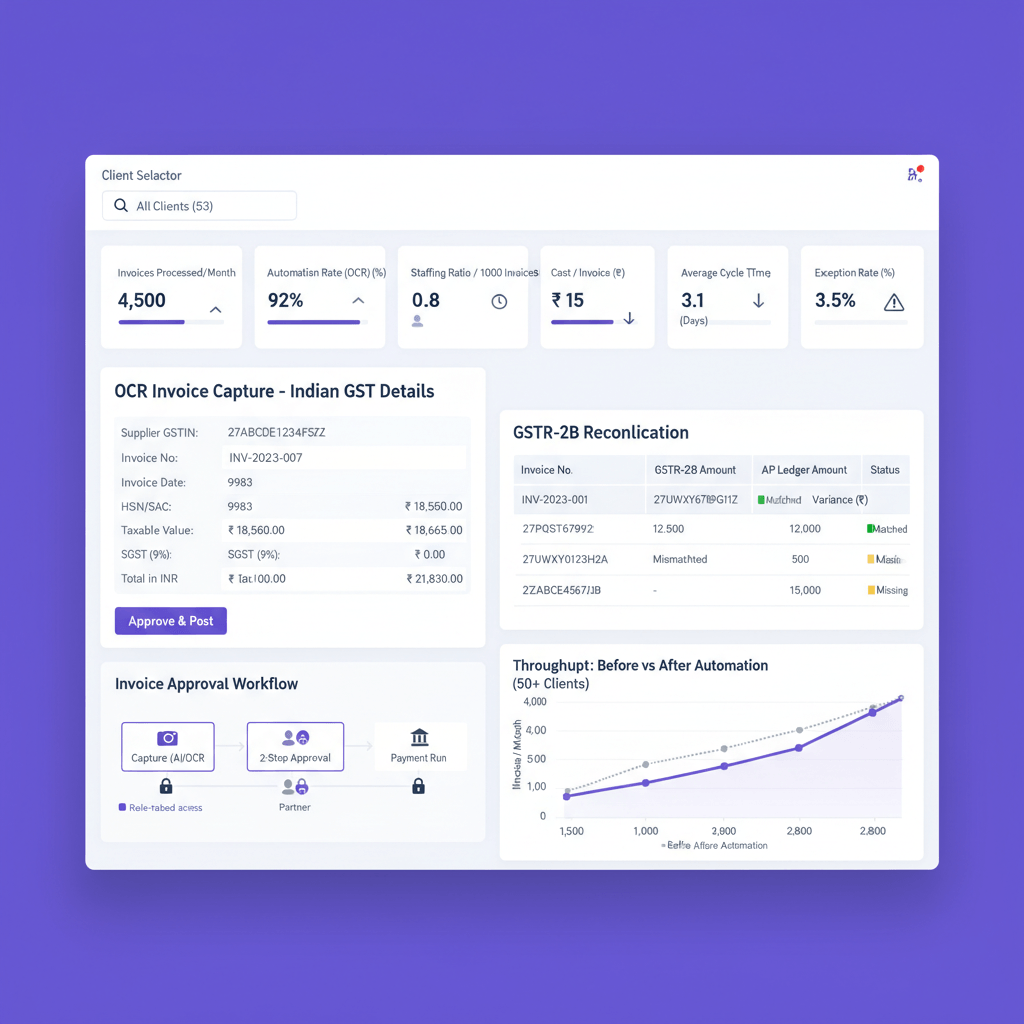
Short answer: CA firms managing AP for 50+ clients need structured workflows combining dedicated AP analysts (1 per 15-20 clients), automated GSTR-2B reconciliation tools, and centralised vendor master management. AI-powered invoice OCR reduces processing costs from ₹15-25 to ₹2-3 per invoice while achieving 95% accuracy, enabling firms to handle 3× more clients without proportional staff increases.
Key takeaways
- One AP analyst can efficiently manage 15-20 clients with automation, versus 5-7 clients manually
- Invoice processing cost drops from ₹15-25 to ₹2-3 per bill using OCR automation
- GSTR-2B reconciliation time reduces to under 90 minutes per client monthly with proper tools
- CA firms save 40-50 hours monthly through automated bill posting and portal downloads
- ISO 27001 and SOC-2 compliance are mandatory for AP automation tool selection
Staffing Model for 50+ Client AP Management
Managing vendor bills for 50+ clients requires a tiered staffing structure that balances efficiency with quality control. The optimal model combines dedicated AP analysts with reviewing CAs and automation tools to maintain accuracy while scaling operations.
For a 50-client portfolio processing approximately 2,500-3,000 bills monthly, you need 3-4 dedicated AP analysts supported by one reviewing CA. Each analyst handles 15-20 clients when equipped with proper automation tools. This represents a significant improvement over manual processing where analysts manage only 5-7 clients effectively.
The reviewing CA spends 2-3 hours daily on exception handling and complex vendor queries. They focus on GST classification disputes, TDS applicability under Sections 194C/194J/194Q, and vendor master hygiene issues. This senior resource ensures compliance while junior staff handle routine bill entry and matching.
| Team Size | Clients per Analyst | Bills per Month | Processing Time per Bill | Automation Level |
|---|---|---|---|---|
| Manual (5 analysts) | 10 clients | 2,500 | 8-10 minutes | None |
| Semi-automated (4 analysts) | 12-15 clients | 2,500 | 4-5 minutes | OCR + manual posting |
| Fully automated (3 analysts) | 17-20 clients | 2,500 | 2-3 minutes | OCR + auto-posting + GSTR-2B match |
Staff retention becomes critical at this scale. Create clear career progression from AP analyst to AP team lead to client relationship manager. Document standard operating procedures for vendor onboarding, bill approval hierarchies, and month-end cutoffs. This reduces training time for new joiners from 3 weeks to 1 week.
Workflow Design for Multi-Client AP Management
Successful multi-client AP management starts with standardised workflows across all clients. Create a unified process that accommodates different client sizes while maintaining consistency in quality and turnaround times.
The intake process determines efficiency downstream. Set up dedicated email IDs for each client's vendor bills ([email protected]). Configure auto-forwarding rules to centralise bills into a shared inbox with client-wise folders. Train clients to forward bills immediately upon receipt rather than month-end dumps.
Bill processing follows a three-stage workflow. First, the OCR system extracts vendor name, GSTIN, invoice number, date, taxable value, and GST breakup. Second, the AP analyst verifies extraction accuracy and maps to the correct expense head in Tally Prime. Third, the system auto-posts to the client's books with proper TDS deduction codes.
Approval hierarchies prevent unauthorised payments while maintaining speed. Bills under ₹10,000 get auto-approved if vendor is pre-approved. Bills between ₹10,000-50,000 require client authorised signatory approval via email. Bills above ₹50,000 need two-level approval with supporting documents. This matrix processes 80% of bills without manual intervention.
Month-end procedures must complete by the 5th of following month (https://www.aiaccountant.com/blog/monthend-payables-close-checklist-cafirms). Day 1-2 focuses on pending bill collection and entry. Day 3 handles GSTR-2B download and matching. Day 4 addresses mismatches and missing bills. Day 5 finalises the creditors ledger and shares ageing reports with clients.
Technology Stack for CA Firm AP Scalability
Building a scalable AP function requires careful technology selection that integrates with existing CA firm tools. The core stack must handle OCR, bill posting, GSTR-2B reconciliation, and multi-entity management without data silos.
Invoice OCR forms the foundation of automation. Modern AI-powered OCR achieves 95% accuracy on Indian invoices compared to 70-80% manual accuracy. The system must handle Hindi text, multiple GST rates, and varied invoice formats. Quality OCR reduces data entry time from 8-10 minutes to 2-3 minutes per invoice.
Portal automation eliminates repetitive GST portal tasks. Automated GSTR-2B downloads for multiple clients save hundreds of hours annually. The system logs into each client's GST portal, downloads GSTR-2B for specified months, and imports data for reconciliation. Similar automation works for Form 26AS and AIS downloads for TDS reconciliation.
Integration with Tally Prime enables direct bill posting without re-entry (https://www.aiaccountant.com/blog/tally-integration-ap-automation-guide). The automation tool must support Tally's multi-company environment and maintain separate databases per client. Real-time sync ensures the CA team and client see identical data. Bulk import capabilities handle 100+ bills in single upload while maintaining voucher numbering sequences.
Security compliance cannot be compromised when handling client financial data. Verify ISO 27001 certification and SOC-2 Type II compliance for any AP automation tool. Ensure data encryption at rest and in transit. Maintain detailed audit logs showing who accessed which client's data and when. Configure role-based access control limiting analysts to assigned clients only.
GSTR-2B Reconciliation at Scale
GSTR-2B reconciliation becomes exponentially complex when managing 50+ clients simultaneously. Each client averages 40-60 purchase invoices monthly, creating 2,000-3,000 line items requiring matching against book entries.
Centralised vendor master management (https://www.aiaccountant.com/blog/vendor-master-data-management-clean) prevents reconciliation failures. Maintain a firm-wide vendor database with verified GSTIN, legal name, and trade name variations. When vendors appear across multiple clients, central updates propagate automatically. This prevents GSTIN mismatches that cause ITC denial during GSTR-2B matching.
The reconciliation process must handle four scenarios efficiently. Perfect matches (invoice in books and GSTR-2B) auto-clear without review. Bills in books but missing from GSTR-2B get flagged for vendor follow-up. Bills in GSTR-2B but missing from books trigger immediate bill collection from client. Partial matches due to amount differences require manual investigation.
Timing differences create false mismatches requiring intelligent handling. Vendors often upload invoices to GST portal weeks after issuing them. Your reconciliation logic must check prior months' GSTR-2B for late-filed invoices. Similarly, advance payments appear in GSTR-2B before goods receipt. Tag these separately to prevent duplicate booking.
AI Accountant streamlines this entire process through automated GSTR-2B ingestion and intelligent matching algorithms. The platform downloads GSTR-2B directly via API integration and matches against Tally Prime purchase entries using GSTIN, invoice number, and amount. Most firms complete monthly GSTR-2B reconciliation in under 90 minutes per client.
Vendor Management Best Practices
Vendor data quality determines AP efficiency more than any other factor. Poor vendor master data causes payment delays, GST mismatches, and compliance failures. Establishing vendor management protocols upfront prevents downstream issues.
Vendor onboarding must capture complete compliance information. Collect GSTIN, PAN, bank account details with cancelled cheque, and MSME certificate if applicable. Verify GSTIN status on GST portal before first transaction. Check for GST return filing compliance over past 6 months. This prevents ITC reversal due to non-compliant vendors.
Implement vendor categorisation for efficient processing. Mark vendors as regular (monthly transactions), occasional (quarterly), or one-time. Apply different approval thresholds based on category. Regular vendors get streamlined approval while one-time vendors need additional verification. This risk-based approach maintains control without slowing routine transactions.
Address common vendor data issues proactively through validation rules:
- GSTIN format validation prevents typos in 15-character registration numbers
- PAN-GSTIN cross-check ensures both belong to same entity
- Bank account name matching confirms payment reaches correct vendor
- Address standardisation enables accurate e-way bill generation
- TDS rate mapping based on vendor type and service category
Quarterly vendor master reviews maintain data hygiene. Check for duplicate vendors with name variations. Identify inactive vendors for archival. Update TDS rates for changes in threshold limits. Verify continued GST registration status. This housekeeping prevents accumulation of bad data that complicates reconciliation.
Performance Metrics and Monitoring
Measuring AP performance across 50+ clients requires standardised metrics that highlight efficiency gaps and improvement opportunities. Track both operational and compliance metrics to ensure scalable growth.
Operational metrics focus on processing efficiency. Monitor bills processed per analyst daily (target: 80-100 with automation). Track first-time match rate for GSTR-2B reconciliation (target: above 85%). Measure average processing time from bill receipt to booking (target: under 24 hours). Calculate cost per invoice processed (target: ₹2-3 with automation versus ₹15-25 manual).
Compliance metrics ensure regulatory adherence across clients. Track GSTR-2B reconciliation completion by 10th of each month. Monitor TDS deposit timeliness for Form 26AS matching. Measure vendor GSTIN verification rate before first transaction. Calculate percentage of bills with proper TDS deduction where applicable.
Client satisfaction metrics guide service improvements. Survey clients quarterly on AP service quality. Track payment delay instances caused by processing errors. Monitor vendor complaint frequency about payment delays. Measure client retention rate for AP outsourcing services.
| Metric Category | KPI | Manual Baseline | Automation Target | Measurement Frequency |
|---|---|---|---|---|
| Efficiency | Bills per analyst per day | 25-30 | 80-100 | Daily |
| Accuracy | First-time match rate | 60-70% | 85-90% | Monthly |
| Speed | Bill to booking time | 48-72 hours | Under 24 hours | Weekly |
| Cost | Processing cost per bill | ₹15-25 | ₹2-3 | Monthly |
| Compliance | GSTR-2B completion by 10th | 70% | 95% | Monthly |
Create automated dashboards showing these metrics per client and consolidated. Use exception reporting to flag clients falling below thresholds. This enables proactive intervention before issues escalate.
How AI Accountant Handles Multi-Client AP Management
AI Accountant specifically addresses the challenges CA firms face when scaling AP operations across multiple clients. The platform combines intelligent OCR, automated GSTR-2B reconciliation, and Tally Prime integration to handle the complete AP workflow without switching between tools.
The system ingests vendor bills through multiple channels including email forwarding, WhatsApp Business API, and direct upload. OCR technology achieves 95% accuracy extracting vendor details, invoice numbers, tax breakup, and line items. This extracted data auto-populates into Tally Prime with appropriate ledger mapping and TDS calculation. The entire process from bill receipt to Tally posting completes in under 3 minutes.
For GSTR-2B reconciliation, AI Accountant connects directly to GST portal via secure API. The platform downloads GSTR-2B data for all specified months and matches against purchase entries using intelligent algorithms. Mismatches get categorised as timing differences, missing bills, or amount variances with suggested resolution steps. Most CA firms using the platform complete monthly reconciliation for 20 clients in single day versus week-long manual process.
Security and compliance features ensure client data protection throughout. The platform maintains ISO 27001 certification with encrypted data storage and transmission. Detailed audit logs track every action for regulatory compliance. Role-based access control ensures analysts access only assigned client data.
Next steps
Start by documenting your current AP processing time per client to establish baseline metrics. Identify top 10 clients by bill volume for pilot automation rollout. Book a 20-minute walkthrough to see live GSTR-2B reconciliation and multi-client AP workflow.
FAQ
How many vendor bills can one AP analyst process daily for CA firm clients?
With proper automation tools, one analyst processes 80-100 bills daily across 15-20 clients. Manual processing limits capacity to 25-30 bills across 5-7 clients. The difference comes from OCR extraction, auto-posting to Tally, and elimination of data re-entry.
What is the ideal client-to-staff ratio for CA firms offering AP services?
The optimal ratio is 15-20 clients per AP analyst with automation support. This assumes average client size of 40-60 bills monthly. Larger clients with 200+ monthly bills count as 2-3 standard clients. Include one reviewing CA per 50 clients for quality control.
How to handle GSTR-2B reconciliation for 50 clients before 10th of each month?
Automate GSTR-2B downloads using portal automation tools starting 1st of month. Run preliminary matching by 3rd using prior month's book entries. Complete final reconciliation by 7th after month-end entries. This leaves buffer for mismatch resolution before 10th deadline. Parallel processing across clients is essential.
Should CA firms charge per bill or fixed fee for multi-client AP management?
Hybrid pricing works best: base fee of ₹5,000-8,000 monthly covering up to 50 bills, then ₹30-50 per additional bill. This ensures minimum revenue while accommodating volume variations. Large clients above 200 bills monthly warrant custom pricing considering complexity and compliance requirements.
What automation tools do CA firms need for scaling AP beyond 50 clients?
Essential tools include OCR for invoice processing (95% accuracy target), portal automation for GSTR-2B/26AS downloads, Tally Prime integration for direct posting, and workflow management for approvals. Choose tools with ISO 27001 certification and API capabilities. Budget ₹15,000-25,000 monthly for 50-client setup.
How to maintain vendor master data quality across multiple client entities?
Create centralised vendor repository with GSTIN as primary key. Validate new vendors against GST portal before first use. Implement monthly reviews to merge duplicates and update compliance status. When same vendor appears across clients, maintain single master record with client-specific payment terms.
What SLAs should CA firms commit for AP processing turnaround time?
Standard SLA includes: bill booking within 24 hours of receipt, payment list preparation within 2 days of request, GSTR-2B reconciliation by 10th monthly, vendor query resolution within 48 hours. Urgent payment processing in 4 hours commands premium pricing. Define exclusions for incomplete documentation.
How much can CA firms save by automating AP for 50+ clients versus manual processing?
Automation reduces processing cost from ₹15-25 to ₹2-3 per bill, saving ₹30,000-50,000 monthly for 2,500 bills. Time savings of 40-50 hours monthly per firm enable handling 3× more clients without proportional staff increase. ROI typically achieved within 6 months of implementation.