-01%201.svg)
Key takeaways
- Bank reconciliation automation uses AI to match bank statement transactions with ledger entries, cutting manual reconciliation time by up to 80% for CA firms handling multiple clients.
- Automated matching achieves 95–99% accuracy on routine transactions, reducing posting errors from 12–15 per month to 2–3 after initial setup.
- CA firms can scale from 20 to 50+ clients without proportional hiring, as automation handles high transaction volumes while teams focus on advisory and analysis.
- Phased implementation with process standardization, clear exception handling, and team training yields the fastest ROI, often within 3–6 months.
- Indian CA practices dealing with multiple bank formats, GST splits, and TDS deductions benefit most from tools purpose built for the Indian accounting ecosystem.
- AI Accountant's bookkeeping automation handles the repetitive matching and categorization work so your team can close books faster and serve clients better.
Bank Reconciliation Automation for CAs: What's New in 2026
The bank reconciliation landscape for Indian CA firms has shifted meaningfully since 2025. The GST portal now requires more granular transaction level reporting for returns, which means reconciliation isn't just about matching bank entries to ledger entries anymore. Every mismatch can cascade into GST filing errors, blocked ITC claims, and compliance flags.
In 2025, most mid-sized CA firms reconciled bank statements in weekly or fortnightly batches. In 2026, real time or daily reconciliation is becoming the baseline expectation. The RBI's push toward faster payment settlement (UPI, RTGS, NEFT) means transaction volumes have surged. Firms handling 500–1,000 transactions per client monthly in 2025 are now seeing 1,200–1,800 for the same clients, driven by increased digital payment adoption.
This volume spike hits firms on legacy or semi-manual workflows hardest. If your team still exports CSVs from bank portals and pastes them into spreadsheets, you're looking at 30–40% more hours per client just to keep up. The cost of inaction is concrete: delayed book closures, missed GST filing deadlines (attracting late fees of ₹50 per day per return under CGST and SGST), and potential ITC reversals flagged during assessments.
- Audit your current reconciliation frequency. If it's weekly or less, plan a shift to daily matching by Q3 2026.
- Map all client bank formats and confirm your automation tool handles them natively.
- Review your GST reconciliation workflow to ensure bank level data feeds into return preparation without manual intervention.
Firms already using AI driven reconciliation are absorbing this volume growth without adding headcount, which is exactly the kind of operational leverage that separates scalable practices from stretched ones.
What is Bank Reconciliation Automation and Why CA Firms Need It
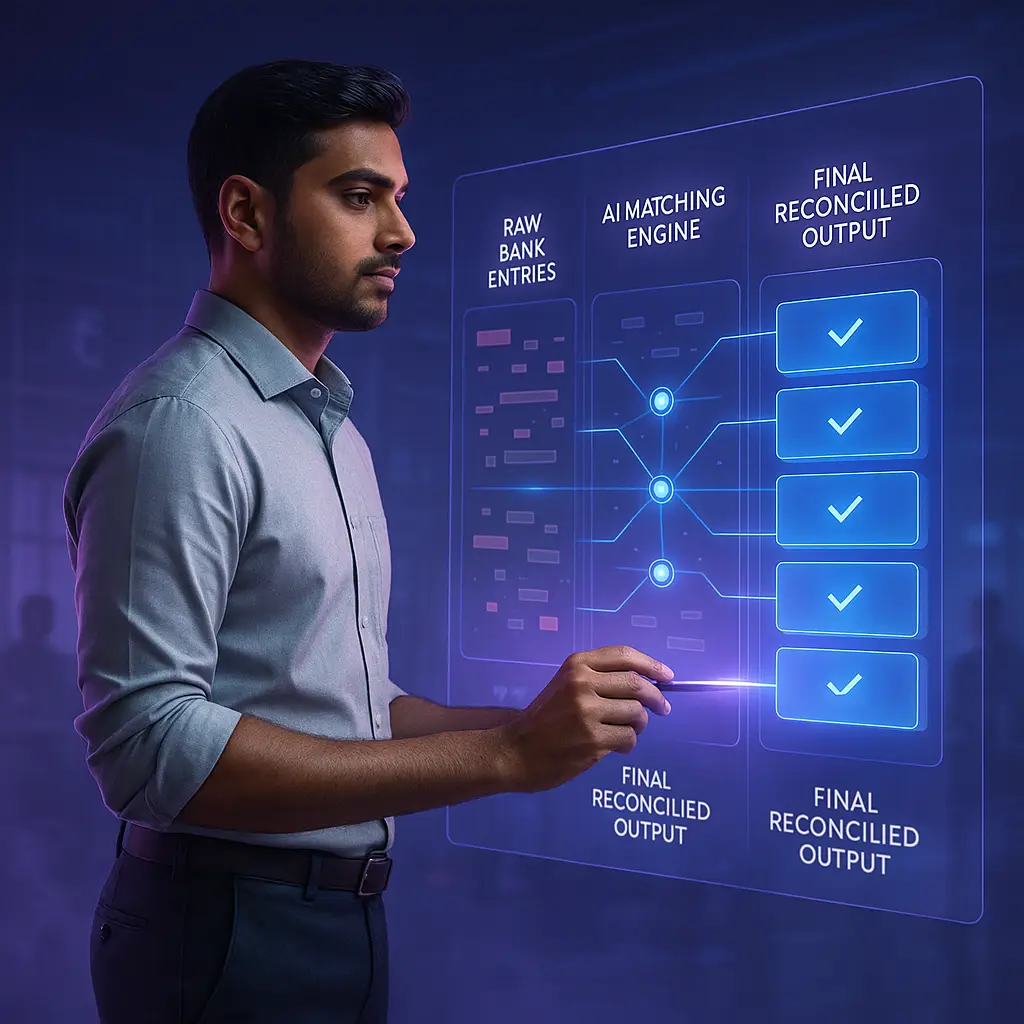
Bank reconciliation automation uses artificial intelligence and machine learning to match bank statement transactions with ledger entries automatically. Instead of manually checking each transaction, the software identifies patterns, learns from your coding preferences, and handles the bulk of reconciliation work.
For CA firms, this addresses three critical pain points:
- Time Compression: Manual reconciliation of a single statement can take 2–4 hours. Automated systems reduce this to 15–30 minutes of review time.
- Accuracy Under Pressure: During month end closing or GST filing deadlines, errors creep in. Automation maintains consistent accuracy even under tight timelines.
- Scalability Challenges: Growing your practice means handling more clients without proportionally increasing your team size. Automation makes this possible.
Indian CA firms face unique complexities. Multiple GST codes, TDS deductions, vendor payments in different formats, and integration with Tally all add layers of difficulty. The shift to automated reconciliation isn't just about speed. It transforms your team's role from data entry clerks to financial advisors.
According to ICAI guidelines, maintaining accurate and timely financial records is a foundational obligation for chartered accountants. Automation helps firms meet this standard consistently across all clients.
Understanding Bank Reconciliation Challenges for CA Practices
- High Transaction Volumes: A mid-sized client might process 500–1,000 transactions monthly. Multiply across 20–50 clients and the manual workload soars.
- Multiple Bank Formats: ICICI's CSV export differs from SBI's PDF layout. HDFC descriptions don't match Axis Bank's coding. Teams spend hours standardizing data before they can even begin matching.
- GST Complexity: CGST, SGST, IGST and various tax rates mean a single transaction can split into multiple ledger entries. Getting these splits wrong triggers compliance issues downstream.
- Integration Gaps: Bank statements arrive separately from Tally, creating delays and manual errors during data entry.
- Client Pressure: Business decisions, loan applications, and compliance deadlines all require real time books. Delayed reconciliation stalls everything.
- Staff Retention: Junior accountants seek analytical roles over repetitive data entry. This leads to turnover and recurring training costs.
- Audit Trail Requirements: Compliance demands clear documentation of every reconciliation decision. Manual processes make this difficult to maintain consistently.
The CBIC's push for tighter GST compliance has made accurate reconciliation even more critical. Mismatches between bank records and GST returns now attract faster scrutiny during assessments.
Key Benefits of Automating Bank Reconciliation for Accounting Firms
CA firms implementing automation typically see a 70–80% reduction in reconciliation time. Here's what that looks like in practice:
- Improved Accuracy and Error Reduction: Automated systems apply consistent rules and flag exceptions for human review. This cuts posting errors and duplicates significantly.
- Enhanced Productivity: Teams shift from data entry to value added work like client advisory, trend analysis, and cash flow forecasting.
- Better Client Service: Faster book closures and real time dashboards keep clients informed. They get answers when they need them, not days later.
- Scalability Without Proportional Hiring: Handle growing transaction volumes with the same team. This is especially valuable during tax season.
- Reduced Training Overhead: Rules captured in software don't walk out the door when staff leaves. Your institutional knowledge stays intact.
- Audit Trail and Compliance: Detailed logs of every match and exception simplify audits. Regulators get what they need without your team scrambling.
- Cost Savings: Less overtime, fewer errors, lower client escalations. The compound effect transforms firm operations over 6–12 months.
A recent analysis by the Economic Times noted that Indian SMEs adopting financial automation tools report 40–60% fewer compliance related penalties within the first year of implementation.
Best Practices for Implementing Bank Reconciliation Automation
Start With Process Standardization
Document current workflows. Standardize coding practices. Create a chart of accounts mapping. This groundwork ensures smoother setup and accurate results from day one.
Choose the Right Implementation Approach
Begin with clients who have straightforward transaction patterns. Phase in more complex clients as your team gains confidence and refines matching rules. A phased rollout reduces risk and builds internal buy in.
Establish Clear Exception Handling Procedures
Define protocols for reviewing flagged transactions, new vendor setups, and unusual items. Document resolutions so the system improves over time. Good exception handling is what separates a useful tool from a frustrating one.
Invest in Team Training and Change Management
Emphasize how automation elevates analytical roles. Provide training on the tool, exception handling, and quality review processes. When your team understands the "why," adoption happens faster.
Set Up Robust Quality Controls
Maintain daily or weekly review checkpoints. Monitor match rates, exception volumes, and processing times. These metrics help you identify optimization opportunities and demonstrate value to partners.
Maintain Strong Vendor Relationships
Choose vendors familiar with the Indian accounting ecosystem. Schedule regular check ins for support, feature requests, and regulatory updates. A vendor who understands Tally, GST, and multi bank formats saves you significant setup time.
As your firm scales its automation efforts, bank reconciliation is only one part of the operational puzzle. Many CA practices also invest in dedicated practice management software to streamline client communication, task tracking, document management, and team workflows alongside their accounting processes.
Top Bank Reconciliation Automation Tools for CA Firms
- AI Accountant: Purpose built for Indian CA firms, with OCR capabilities, intelligent categorization, Tally integration, and up to 75% manual work reduction. Handles multiple bank statement formats natively.
- QuickBooks: Bank feeds and rule based matching. Ideal for simple reconciliation needs and smaller client bases.
- Xero: Automated feeds and powerful reporting. May need additional GST configuration for Indian compliance requirements.
- FreshBooks: User friendly automation for smaller practices. Good for solopreneurs and freelance accountants.
- Tally Prime: Strong in Indian compliance with growing automation features. Works best when paired with specialized automation layers for bank reconciliation.
FAQ
How does AI Accountant handle mismatched transactions during bank reconciliation?
AI Accountant flags mismatches in a review dashboard and suggests corrections based on learned patterns. Over time, the system's machine learning engine reduces future exceptions by applying rules from your previous resolutions.
Can AI-based bank reconciliation tools integrate with Tally Prime?
Yes, most modern tools including AI Accountant offer native connectors to Tally Prime. These integrations automate data flow between bank statements and your accounting software, eliminating manual imports and reducing entry errors.
What is the accuracy rate of automated bank reconciliation for high-volume transactions?
Leading solutions achieve 95–99% match rates on routine transactions. Error rates typically drop from 12–15 per month to 2–3 after initial setup and rule configuration.
How long does it take to implement bank reconciliation automation in a CA practice?
For straightforward clients, setup takes 2–4 weeks including process mapping, rule configuration, and training. Complex clients with multiple bank accounts and GST structures may require 6–8 weeks for full rollout.
What security measures protect sensitive financial data in automated reconciliation tools?
AI Accountant uses end to end encryption, role based access controls, and SOC 2 Type II compliant infrastructure. Regular security audits, ISO 27001 certification, and automated data backups ensure client information remains protected (2026 update).
How does bank reconciliation automation help with GST compliance?
Automated reconciliation matches bank transactions against GST ledger entries in real time, flagging discrepancies before filing deadlines. This reduces the risk of ITC reversals and late filing penalties, which under current rules can reach ₹50 per day per return under both CGST and SGST (2026 update).

Rohan Sinha is a fintech and growth leader building aiaccountant.com, focused on simplifying accounting and compliance for Indian businesses through automation. An IIT BHU alumnus, he brings hands-on experience across 0 to 1 product building, growth, and strategy in B2B SaaS and fintech.