-01%201.svg)
Key takeaways
- Accounting process automation is now essential for Indian startups, SMEs, and freelancers, it reduces manual work across GST, TDS, and ROC while improving speed and accuracy.
- Well designed automation can cut data entry errors by up to ninety percent, speed reconciliations, and shorten month end close.
- Start with quick wins, accounts payable, receivables, bank reconciliation, expense management, GST and TDS workflows.
- Use OCR, machine learning, APIs, workflow engines, and RPA where needed, aim for a single, auditable flow from source documents to filings.
- Adopt a seven step roadmap with a clear thirty, sixty, ninety day plan, train users, and track KPIs to prove ROI.
- Design for strong controls, maker checker, role based access, and timely regulatory updates to stay compliant.
- Choose build, buy, or managed service based on team bandwidth and complexity, AI Accountant’s Virtual Accounting offers a CA led managed option.
Introduction, why accounting process automation now
Manual spreadsheets, late night filings, and last minute reconciliations are costly distractions. For Indian startups and SMEs, the pace of e invoicing and strict timelines for GSTR 1 and GSTR 3B leave little room for error. With automation, software and AI handle repeat work, you focus on growth, cash flow, and customers.
Real outcomes include fewer errors, faster closes, live dashboards, and predictable compliance. Studies and real teams report large gains when data capture, matching, and approvals are automated.
Bottom line, automation turns recurring tasks into a quiet, reliable system, freeing founders, finance heads, and CAs for analysis and decisions.
Further reading for context: Klippa on automated accounting, RunEleven on accounting automation.
What is accounting process automation
Accounting process automation uses software, AI, APIs, and workflows to complete repeatable finance tasks with minimal human touch. Bills and receipts are captured with OCR, machine learning reads fields and suggests categories, rules post entries into your books, bank feeds match transactions, and the system routes approvals, creates vouchers, and prepares summaries. Dashboards show cash, burn, runway, and compliance status, supporting GST, TDS, income tax, and ROC filings.
Automation is more than digitization. Digitization only stores documents as images or PDFs, automation applies logic to move work across stages with checks and balances, orchestration links all steps into one clean flow with clear approvals and separation of duties. RPA can help when no APIs exist, it mimics clicks in legacy systems, yet direct integrations are safer and faster where APIs are available.
- Source documents, invoices, receipts, purchase orders, bank statements
- Books and ledgers, clean chart of accounts and coding consistency
- Compliance, GST returns, TDS challans and returns, ROC forms
- Dashboards, revenues, expenses, cash flow, burn, category splits, due dates
Learn more: Klippa, Velan, NetSuite, Karbon.
Key benefits of accounting process automation
- Accuracy improves, OCR and ML prefill fields consistently, error rates can drop by up to ninety percent with good setup and training data.
- Speed rises, automated bank feeds, reconciliations, and accruals shorten month end close, leaders get near real time visibility.
- Compliance gets easier, automated two B recon, RCM checks, HSN validation, TDS challan prep, return filing workflows, and ROC reminders reduce misses.
- Costs scale better, more throughput without a linear rise in headcount, on time filings cut penalties, clean audit trails and maker checker controls reduce risk.
References, Klippa, RunEleven, Corient, Velan.
Processes to automate first in India, quick wins to scale
Start where volume and pain are highest. Pick processes with clear rules, quick returns, and easy integrations, then expand to end to end close.
- Accounts payable automation. Use OCR for vendor invoices, apply three way match with POs and GRNs, approvals, GST input credit and GSTIN validation, payment batches and postings. Guide, automated accounts payable solutions.
- Accounts receivable automation. Auto invoice from CRM or billing, payment links and reminders, track DSO, flag overdue, auto match receipts to bank entries.
- Bank reconciliation automation. Pull daily bank feeds, create rules for common matches, bucket exceptions, treat gateways and wallets as sub ledgers. Deep dive, automated reconciliation services.
- Expense management automation. Mobile capture, auto category and tax, enforce policy rules, sync to ledger with correct GST treatment.
- GST automation. Prepare GSTR 1 and GSTR 3B from books, reconcile with GSTR two B, manage reverse charge and HSN coding, align e invoicing where needed. Learn more, GST reconciliation services.
- TDS automation. Compute tax on payments, validate PAN, prepare challans, file twenty six Q, twenty four Q, and twenty seven Q, reconcile with Form twenty six AS.
- Month end close automation. Automate accruals, fixed asset updates, routine schedules, publish MIS dashboards and cash flow views.
Simple comparison table
| Process | Quick win automation | India specific impact |
|---|---|---|
| AP automation | OCR capture, three way match, approvals, vendor GST validation | Higher eligible GST credit, cleaner e invoicing |
| Bank reconciliation automation | Daily bank feeds, rules, exception buckets | Faster match for payment gateways and UPI |
| GST automation | Two B reconciliation, guided filings | On time GSTR 1 and GSTR 3B with fewer notices |
Official formats and timelines, GST portal. More reading, Klippa, RunEleven, NetSuite.
Enabling technologies for accounting process automation
- OCR and ML, read invoices, receipts, statements, map fields like date, amount, GST, vendor, suggest categories, flag anomalies.
- APIs and RPA, sync with general ledger, banks, gateways, billing, and e invoicing, use RPA to bridge legacy gaps when APIs are absent.
- Workflow engines and dashboards, define approvals, maker checker, thresholds, role based access and logs, show KPIs for cash, DSO, DPO, recon status, and compliance calendars.
Popular tools for automation and finance operations
Image alt suggestion, Flow diagram of accounting process automation for AP workflows.
Further reading, Klippa, Karbon, Velan.
Implementing accounting process automation, step by step roadmap
Step 1, assess current workflows
Map how work moves today, entry points, handoffs, pain points, error hotspots, rework, tools, spreadsheets, shadow processes, compliance misses and causes, talk to bookers and report users, build a shared baseline.
Step 2, standardize the ground rules
Clean the chart of accounts, set naming and coding norms, create templates for bills, POs, expense claims, define approval rules and levels, align vendor and customer masters, give automation a stable base.
Step 3, prioritize three to five quick wins
Start with bank feeds, AP capture, two B recon, AR reminders, keep scope tight, deliver visible results in weeks.
Step 4, select approach and tools
Decide to build, buy, or use a managed service, score options on accuracy, ease, API depth, India compliance, and security, run short trials with real data, verify ledger and bank fit.
Step 5, design controls and audit trails
Set maker checker steps, separate duties for setup, posting, and payment release, ensure every action has a timestamp and user stamp, maintain version control on SOPs and rule changes.
Step 6, migrate and pilot
Clean masters, import opening balances and vendor and customer lists, run a parallel pilot for one or two processes, compare results, tune rules, fix gaps before go live.
Step 7, change management and go live
Train users, share SOPs and a simple RACI, set a help channel with response times, go live in waves, monitor dashboards daily for the first month, adjust rules until noise reduces.
Thirty, sixty, ninety day plan
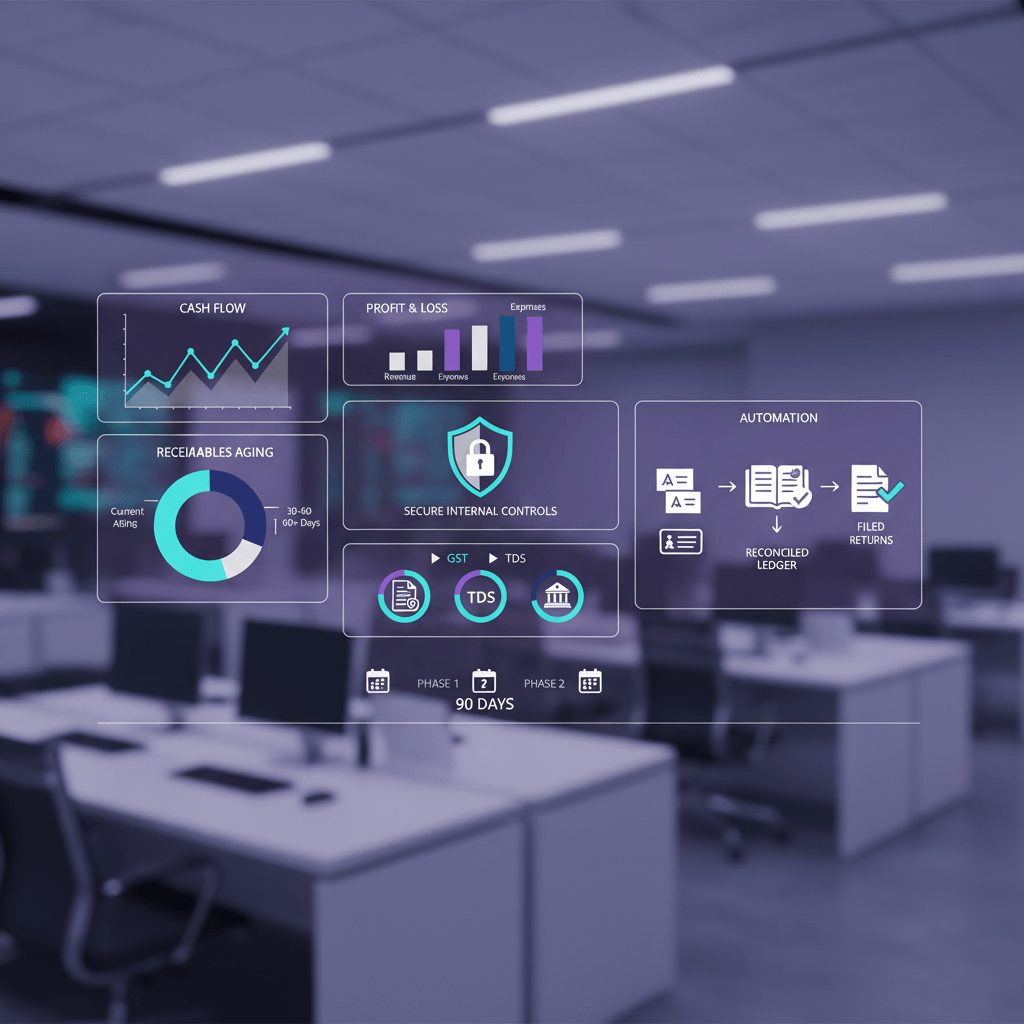
- By day thirty, map and standardize, go live with bank feeds and AR reminders.
- By day sixty, switch on AP capture, two B recon, and basic TDS workflows.
- By day ninety, orchestrate close tasks, publish MIS dashboards, align ROC calendars.
Readiness checklist
- Clean chart of accounts and master data
- Documented policies and approval levels
- Access to bank feeds and ledgers
- Owner assigned for each process
More guidance, Klippa, RunEleven, Velan, Corient, NetSuite.
Metrics and KPIs for automation success
- Days to close, from month end to final MIS
- Touchless rate, share of transactions posted without manual touch, target eighty to eighty five percent steady state
- DSO and DPO
- Bank reconciliation time per account, and exception count
- Error rate and rework for entries and filings
- On time GST and TDS filing rate, aim for one hundred percent
- Cost per transaction and cost per invoice processed
- Dashboard data lag time, event to view
Benchmarks and tips, Klippa, RunEleven, Corient.
Risks, controls, and compliance
- Data governance, define who can view, edit, approve, and release, enforce role based access, logs, alerts, backups, encryption.
- Controls and oversight, separation of duties for setup, posting, and payment release, version control on rules and SOPs, monthly audit trail reviews.
- Regulatory change, track GST, TDS, ROC updates, ensure tools and workflows update quickly, check official portals.
- Human judgment, avoid over automation where context matters, keep review steps for complex items and high value entries.
- Vendor assessment, check security, uptime, support, India compliance, SLA and exit terms.
Helpful links, GST portal, Income Tax e filing, MCA portal. Sources, Velan, Corient, Klippa.
Build versus buy versus managed service
Choose based on process uniqueness, team bandwidth, and compliance load.
| Option | Best for | Total cost notes |
|---|---|---|
| Build | Unique workflows with a strong tech team | High spend on development, integrations, and upkeep, risk of delays and turnover |
| Buy tools | Standard processes that need fast deployment | Licenses plus integrations, you still run operations and compliance |
| Managed service | Teams that want expert oversight with lean staff | Subscription bundles tools, bookkeeping, and compliance in one service |
Managed service spotlight, AI Accountant’s Virtual Accounting is a CA led managed service. A dedicated CA team pairs with a live dashboard, covering bookkeeping, GST filings such as GSTR 1, GSTR 3B, GSTR 9, e invoicing setup, input tax checks, TDS advisory and returns such as twenty six Q, twenty four Q, and twenty seven Q, income tax filing for individuals, partnerships, and companies, and ROC annual filings for small companies. The dashboard shows live books, category splits, cash flow, burn rate, and runway, stores documents, tracks compliance dates, and offers central chat with the CA team.
Background reading, RunEleven, Klippa, Karbon.
Mini case vignette, automation in action
A seed stage SaaS startup ran on spreadsheets and late nights, month end close took twelve days, GST and TDS filings were last minute. After a managed rollout, bank feeds and AP capture went live in three weeks, month end close dropped to five days, touchless AP reached eighty five percent, GST and TDS moved to one hundred percent on time. The founder now reviews a weekly runway view with burn rate and cash projections, and spends Fridays on customers, not compliance.
For perspective, Klippa, RunEleven.
Actionable checklist and thirty, sixty, ninety plan
Readiness
- Clean master data and chart of accounts
- Clear policies for approvals and expenses
- Access to bank feeds and ledgers
Thirty days
- Map flows and bottlenecks
- Switch on bank feeds and AR reminders
Sixty days
- Roll out AP capture and approvals
- Start GST two B recon and basic TDS
Ninety days
- Orchestrate close tasks
- Publish MIS dashboards, align ROC calendars
Conclusion and next steps
Automation turns repeat work into a calm, auditable flow. You get clean books, faster closes, and on time compliance across GST, TDS, and ROC. Use the roadmap here to start small and win fast. If you want a partner to run the engine with you, explore AI Accountant’s Virtual Accounting, a CA led managed service with a live dashboard, so you get both brains and tools in one place.
Explore, AI Accountant, Virtual Accounting overview.
Suggested image alts, Accounting process automation workflow for AP, GST compliance dashboard KPIs with due dates.
FAQ
How should a founder decide between build, buy, and a CA managed service for automation
Score your use cases on uniqueness, time to value, and compliance risk. If you need speed and Indian compliance depth, a CA led managed service like AI Accountant’s Virtual Accounting reduces integration effort and operational risk, while a buy option works when your processes are standard and your team can run operations.
As a CFO, which KPIs prove that automation is working in my India finance stack
Track touchless rate across AP and AR, days to close, bank recon time and exception count, on time GST and TDS filings, DSO and DPO trends, and cost per invoice. For example, moving touchless AP from forty percent to eighty percent with stable exception aging shows real impact.
Can automation handle e invoicing for B2B with IRN generation and QR code sync into Tally or Zoho Books
Yes, with API driven connectors your system can generate and validate IRNs, embed QR codes, and post entries back to Tally or Zoho Books, including HSN, GST rate, and place of supply, with maker checker for edits.
How does an AI enabled Virtual Accounting service like AI Accountant reduce GST two B mismatch notices
By reconciling purchase registers to GSTR two B weekly, validating vendor GSTINs, flagging RCM, and nudging non compliant vendors early. The CA team reviews exceptions, corrects coding, and documents follow ups, which reduces notices and interest.
What controls should a CA insist on when automating AP approvals and vendor payments
Set threshold based approvals, ensure separation between master changes, invoice posting, and payment release, enforce vendor validation including PAN and GSTIN, and maintain immutable audit logs with timestamps and user stamps for each action.
How quickly can a finance head show results, what is a realistic thirty, sixty, ninety day plan
Thirty days, bank feeds and AR reminders live. Sixty days, AP capture, two B recon, and basic TDS workflows. Ninety days, orchestrated close with MIS dashboards and ROC calendar alignment. Each wave should include training and rule tuning.
Will automation replace my CA or in house accountant
No, it removes repetitive data work so your CA and team focus on analysis, cash planning, controls, and advisory. For lean teams, AI Accountant’s Virtual Accounting blends tools with a CA led operating model to lift outcomes without extra hires.
Can we automate TDS computation and returns such as twenty six Q, twenty four Q, and twenty seven Q with reliable PAN validation
Yes, rules compute TDS on eligible payments, validate PANs, prepare challans, and generate returns, with reconciliations to Form twenty six AS and automated reminders for due dates to ensure on time filing.
How do we integrate payment gateways and UPI with bank reconciliation without messy suspense accounts
Treat gateways and wallets as sub ledgers, ingest daily settlements via APIs, map fees and GST on charges, and auto match batches to orders, leaving only true exceptions for review.
What is the fastest way to improve input tax credit accuracy in AP
Automate invoice capture with OCR, validate GST fields and vendor GSTIN, perform two B recon weekly, enforce three way match for POs and GRNs, and use exception queues for HSN or RCM issues, with the CA team closing gaps before GSTR 3B.
How do I quantify ROI for the board when moving from manual to automated close
Compare baseline to post go live on days to close, labor hours per invoice, touchless rate, error and rework counts, penalties avoided for GST and TDS, and cash acceleration from lower DSO. Add qualitative gains, such as audit readiness and runway visibility.
Will this work if parts of our stack are legacy systems without APIs
Yes, use APIs wherever possible, and apply RPA selectively for legacy screens, with strict controls and monitoring. Over time, replace brittle steps with stable integrations as vendors modernize.