-01%201.svg)
Key Takeaways
- A strong CA engagement letter format includes clear scope, deliverables, payment terms, and ICAI aligned documentation standards under SA 210, making it enforceable and professional from day one.
- State all fees in INR exclusive of 18 percent GST, mandate 10 percent TDS under Section 194J, add late fee clauses at 1.5 percent per month, and define invoice cadence to avoid collection disputes.
- Use Aadhaar eSign, DSC, or email OTP for digital signatures, confirm state stamping rules before execution, and store the audit trail certificate securely for every signed engagement.
- Map proposal scope to delivery workflows immediately after signing so that bookkeeping, GST reconciliation, and dashboard commitments are met without manual handoff gaps.
- Set proposal validity to 15 to 30 days to create urgency and reduce scope creep risk during extended negotiations.
- Once the engagement letter is signed, tools like AI Accountant's bookkeeping automation handle bank ingestion, ledger mapping, and month end close, so your team delivers on proposal commitments without scrambling.
CA Engagement Letter and Proposal Templates: What's New in 2026
If you drafted your last engagement letter template in 2024 or early 2025, the core ICAI framework under SA 210 has not changed, but several practical shifts affect how you execute proposals and onboard clients in 2026.
ICAI's Auditing and Assurance Standards Board released updated tools in late 2024 and 2025, including a Utility on Engagement Letters that automates clause generation for SA 210 compliance. This covers first time audit appointments, recurring engagement renewals, and client acknowledgment language. The Review and Monitoring Tool on Standards on Auditing (Version 2.0) now cross checks engagement terms against the latest SA updates. If you are still copy pasting from a 2023 Word file, these utilities save time and reduce compliance gaps.
GST and TDS rates remain unchanged for professional services in 2026: 18 percent GST on all invoices and 10 percent TDS under Section 194J of the Income Tax Act. No Finance Act 2025 amendments altered these rates. However, more states now support eStamp for professional service agreements, reducing the need for physical stamp paper. Maharashtra, for instance, requires eStamp for agreements above INR 500, which covers nearly every CA engagement. Check your state's revenue portal before defaulting to wet ink annexures.
The operational shift matters most for firms handling multiple clients across cities. Digital signature plus eStamp is now the default in most metros, cutting turnaround from days to hours. Firms still using physical stamp paper for every engagement lose 3 to 5 days per onboarding cycle. The cost of delay compounds during filing season when every day counts.
- Verify your state's eStamp availability and thresholds before your next proposal goes out.
- Download ICAI's engagement letter utility from the AASB tools page and compare it against your current templates.
- Ensure your proposal to delivery handoff is automated. Platforms that handle GST reconciliation workflows eliminate the manual gap between signing and first deliverable.
Introduction: Why Every Indian CA Needs a Clean Proposal Template
For Indian Chartered Accountants, a crisp, copy ready proposal converts prospects into clients with fewer follow ups. Vague scope, missing payment terms, or lack of digital signature process often delay onboarding and undermine legal standing. These are costly mistakes before filing deadlines.
Think about your last pitch. You invested hours building trust, then scrambled for an old template when it was time to formalize. A solid CA proposal template solves this. It speeds up onboarding, protects your practice legally, and shows professionalism that wins mandates.
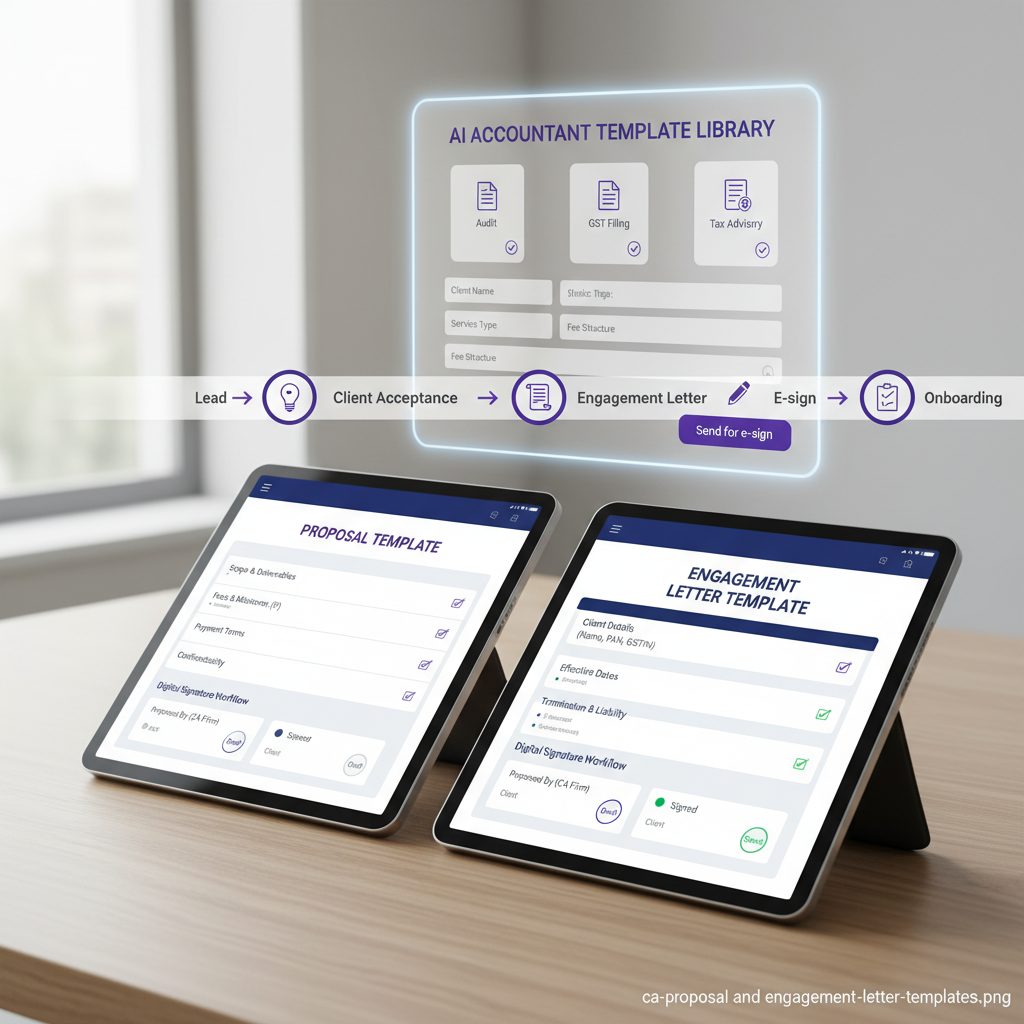
This guide gives you everything you need: a ready to copy accounting proposal letter, an ICAI compliant engagement letter format, and a digital signature workflow you can use today.
What Makes a Strong CA Proposal in India
A powerful CA proposal goes beyond listing services and fees. It creates a legally binding framework that protects both parties. Your engagement letter serves as the legally enforceable agreement under ICAI guidelines, distinct from the proposal summary.
- Include India specific compliance notes: GST at 18 percent, TDS under Section 194J, jurisdiction and arbitration clauses aligned to your city.
- Keep ICAI standards for documentation, audit trail, and service scope front and center. The ICAI illustrative audit engagement letter under Companies Act 2013 provides the foundational format for audit mandates.
- Address data security, payment schedules, and termination scenarios clearly.
Pro tip: Treat the proposal as your pitch, and the engagement letter as your contract. Both should be tight, clear, and mutually reinforcing. ICAI's SA 210 guidance on agreeing the terms of audit engagements provides illustrative formats and implementation guidance you can adapt for non audit services too.
Copy Ready Proposal Template for CA
Cover Page Elements
Identify the parties clearly. Include firm name and complete address, client legal name and registered address, engagement period with exact dates or mark as ongoing. Summarize services in one line, for example, Monthly Bookkeeping and GST Filing.
State your fee model upfront. Choose monthly retainer, fixed fee, or milestone billing based on the engagement type and client size.
Section 1: Scope and Deliverables
- Bookkeeping: monthly close, ledger mapping, report timelines.
- GST: preparation of GSTR 1 and 3B, input credit reconciliation against GSTR 2B, exception handling.
- TDS returns: quarterly filings, Form 16A certificate management.
- Audit: sampling methods, management representations, findings report format. Reference the ICAI audit engagement letter format for Companies Act 2013 compliance.
- VCFO: KPIs, review frequency, compliance calendar deliverables.
Section 2: Payment Terms
- Fees as INR plus 18 percent GST. Never leave GST implications ambiguous.
- Advance requirements, for example 50 percent for new clients.
- TDS at 10 percent as per Section 194J. Quarterly certificate submission via email.
- Invoice cadence: monthly or quarterly, payment due in 15 to 30 days.
- Late fee at 1.5 percent per month after due date.
Section 3: Termination and Liability
- Termination with 30 days written notice. For cause termination upon material breach with 7 days cure period.
- Liability capped at total professional fees paid. Exclude indirect damages.
- Professional indemnity insurance maintenance with minimum coverage guidance.
- Survival clauses for confidentiality, IP, and payment obligations.
- Arbitration venue and exclusive jurisdiction city specified.
Section 4: Confidentiality and Data Protection
Reference compliance with ICAI standards. Include NDA provisions covering all financial data. Specify data retention and deletion policies post engagement.
Section 5: Signature Block
Provide options for Aadhaar eSign, DSC, or email OTP. Note stamp paper or eStamp requirements based on state law. Include designated signature lines for both parties with dates.
Scope and Deliverables Bullets
Bookkeeping and Reconciliation
Ingest monthly transactions from bank statements, credit cards, and cash books. Map ledgers in Tally or specified ERP. Close month within 5 working days of documentation.
Deliver P and L, Balance Sheet, and Cash Flow by the 10th of each month. This commitment should match exactly what your bookkeeping proposal letter promises.
GST Compliance
Prepare and file GSTR 1 and 3B monthly or quarterly. Reconcile sales data against GSTR 2B for input tax credit.
Document exceptions clearly. Dependencies on timely purchase registers and sales invoices should be stated in the engagement letter so both parties know what triggers delays.
TDS Returns
Prepare and submit quarterly TDS returns. Manage Form 16A certificates for vendors and contractors. Coordinate challan payments and corrections.
Audit and Internal Audit
Use risk based sampling for transaction testing. Collect management representations. Deliver the audit report with observations and recommendations.
Hold post audit review within 7 days of submission. Your audit engagement letter format should reference the specific reporting requirements under Section 143(3) of the Companies Act 2013 where applicable. Maintain audit working papers as per SA standards for review readiness.
VCFO and Dashboards
Deliver monthly MIS showing Revenue, Expenses, Net Profit, and agreed KPIs. Provide secure portal access. Schedule monthly review calls and quarterly business reviews.
Payment Terms Templates
Retainer Model
Monthly retainer of INR [amount] payable in advance by 5th of each month. Retainer covers up to [X] hours. Additional hours billed at INR [rate] per hour.
Fixed Fee per Filing
Per GSTR filing fee of INR [amount], inclusive of two revisions. Additional revisions at INR [amount]. Payment due within 7 days of filing confirmation.
Milestone Based Billing
Total project fee of INR [amount] payable as 40 percent on signing, 30 percent at midpoint, 30 percent on acceptance.
GST and TDS Provisions
All fees are exclusive of 18 percent GST. TDS at 10 percent as per Section 194J will be deducted by client. TDS certificate issued quarterly within 15 days of quarter end.
Late Payment Charges
Interest at 1.5 percent per month applies beyond 15 days credit. Services may be suspended for payments overdue by 30 days.
Scope Change Management
Any request beyond agreed deliverables requires a written change order. Additional work billed hourly at INR [amount] or via fixed fee agreement.
Termination and Liability Clauses
Termination for Convenience
Either party may terminate with 30 days written notice. All work completed until termination remains billable. Client receives deliverables upon payment clearance.
Termination for Cause
Immediate termination permitted for payment default exceeding 45 days or material breach. Breaching party has 7 days to cure.
Liability Cap
Total liability limited to professional fees paid in the preceding twelve months. Excludes gross negligence, willful misconduct, or fraud.
Indemnity Provisions
Mutual indemnification for third party claims arising from respective actions. Firm maintains professional indemnity insurance with minimum coverage of INR [amount].
Survival Clauses
Confidentiality survives for 3 years post termination. IP rights remain with respective owners. Payment obligations for completed work survive termination.
Dispute Resolution
All disputes resolved through arbitration under the Indian Arbitration and Conciliation Act. Arbitration venue in your city. Indian law governs. Courts of your city have exclusive jurisdiction.
Digital Signature Workflow Checklist
Choose Your Signature Method
- Aadhaar eSign via NSDL or eMudhra: most cost effective for routine CA engagement letters.
- DSC (Digital Signature Certificate): highest legal validity, required for certain statutory filings and MCA submissions.
- Email with OTP verification: suitable for smaller engagements. Maintain an audit trail.
Stamping Requirements
- Check state specific stamp duty for professional service agreements. Verify exemptions or thresholds.
- Use eStamp where available. If not, attach physical stamp paper as annexure to the digitally signed document.
Step by Step Workflow
- Finalize proposal or engagement letter in PDF. Ensure all fields are complete.
- Insert signature blocks for both parties. Mark areas clearly.
- Upload to NSDL, eMudhra, or DocuSign India mode.
- Send signing invitation. Set reminders at 48 hours.
- Download audit trail certificate post signing. Store securely.
- File countersigned agreement in DMS. Create calendar reminders for key dates.
- Share final PDF with client, including stamped copy if applicable.
Client Onboarding Integration
Collect KYC documents (PAN, GSTIN, registration certificate) prior to sending the proposal. After signature, provision access to Tally, obtain authorizations for the GST portal, bank statements, and payments. Set up recurring payment instructions for retainers.
Tools for Streamlining Proposal to Delivery
Proposal and Document Management
AI Accountant automates post proposal workflows. After signing, it handles bank statement ingestion, ledger entry mapping, and dashboard generation. ISO 27001 and SOC 2 Type II certifications support confidentiality clauses in your engagement letter.
PandaDoc creates dynamic proposals with pricing tables and signature workflows. It sends automatic reminders and tracks views.
Adobe Sign provides enterprise grade audit trails for firms handling high value engagements. HelloSign integrates with Google Workspace for Gmail and Drive centric firms. SignDesk offers Aadhaar eSign with Indian compliance features built in.
Practice Management Integration
Connect signed proposals to practice management systems like Karbon, TaxWorkflow, or Practice Ignition. Trigger automatic task lists on signature. Set billing schedules directly from proposal terms for automated invoicing.
AI Accountant Guidance for Operational Delivery
Scope to Workflow Mapping
Use the Bills module for vendor invoice ingestion. Configure Transactions for bank processing. Enable reconciliation workflows for month end close commitments. Flag exceptions for review as promised in your engagement letter.
Platform Sync Setup
Connect to Tally immediately after onboarding. Configure bi directional sync to fetch bills and invoices while pushing clean entries back. Set user permissions aligned with confidentiality provisions in your signed engagement.
Dashboard Delivery
Generate KPIs and MIS automatically: Revenue versus Expenses, Gross Profit, Net Profit. Schedule dashboard emails by the 10th each month. Offer secure portal access for real time viewing.
Compliance and Security
Maintain ISO 27001 and SOC 2 Type II aligned controls. Keep detailed audit logs for reviews. Apply regular security updates and monitoring to protect client data.
Final Checklist Before Sending
Content Review
- Scope, deliverables, and fees match sales discussions exactly.
- Payment terms include GST and TDS provisions explicitly.
- Termination and liability clauses reflect firm practice with stamping notes.
- All annexures and schedules referenced are attached.
Technical Preparation
- Digital signature process confirmed and tested. Backup method ready.
- Signature blocks are clearly marked, not overlapping text.
- File naming follows convention: client name, service, date.
Post Signature Process
- Countersigned copy filed immediately in DMS.
- Onboarding checklist prepared and assigned to team.
- Calendar reminders set for review dates, payment schedules, deliverable deadlines.
- First deliverable or kickoff meeting scheduled within 48 hours.
Implementation Timeline for Your New Proposal System
Week 1: Template Customization
Download and review templates. Customize with firm details, fees, and terms. Get legal review for ICAI compliance. Create variations per service line. Test the digital signature workflow with your team.
Week 2: Team Training
Train the team on template selection and usage. Practice the signing workflow end to end. Prepare backup plans for technical glitches. Maintain a shared repository with version control.
Week 3: Client Rollout
Use templates with new prospects. Track time saved versus old methods. Gather feedback from closed engagements. Refine templates based on repeated client queries.
Ongoing: Optimization
Review templates quarterly. Track conversion rates from proposal to signing. Identify clauses that cause delays. Build a clause library of variations that work for different client profiles.
Download Your CA Proposal and Engagement Letter Template Bundle
- One page master proposal template in Word and PDF. Edit once and reuse.
- ICAI format engagement letter with formal legal language, battle tested for audit and non audit mandates.
- Clause library covering scope, payment, termination, and liability for multiple service lines.
- Digital signature workflow checklist with platform comparisons and stamping guidance.
- Service specific annexures for bookkeeping, GST, statutory audit, internal audit, and VCFO.
- Print friendly versions with copy ready clause blocks.
Conclusion: Transform Your Practice with Professional Proposals
A well crafted proposal template transforms how you win and onboard clients. Your engagement letter becomes a competitive advantage. Clients sign faster when terms are transparent.
Proper scope and deliverables prevent disputes. GST and TDS clauses ensure smooth collections. Termination and liability guard your practice.
Digital signature workflows save days. Clients in different cities sign immediately. You start delivering value faster. Your proposal is the first formal interaction. Make it count with professional templates that convey expertise and reliability.
Customize the templates, test the digital workflow, and within weeks you will wonder how you managed without a proper proposal system.
FAQs About CA Proposals and Engagement Letters
Is a CA engagement letter enforceable under ICAI and Indian law, and what stamping is required?
Yes, Indian courts recognize properly executed engagement letters as binding contracts under the Indian Contract Act. Ensure mutual acceptance, clarity of terms, and stamping per your state rules. ICAI's SA 210 provides illustrative formats for audit engagements under the Companies Act 2013, covering scope, responsibilities, and acceptance language. Where eStamp is available, attach the eStamp annexure to your digitally signed PDF. Where only physical stamp paper is permitted, annex a scan with serial number and date.
How should I draft payment terms with 18 percent GST, TDS under Section 194J, and late fees?
State fees exclusive of GST, add 18 percent GST to every invoice, mandate TDS deduction at 10 percent under Section 194J, and require quarterly TDS certificates within 15 days of quarter end. Add interest at 1.5 percent per month after a 15 day credit period. These rates remain unchanged in 2026 per Finance Act 2025 extensions (2026 update).
Is Aadhaar eSign or DSC acceptable for corporate clients and statutory filings?
Under the Information Technology Act, both Aadhaar eSign and DSC provide legal validity for corporate engagements and most regulatory filings. DSC is mandatory for certain MCA filings and GST registration changes. Some banks or legacy processes may still request wet ink signatures, so keep a printable counterpart ready. For speed, many CA firms finalize proposals via Aadhaar eSign, then use DSC for statutory filings where required.
What scope language covers GST filings, bookkeeping, and audit in one proposal without ambiguity?
List each service under separate sub sections with deliverables, dependencies, timelines, and acceptance criteria. For GST, specify GSTR 1 and 3B, reconciliation against GSTR 2B, and an exceptions log. For bookkeeping, define month end close within 5 working days and reports by the 10th. For audit, state sampling method, management representations, and report format. Separate sub sections prevent scope disputes when clients assume one service covers another.
What is the correct audit engagement letter format as per ICAI for Companies Act 2013?
ICAI's AASB provides two illustrative engagement letter formats under SA 210 for Companies Act 2013 audits: one for engagements where Section 143(3)(i) reporting applies, and one where it does not. Both cover auditor responsibilities, management representations, scope of work, and terms of engagement. Download the latest versions from ICAI's AASB publications page and customize for your firm's practice (2026 update).
How do I handle change requests after signing?
Include a clause requiring a written change order for any work beyond agreed deliverables. Specify pricing (hourly or fixed fee) and updated timelines in the change order. Do not commence additional work until the amendment is accepted via digital signature. This protects both parties and keeps the engagement letter current.
What stamping rules apply across states when using digital signatures?
Stamp duty is state specific. Most major states now support eStamp for professional service agreements. Maharashtra requires eStamp for agreements above INR 500. Check your state revenue portal for current thresholds and exemptions. Digital signature combined with proper eStamp is generally valid. Retain the audit trail certificate alongside the stamped annexure in your document management system.