High vendor bill volume in architecture firms needs a disciplined, digital workflow that captures GST, TDS, project, and cost codes with zero manual chaos.
Centralized intake, AI powered OCR tuned for Indian invoices, and strict validation rules prevent duplicates, compliance errors, and approval bottlenecks.
Smart approvals, amount thresholds, and escalations keep bills moving quickly, while one click sync to Tally or Zoho Books eliminates re typing.
Real time dashboards, aging analysis, and audit trails deliver clarity on cash flow, vendor performance, and project profitability.
Measure what matters, cycle time, first pass yield, GST and TDS error rates, and automation percentage, then improve continuously.
Tools like AI Accountant help architecture firms operationalize India specific compliance at scale.
Table of contents
Why vendor bill volume hits architecture firms differently
Architecture firms handle a sprawling vendor ecosystem, consultants, material suppliers, site contractors, SaaS subscriptions, travel vendors, printers, and model makers. Bill flow is irregular, it spikes around milestones, pours during site work, and clusters near month end. Each format varies, GST rates and TDS sections differ, and a single mismatch risks Input Tax Credit and notices. What worked at fifty bills collapses at five hundred, Excel threads break, WhatsApp trails vanish, and signatures become bottlenecks.
Irregular volume and fragmented formats are not just messy, they are a compliance risk, GST and TDS accuracy depends on consistent documentation and review.
What good bill documentation means
Good vendor documentation is a complete packet, not only the invoice.
System generated invoice, linked to a Purchase or Work Order with agreed scope and rates.
Evidence of completion, delivery notes, site measurement sheets, or consultant timesheets.
Accurate GST data, GSTIN, place of supply, HSN or SAC, tax breakup, matching GSTR 2B matters.
Clear TDS mapping, 194C for contractors, 194J for professional services, 194I for rent.
Project and cost codes, for visibility into profitability and budget control.
Payment terms and mode, bank transfer, UPI, or cheque, stated upfront.
Approval trail, who verified quantity, who validated GST, who gave final approval.
The current reality versus a digital workflow
Most firms still run on Word or email POs, WhatsApp invoices, printed packets, and manual Tally entry. Approvals stall when principals travel, documents go missing, GST codes get keyed wrong, and TDS is calculated at the last minute. Vendors keep calling for status, finance scrambles at filing deadlines.
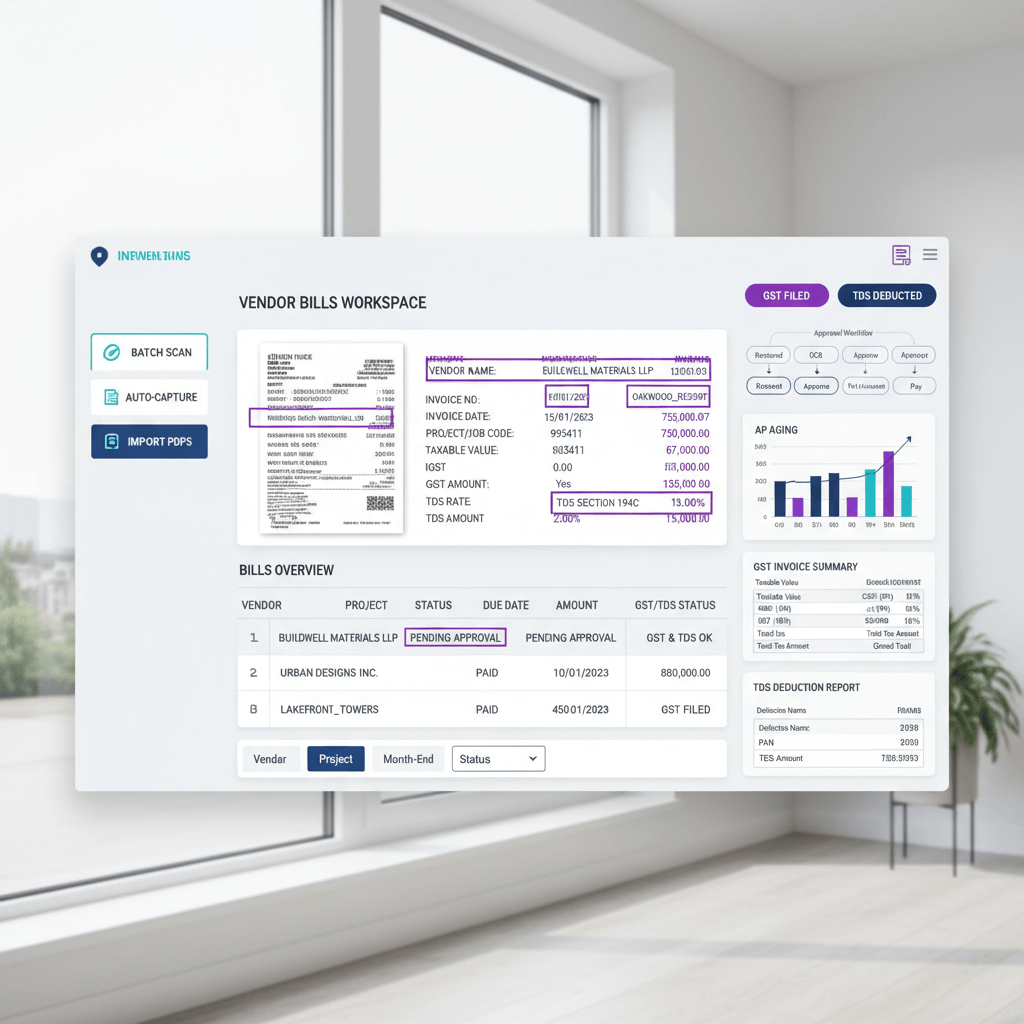
Shift to a digital intake and workflow, every bill enters one system, OCR and AI extract data automatically, the Project Manager validates completion and tagging, finance checks GST and TDS, partners approve by thresholds, and approved bills sync to Tally or Zoho Books without re typing.
Documents stay linked, searchable, and audit ready, payment schedules follow due dates, and vendor visibility improves.
Critical challenges when volume scales
Format fragmentation, PDFs, images of handwritten bills, Excel, and subscription emails require different handling.
Duplicates and partial payments create confusion and risk double payouts.
Multi project allocations turn tedious, splitting line items across projects and cost codes invites errors.
Approval delays multiply with busy project managers and traveling partners.
Reconciliation pain increases, bank transfers without clear tags, ledger mismatches cost hours.
Building your digital vendor bill management system
Centralize your intake channels
Create a dedicated AP email and auto forward to your bill system.
Scan physical bills immediately at reception, store the digital copy.
Enable mobile uploads for site supervisors with project tagging at source.
Support bulk ingestion during month end rushes to avoid queues.
Enforce file naming discipline, VendorID_ProjectCode_InvoiceNo_YYYYMMDD, for faster retrieval.
Standardize data extraction and validation
Use OCR tuned to Indian formats, read invoice numbers, dates, GSTIN, tax breakup, and totals.
Validate GSTIN checksum and match with government data, flag mismatches early.
Detect duplicates by vendor, invoice number, and amount before posting.
Check PO linkage and tolerance, validate scope and rates.
Standardize vendor master, PAN, bank account, and name consistency across bills.
Implement smart classification and tagging
Mandatory project codes for every bill, simple and memorable taxonomy.
Cost codes by category, design fees, structural consultation, electrical materials, site labour.
Track retention and advance amounts distinctly to avoid confusion in payments.
Specify payment mode and terms at upload.
Mark GST applicability and any Reverse Charge implications.
Auto suggest TDS section, 194J for professionals, 194C for contractors, 194I for rent.
Design your approval workflow
Upload with supporting documents and notes by the project team.
Review within twenty four hours, validate work completion and tagging.
Finance approval within twenty four hours, confirm GST, TDS, and ledger mapping.
Auto sync to accounting after approval, no manual re typing.
Threshold rules, small bills skip to finance, large bills need partner sign off, retention releases need special authorization.
Escalations and reminders keep items moving when people are busy.
Ensure seamless accounting integration
One click posting to Tally or Zoho Books with vendor, ledger, GST, TDS, and project codes intact.
Prepare for GSTR 2B matching, flag mismatches proactively.
Automate TDS computation, challans, and certificate tracking.
Reverse sync payment status back to the bill system for vendor visibility.
Build comprehensive dashboards
Aging analysis by vendor, project, and amount for cash flow prioritization.
Days Payable Outstanding by vendor category for adherence to terms.
Month wise payment trends to catch cash flow stress early.
Critical bills surface automatically, large pending approvals, near due dates, disputed invoices.
Vendor scorecards for documentation quality and compliance reliability.
Create robust storage and audit trails
Versioned documents with timestamps and change reasons.
Immutable logs of who did what and when, comments included.
Lightning fast search by vendor, invoice number, project, amount, GSTIN, or date range.
Retention aligned with statutes, GST documents kept for seven years and archived appropriately.
Essential tools for digital vendor management
AI Accountant, purpose built for Indian SMBs and CA firms, reads multiple formats including handwritten bills, supports bulk uploads, and offers four stage workflow automation. With OCR trained on Indian bank formats and one click Tally or Zoho Books sync, it fits architecture firms managing complex GST and TDS.
Zoho Books, strong for accounting and GST compliance, limited bill workflow automation compared to specialized tools.
Tally Prime, the compliance gold standard in India, needs add ons or manual processes for high volume AP automation.
QuickBooks Online, good for smaller firms with international work, basic bill features, limited Indian GST and TDS depth.
Xero, cloud native with integrations, Indian localization still evolving.
FreshBooks, simple for small teams, not ideal for multi project allocations and Indian compliance.
Implementing your digital workflow, practical steps
Start by consolidating your vendor master database, collect PAN, GSTIN, TDS category, and payment terms, deduplicate and standardize naming.
PO matching rate, reveals procurement discipline upstream.
GST and TDS error rate, fewer corrections mean stronger compliance.
Duplicate detection effectiveness, catching even one duplicate pays for itself.
AP aging improvement, bring DPO in line with agreed vendor terms.
Automation percentage, target at least seventy five percent auto population of fields.
Common pitfalls and how to avoid them
Missing GST details, solve with vendor onboarding checklists and instant GSTIN validation, reject invalid data early.
Handwritten site bills, solve with mobile capture, attach measurement sheets, use OCR then complete gaps in finance.
Duplicate uploads, solve with system checks across vendor, invoice number, and amount.
Inconsistent project tagging, solve with locked taxonomy and dropdowns, not free text.
Approval bottlenecks, solve with amount based auto approvals, reminders, and escalations.
Integration failures, solve with pre go live testing, error logs, and reliable retry mechanisms.
Change resistance, solve with early adopters, quick wins, and clear communication of benefits.
Real world impact, a case study
A mid size architecture firm processed three thousand vendor bills yearly. Manual Tally entry, email approvals, and WhatsApp coordination led to GST corrections at month end, rushed TDS calculations, and AP aging beyond seventy five days. Project profitability surfaced only at year end.
After adopting AI Accountant, bill cycle time dropped by fifty percent, manual classification reduced by seventy five percent through automation, AP aging aligned to negotiated terms, vendor payments became predictable, and GST filings stabilized. Most importantly, real time project profitability enabled faster corrective decisions.
The path forward
Digital vendor bill management is not about fancy tools alone, it is about process clarity, compliance discipline, and consistent adoption. Define standards for documentation and approvals, choose tools that understand Indian GST and TDS, roll out gradually, measure relentlessly, and keep refining.
Your goal is simple, free your team from mundane data entry, improve cash flow visibility, strengthen vendor relationships, and make better project decisions faster. The firms that master this today will operate leaner and scale easier tomorrow.
FAQ
How should a CA set up TDS section 194J for consultant invoices in AI Accountant, then push to Tally Prime without double entry?
Configure the vendor category as professional services in AI Accountant, map the TDS section to 194J with rate and threshold, validate PAN and GSTIN during upload, and approve the bill. On sync, TDS ledger mapping and the 194J deduction carry into Tally Prime automatically, the payment entry in Tally updates the bill status back in AI Accountant, ensuring no duplicate work.
What is the recommended three way match for architecture POs, GRNs, and invoices, and where does AI Accountant fit?
Use a PO as the commercial baseline, a site measurement or delivery note as the receipt proof, and the vendor invoice as the financial document. AI Accountant binds these in one packet, validates rates against the PO, checks quantity variance tolerances, and flags exceptions before finance approval, then syncs cleanly to Tally or Zoho Books.
How do I ensure correct GST place of supply for inter state consultant invoices, so GSTR 2B matching and ITC remain intact?
Capture project location and the consultant’s registration in the vendor master, then validate the place of supply at upload. AI Accountant enforces GSTIN checksum, compares invoice state codes to project entity, and flags mismatches before approval, reducing ITC loss and reconciliation headaches during GSTR 2B review.
What workflow thresholds should I configure, for example auto approve bills under ₹10,000 and escalate above ₹1,00,000?
Set three tiers, low value auto route to finance for compliance checks, mid value requires project manager review plus finance approval, high value needs partner approval. AI Accountant supports amount based rules, time bound reminders at forty eight hours, and escalation at seventy two hours to keep throughput high.
How can a CA manage multi project allocation on a single consultant invoice, and avoid journal rework later?
Break line items by project and cost code at upload, or split the total by percentages if the invoice is consolidated. AI Accountant posts project wise expenses to the right ledgers on sync, preventing manual journals in Tally or Zoho Books, and preserving clean analytics in dashboards.
What is the best practice for handwritten site bills, do I need to reject them or can I digitize reliably?
Do not reject outright, capture the image via mobile, attach measurement sheets or delivery receipts, and let OCR extract what it can. Finance completes missing fields, AI Accountant then runs duplicate checks, GST validations where applicable, and routes for approval. Maintain the image in the audit trail.
How should we maintain vendor masters, PAN, GSTIN, bank details, and TDS categories, to prevent recurring mismatches?
Centralize vendor onboarding, validate PAN and GSTIN during creation, standardize naming, and lock TDS category per vendor. AI Accountant flags deviations on future invoices, for example a new bank account or name change, so finance can review before posting.
What KPIs should a CA track weekly to prove AP digitization ROI for an architecture firm?
Track cycle time per bill, first pass yield, percent posted within forty eight hours, GST or TDS correction rate, duplicate detection count, and automation percentage. AI Accountant dashboards surface these KPIs in real time, letting you intervene quickly and document ROI.
How do I handle Reverse Charge Mechanism scenarios for certain services, without breaking automation?
Tag the expense category as RCM applicable, AI Accountant will set ITC logic accordingly, post the liability and input entries properly in Tally or Zoho Books, and keep the audit trail clear. Approvals enforce documentation of the service nature and RCM rationale.
Can AI Accountant post retention and advance adjustments cleanly, so vendor statements reconcile monthly?
Yes, mark retention and advances at upload, apply releases against milestones, and post adjustments during approval. On sync, entries map to the right ledgers in Tally or Zoho Books, vendor statements reconcile, and AP aging reflects net payable accurately.
What is the recommended approach for duplicate detection, when two team members upload the same invoice from WhatsApp and email?
Use multi parameter matching, vendor, invoice number, amount, and date, plus image hash where possible. AI Accountant flags suspected duplicates before validation, finance reviews and discards one, protecting cash and preventing downstream reconciliation noise.
How can a CA audit approvals quickly during scrutiny, without digging through email trails?
Rely on immutable logs, AI Accountant records who uploaded, who reviewed, who approved, with timestamps and comments. Search by vendor, invoice number, or amount, retrieve the full packet in seconds, and share the audit trail confidently during scrutiny.
-01.webp)


-05.webp)